 yupi-translate-app[bot]
7.9 KiB
20 Essential Things Programmers Must Do in the AI Era
Hello, I'm programmer Yupi.
It's 2026, and AI can now write 85% of code, enabling one person to do the work of an entire team. The role of programmers is being redefined: from code writers to AI commanders, from manual implementation to intent-driven development.
You might wonder:
- What's the biggest risk for programmers in the AI era?
- Which skills will make me more competitive in the workplace?
- How should I adjust my learning and working methods?
Don't worry. In this article, I'll share 20 essential things programmers must do in the AI era. Master more than half of these, and you'll stand firm in this changing landscape.
1. Mindset Shift
In the AI era, a programmer's core competency is no longer coding speed or quality, but the ability to clearly articulate ideas.
- Think things through and express them clearly to accurately convey your requirements.
Clear requirements remain the first step in a programmer's work. No matter how powerful AI becomes, it can't replace human communication. More importantly, you need to learn how to clearly explain what you want to AI using precise language.
- AI-generated code may contain flaws. Pay extra attention to edge cases and coding standards, and conduct more testing.
You must establish strict code quality check processes: automated testing, static analysis, security scanning, and manual reviews—none can be skipped.
- Plan and track progress diligently at work, communicate and report promptly, and never let issues escalate into incidents.
When letting AI do the work, constantly check its output to ensure every automatically generated feature is traceable. The speed of risk control must exceed coding speed.
- Continuously analyze and optimize workflows by introducing tools and methods to enhance productivity.
The most valuable skill in the AI era is knowing when to use which tool. Integrate AI into your daily work to double your efficiency.
2. Technical Mastery
AI can write code for you, but it can't make decisions. Your technical knowledge determines whether you can judge if AI's code is correct or optimal.
- Master the technologies you use at work, understanding their principles, pros/cons, and applicable scenarios.
Without technical understanding, you'll blindly trust AI—agreeing with whatever it says. Only by truly understanding technology can you select the best solution from AI's proposals.
- Actively expand your skill set—frontend developers should learn backend, and vice versa.
Many companies now promote full-stack development, and AI makes cross-domain learning easier. Don't limit yourself—those who can handle everything independently are what companies truly need.
- Deep dive into at least one popular open-source project, mastering the technology at the source code level.
AI struggles to comprehend the overall design of large projects. When learning to read source code, you're also learning "how to write code that AI can better understand."
- Develop a complete project from 0 to 1 by yourself.
Go through every stage: requirements, design, development, testing, and deployment. Only those who've completed full projects truly understand where AI helps and where it falls short.
3. AI Practice
Using AI tools is just the beginning—true experts are those who can command and manage AI.
- Master at least one AI programming tool like Cursor, Claude Code, or GitHub Copilot.
Programmers who can't use AI tools are like those who can't use search engines—their efficiency will lag significantly.
- Master Vibe Coding techniques.
Simply put, use natural language to tell AI what you want, letting AI write the code. Focus less on syntax details and more on the product's overall feel and direction.
- Learn to write high-quality prompts for more precise AI-generated code.
How to communicate with AI is a required course in the AI era. For example, breaking complex tasks into smaller steps for AI yields better results.
- Learn to provide sufficient context to AI.
The quality of AI-generated code largely depends on the information you provide. Learn to organize project documentation and code comments to help AI better understand your project.
- Learn AI application development, like LangChain, Spring AI, or Agent development.
Future software will almost universally incorporate AI features. Those skilled in AI application development hold tickets to the future.
- Learn to make multiple AIs collaborate on complex tasks.
Future programmers will increasingly resemble project managers—breaking large tasks into smaller ones, assigning them to different AIs, and integrating the results.
4. Continuous Learning
With accelerating technological changes, only continuous learning and accumulation can prevent obsolescence.
- Read 2-3 technical articles daily—nearly 1,000 articles yearly, equivalent to dozens of tutorials.
Many claim they're too busy to learn, but just 10+ minutes daily for fragmented learning suffices. Focus on new technologies like AI models, AI Agents, and RAG.
- Continuously explore new technologies and tools to improve your knowledge system.
Technology evolves too fast—what's hot this year may be outdated next. Stay updated with AI news, maintain curiosity, and don't fall behind.
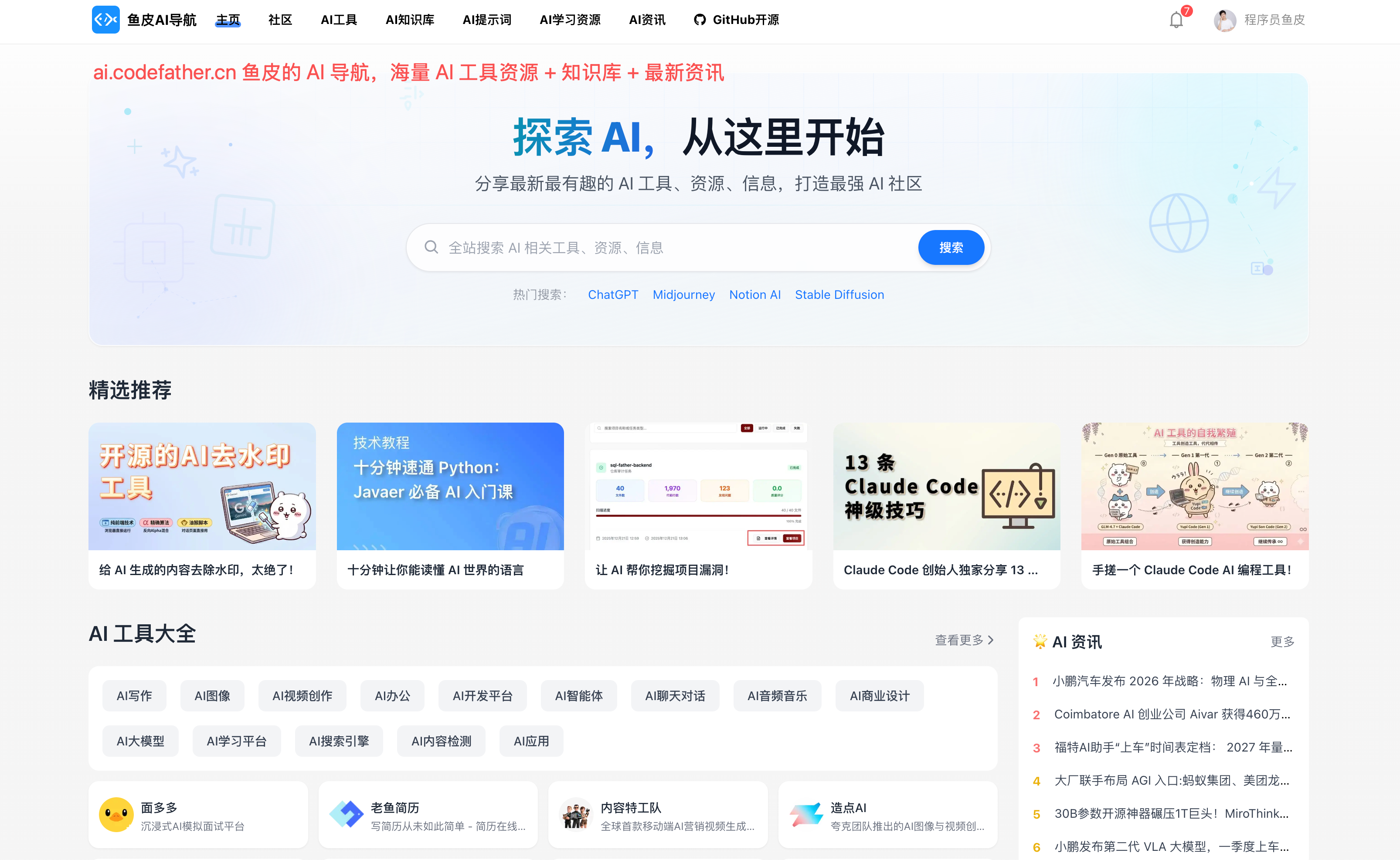
💡 Get the latest AI news and learning resources at Yupi's AI Navigation Site.
- Consistently review and summarize—record daily work, organize monthly gains, and conduct major reviews every six months.
Unsummarized experience isn't experience—it's just history. Document pitfalls and knowledge for future reuse.
- Build your personal resource library—bug logs, experience banks, knowledge notes, and tool collections.
The difference between 1 and 3 years of experience lies in continuous accumulation. These resources form the foundation for judging AI's code and solving tough problems. Use knowledge base software like Yuque or Notion for organization.
- Maintain consistent technical content output—1-2 original articles or notes weekly.
Output isn't mere knowledge transfer—share practical experiences AI can't learn, like communicating with different stakeholders, applying AI to legacy projects, or balancing development costs and benefits. Output also drives continuous knowledge input.
- Stay open-minded, embrace change, and treat AI as a teammate, not a rival.
Rather than fearing AI replacement, become among the best at using AI. The future belongs to those who can collaborate seamlessly with AI.
Final Thoughts
These 20 points boil down to two cores:
- Master AI: Make AI your efficiency multiplier, not your replacement
- Build real skills: Technical depth and practical experience form your foundation for judging AI's output
Programmers who only do CRUD, refuse to learn, or resist change will inevitably be phased out. But those who embrace AI, continuously evolve, and possess core competitiveness will enter their career golden age.
You don't need to be better than AI—you just need to be better than those who can't use AI.
The best time to plant a tree was 10 years ago; the second-best time is now. Start today by choosing 3 things to practice consistently—you'll see changes within a month.
Let's grow together!
Recommended Resources
-
Yupi's AI Navigation: Comprehensive AI Resources, Latest AI News, Free AI Tutorials
-
Programming Navigation Learning Community: Learning Paths, Programming Tutorials, Practical Projects, Job Hunting Guides, Q&A
-
Programmer Interview Cheatsheet: Internship/Campus/Social Recruitment FAQs, Company Interview Analysis
-
Programmer Resume Builder: Professional Templates, Rich Examples, Direct Interview Access
-
1-on-1 Mock Interviews: Essential for Internship/Campus/Social Recruitment Interviews