- Freeze all config models (AppConfig + 15 sub-configs) with frozen=True
- Purify from_file() — remove 9 load_*_from_dict() side-effect calls
- Replace mtime/reload/push/pop machinery with single ContextVar + init_app_config()
- Delete 10 sub-module globals and their getters/setters/loaders
- Migrate 50+ consumers from get_*_config() to get_app_config().xxx
- Expand DeerFlowContext: app_config + thread_id + agent_name (frozen dataclass)
- Wire into Gateway runtime (worker.py) and DeerFlowClient via context= parameter
- Remove sandbox_id from runtime.context — flows through ThreadState.sandbox only
- Middleware/tools access runtime.context directly via Runtime[DeerFlowContext] generic
- resolve_context() retained at server entry points for LangGraph Server fallback
* feat(channels): add Discord channel integration
Add a Discord bot channel following the existing Telegram/Slack pattern.
The bot listens for messages, creates conversation threads, and relays
responses back to Discord with 2000-char message splitting.
- DiscordChannel extends Channel base class
- Lazy imports discord.py with install hint
- Thread-based conversations (each Discord thread maps to a DeerFlow thread)
- Allowed guilds filter for access control
- File attachment support via discord.File
- Registered in service.py and manager.py
Co-Authored-By: Claude Opus 4.6 (1M context) <noreply@anthropic.com>
* fix(channels): address Copilot review suggestions for Discord integration
- Disable @everyone/@here mentions via AllowedMentions.none()
- Add 10s timeout to client close to prevent shutdown hangs
- Log publish_inbound errors via future callback instead of silently dropping
- Open file handle on caller thread to avoid cross-thread ownership issues
- Notify user in channel when thread creation fails
Co-Authored-By: Claude Opus 4.6 (1M context) <noreply@anthropic.com>
* fix(discord): resolve lint errors in Discord channel
- Replace asyncio.TimeoutError with builtin TimeoutError (UP041)
- Remove extraneous f-string prefix (F541)
- Apply ruff format
Co-Authored-By: Claude Opus 4.6 (1M context) <noreply@anthropic.com>
* fix(tests): remove fake langgraph_sdk shim from test_discord_channel
The module-level sys.modules.setdefault shim installed a fake
langgraph_sdk.errors.ConflictError during pytest collection. Because
pytest imports all test modules before running them, test_channels.py
then imported the fake ConflictError instead of the real one.
In test_handle_feishu_stream_conflict_sends_busy_message, the test
constructs ConflictError(message, response=..., body=...). The fake
only subclasses Exception (which takes no kwargs), so the construction
raised TypeError. The manager's _is_thread_busy_error check then saw a
TypeError instead of a ConflictError and fell through to the generic
'An error occurred' message.
langgraph_sdk is a real dependency, so the shim is unnecessary.
Removing it makes both test files import the same real ConflictError
and the full suite pass (1773 passed, 15 skipped).
---------
Co-authored-by: Matt Van Horn <455140+mvanhorn@users.noreply.github.com>
Co-authored-by: Claude Opus 4.6 (1M context) <noreply@anthropic.com>
Co-authored-by: Willem Jiang <willem.jiang@gmail.com>
* fix(sandbox): resolve paths in read_file/write_file content for LocalSandbox
In LocalSandbox mode, read_file and write_file now transform
container paths in file content, matching the path handling
behavior of bash tool.
- write_file: resolves virtual paths in content to system paths
before writing, so scripts with /mnt/user-data paths work
when executed
- read_file: reverse-resolves system paths back to virtual
paths in returned content for consistency
This fixes scenarios where agents write Python scripts with
virtual paths, then execute them via bash tool expecting the
paths to work.
Fixes#1778
* fix(sandbox): address Copilot review — dedicated content resolver + forward-slash safety + tests
- Extract _resolve_paths_in_content() separate from _resolve_paths_in_command()
to decouple file-content path resolution from shell-command parsing
- Normalize resolved paths to forward slashes to avoid Windows backslash
escape issues in source files (e.g. \U in Python string literals)
- Add 4 focused tests: write resolves content, forward-slash guarantee,
read reverse-resolves content, and write→read roundtrip
* style: fix ruff lint — remove extraneous f-string prefix
* fix(sandbox): only reverse-resolve paths in agent-written files
read_file previously applied _reverse_resolve_paths_in_output to ALL
file content, which could silently rewrite paths in user uploads and
external tool output (Willem Jiang review on #1935).
Now tracks files written through write_file in _agent_written_paths.
Only those files get reverse-resolved on read. Non-agent files are
returned as-is.
---------
Co-authored-by: JasonOA888 <JasonOA888@users.noreply.github.com>
* fix(middleware): add per-tool-type frequency detection to LoopDetectionMiddleware
The existing hash-based loop detection only catches identical tool call
sets. When the agent calls the same tool type (e.g. read_file) on many
different files, each call produces a unique hash and bypasses detection.
This causes the agent to exhaust recursion_limit, consuming 150K-225K
tokens per failed run.
Add a second detection layer that tracks cumulative call counts per tool
type per thread. Warns at 30 calls (configurable) and forces stop at 50.
The hard stop message now uses the actual returned message instead of a
hardcoded constant, so both hash-based and frequency-based stops produce
accurate diagnostics.
Also fix _apply() to use the warning message returned by
_track_and_check() for hard stops, instead of always using _HARD_STOP_MSG.
Closes#1987
* Apply suggestions from code review
Co-authored-by: Copilot <175728472+Copilot@users.noreply.github.com>
* fix(lint): remove unused imports and fix line length
- Remove unused _TOOL_FREQ_HARD_STOP_MSG and _TOOL_FREQ_WARNING_MSG
imports from test file (F401)
- Break long _TOOL_FREQ_WARNING_MSG string to fit within 240 char limit (E501)
* style: apply ruff format
* test: add LRU eviction and per-thread reset coverage for frequency state
Address review feedback from @WillemJiang:
- Verify _tool_freq and _tool_freq_warned are cleaned on LRU eviction
- Add test for reset(thread_id=...) clearing only the target thread's
frequency state while leaving others intact
* fix(makefile): route Windows shell-script targets through Git Bash (#2060)
---------
Co-authored-by: Willem Jiang <willem.jiang@gmail.com>
Co-authored-by: Copilot <175728472+Copilot@users.noreply.github.com>
Co-authored-by: Asish Kumar <87874775+officialasishkumar@users.noreply.github.com>
* fix: improve sandbox security and preserve multimodal content
* Add unit test modifications for test_injects_uploaded_files_tag_into_list_content
* format updated_content
* Add regression tests for multimodal upload content and host bash default safety
* feat(provisioner): add optional PVC support for sandbox volumes (#1978)
Add SKILLS_PVC_NAME and USERDATA_PVC_NAME env vars to allow sandbox
Pods to use PersistentVolumeClaims instead of hostPath volumes. This
prevents data loss in production when pods are rescheduled across nodes.
When USERDATA_PVC_NAME is set, a subPath of threads/{thread_id}/user-data
is used so a single PVC can serve multiple threads. Falls back to hostPath
when the new env vars are not set, preserving backward compatibility.
* add unit test for provisioner pvc volumes
* refactor: extract shared provisioner_module fixture to conftest.py
Agent-Logs-Url: https://github.com/bytedance/deer-flow/sessions/e7ccf708-c6ba-40e4-844a-b526bdb249dd
Co-authored-by: WillemJiang <219644+WillemJiang@users.noreply.github.com>
---------
Co-authored-by: copilot-swe-agent[bot] <198982749+Copilot@users.noreply.github.com>
Co-authored-by: JeffJiang <for-eleven@hotmail.com>
* feat(blog): implement blog structure with post listing and tagging functionality
* feat(blog): enhance blog layout and post metadata display with new components
* fix(blog): address PR #1962 review feedback and fix lint issues (#14)
* fix: format
---------
Co-authored-by: Copilot <198982749+Copilot@users.noreply.github.com>
* fix(backend): stream DeerFlowClient AI text as token deltas (#1969)
DeerFlowClient.stream() subscribed to LangGraph stream_mode=["values",
"custom"] which only delivers full-state snapshots at graph-node
boundaries, so AI replies were dumped as a single messages-tuple event
per node instead of streaming token-by-token. `client.stream("hello")`
looked identical to `client.chat("hello")` — the bug reported in #1969.
Subscribe to "messages" mode as well, forward AIMessageChunk deltas as
messages-tuple events with delta semantics (consumers accumulate by id),
and dedup the values-snapshot path so it does not re-synthesize AI
text that was already streamed. Introduce a per-id usage_metadata
counter so the final AIMessage in the values snapshot and the final
"messages" chunk — which carry the same cumulative usage — are not
double-counted.
chat() now accumulates per-id deltas and returns the last message's
full accumulated text. Non-streaming mock sources (single event per id)
are a degenerate case of the same logic, keeping existing callers and
tests backward compatible.
Verified end-to-end against a real LLM: a 15-number count emits 35
messages-tuple events with BPE subword boundaries clearly visible
("eleven" -> "ele" / "ven", "twelve" -> "tw" / "elve"), 476ms across
the window, end-event usage matches the values-snapshot usage exactly
(not doubled). tests/test_client_live.py::TestLiveStreaming passes.
New unit tests:
- test_messages_mode_emits_token_deltas: 3 AIMessageChunks produce 3
delta events with correct content/id/usage, values-snapshot does not
duplicate, usage counted once.
- test_chat_accumulates_streamed_deltas: chat() rebuilds full text
from deltas.
- test_messages_mode_tool_message: ToolMessage delivered via messages
mode is not duplicated by the values-snapshot synthesis path.
The stream() docstring now documents why this client does not reuse
Gateway's run_agent() / StreamBridge pipeline (sync vs async, raw
LangChain objects vs serialized dicts, single caller vs HTTP fan-out).
Fixes#1969
* refactor(backend): simplify DeerFlowClient streaming helpers (#1969)
Post-review cleanup for the token-level streaming fix. No behavior
change for correct inputs; one efficiency regression fixed.
Fix: chat() O(n²) accumulator
-----------------------------
`chat()` accumulated per-id text via `buffers[id] = buffers.get(id,"") + delta`,
which is O(n) per concat → O(n²) total over a streamed response. At
~2 KB cumulative text this becomes user-visible; at 50 KB / 5000 chunks
it costs roughly 100-300 ms of pure copying. Switched to
`dict[str, list[str]]` + `"".join()` once at return.
Cleanup
-------
- Extract `_serialize_tool_calls`, `_ai_text_event`, `_ai_tool_calls_event`,
and `_tool_message_event` static helpers. The messages-mode and
values-mode branches previously repeated four inline dict literals each;
they now call the same builders.
- `StreamEvent.type` is now typed as `Literal["values", "messages-tuple",
"custom", "end"]` via a `StreamEventType` alias. Makes the closed set
explicit and catches typos at type-check time.
- Direct attribute access on `AIMessage`/`AIMessageChunk`: `.usage_metadata`,
`.tool_calls`, `.id` all have default values on the base class, so the
`getattr(..., None)` fallbacks were dead code. Removed from the hot
path.
- `_account_usage` parameter type loosened to `Any` so that LangChain's
`UsageMetadata` TypedDict is accepted under strict type checking.
- Trimmed narrating comments on `seen_ids` / `streamed_ids` / the
values-synthesis skip block; kept the non-obvious ones that document
the cross-mode dedup invariant.
Net diff: -15 lines. All 132 unit tests + harness boundary test still
pass; ruff check and ruff format pass.
* docs(backend): add STREAMING.md design note (#1969)
Dedicated design document for the token-level streaming architecture,
prompted by the bug investigation in #1969.
Contents:
- Why two parallel streaming paths exist (Gateway HTTP/async vs
DeerFlowClient sync/in-process) and why they cannot be merged.
- LangGraph's three-layer mode naming (Graph "messages" vs Platform
SDK "messages-tuple" vs HTTP SSE) and why a shared string constant
would be harmful.
- Gateway path: run_agent + StreamBridge + sse_consumer with a
sequence diagram.
- DeerFlowClient path: sync generator + direct yield, delta semantics,
chat() accumulator.
- Why the three id sets (seen_ids / streamed_ids / counted_usage_ids)
each carry an independent invariant and cannot be collapsed.
- End-to-end sequence for a real conversation turn.
- Lessons from #1969: why mock-based tests missed the bug, why
BPE subword boundaries in live output are the strongest
correctness signal, and the regression test that locks it in.
- Source code location index.
Also:
- Link from backend/CLAUDE.md Embedded Client section.
- Link from backend/docs/README.md under Feature Documentation.
* test(backend): add refactor regression guards for stream() (#1969)
Three new tests in TestStream that lock the contract introduced by
PR #1974 so any future refactor (sync->async migration, sharing a
core with Gateway's run_agent, dedup strategy change) cannot
silently change behavior.
- test_dedup_requires_messages_before_values_invariant: canary that
documents the order-dependence of cross-mode dedup. streamed_ids
is populated only by the messages branch, so values-before-messages
for the same id produces duplicate AI text events. Real LangGraph
never inverts this order, but a refactor that does (or that makes
dedup idempotent) must update this test deliberately.
- test_messages_mode_golden_event_sequence: locks the *exact* event
sequence (4 events: 2 messages-tuple deltas, 1 values snapshot, 1
end) for a canonical streaming turn. List equality gives a clear
diff on any drift in order, type, or payload shape.
- test_chat_accumulates_in_linear_time: perf canary for the O(n^2)
fix in commit 1f11ba10. 10,000 single-char chunks must accumulate
in under 1s; the threshold is wide enough to pass on slow CI but
tight enough to fail if buffer = buffer + delta is restored.
All three tests pass alongside the existing 12 TestStream tests
(15/15). ruff check + ruff format clean.
* docs(backend): clarify stream() docstring on JSON serialization (#1969)
Replace the misleading "raw LangChain objects (AIMessage,
usage_metadata as dataclasses), not dicts" claim in the
"Why not reuse Gateway's run_agent?" section. The implementation
already yields plain Python dicts (StreamEvent.data is dict, and
usage_metadata is a TypedDict), so the original wording suggested
a richer return type than the API actually delivers.
The corrected wording focuses on what is actually true and
relevant: this client skips the JSON/SSE serialization layer that
Gateway adds for HTTP wire transmission, and yields stream event
payloads directly as Python data structures.
Addresses Copilot review feedback on PR #1974.
* test(backend): document none-id messages dedup limitation (#1969)
Add test_none_id_chunks_produce_duplicates_known_limitation to
TestStream that explicitly documents and asserts the current
behavior when an LLM provider emits AIMessageChunk with id=None
(vLLM, certain custom backends).
The cross-mode dedup machinery cannot record a None id in
streamed_ids (guarded by ``if msg_id:``), so the values snapshot's
reassembled AIMessage with a real id falls through and synthesizes
a duplicate AI text event. The test asserts len == 2 and locks
this as a known limitation rather than silently letting future
contributors hit it without context.
Why this is documented rather than fixed:
* Falling back to ``metadata.get("id")`` does not help — LangGraph's
messages-mode metadata never carries the message id.
* Synthesizing ``f"_synth_{id(msg_chunk)}"`` only helps if the
values snapshot uses the same fallback, which it does not.
* A real fix requires provider cooperation (always emit chunk ids)
or content-based dedup (false-positive risk), neither of which
belongs in this PR.
If a real fix lands, replace this test with a positive assertion
that dedup works for None-id chunks.
Addresses Copilot review feedback on PR #1974 (client.py:515).
* fix(frontend): UI polish - fix CSS typo, dark mode border, and hardcoded colors (#1942)
- Fix `font-norma` typo to `font-normal` in message-list subtask count
- Fix dark mode `--border` using reddish hue (22.216) instead of neutral
- Replace hardcoded `rgb(184,184,192)` in hero with `text-muted-foreground`
- Replace hardcoded `bg-[#a3a1a1]` in streaming indicator with `bg-muted-foreground`
- Add missing `font-sans` to welcome description `<pre>` for consistency
- Make case-study-section padding responsive (`px-4 md:px-20`)
Closes#1940
* docs: clarify deployment sizing guidance (#1963)
* fix(frontend): prevent stale 'new' thread ID from triggering 422 history requests (#1960)
After history.replaceState updates the URL from /chats/new to
/chats/{UUID}, Next.js useParams does not update because replaceState
bypasses the router. The useEffect in useThreadChat would then set
threadIdFromPath ('new') as the threadId, causing the LangGraph SDK
to call POST /threads/new/history which returns HTTP 422 (Invalid
thread ID: must be a UUID).
This fix adds a guard to skip the threadId update when
threadIdFromPath is the literal string 'new', preserving the
already-correct UUID that was set when the thread was created.
* fix(frontend): avoid using route new as thread id (#1967)
Co-authored-by: luoxiao6645 <luoxiao6645@gmail.com>
* Fix(subagent): Event loop conflict in SubagentExecutor.execute() (#1965)
* Fix event loop conflict in SubagentExecutor.execute()
When SubagentExecutor.execute() is called from within an already-running
event loop (e.g., when the parent agent uses async/await), calling
asyncio.run() creates a new event loop that conflicts with asyncio
primitives (like httpx.AsyncClient) that were created in and bound to
the parent loop.
This fix detects if we're already in a running event loop, and if so,
runs the subagent in a separate thread with its own isolated event loop
to avoid conflicts.
Fixes: sub-task cards not appearing in Ultra mode when using async parent agents
Co-Authored-By: Claude Sonnet 4.6 <noreply@anthropic.com>
* fix(subagent): harden isolated event loop execution
---------
Co-authored-by: Claude Sonnet 4.6 <noreply@anthropic.com>
* refactor(backend): remove dead getattr in _tool_message_event
---------
Co-authored-by: greatmengqi <chenmengqi.0376@bytedance.com>
Co-authored-by: Xinmin Zeng <135568692+fancyboi999@users.noreply.github.com>
Co-authored-by: 13ernkastel <LennonCMJ@live.com>
Co-authored-by: siwuai <458372151@qq.com>
Co-authored-by: 肖 <168966994+luoxiao6645@users.noreply.github.com>
Co-authored-by: luoxiao6645 <luoxiao6645@gmail.com>
Co-authored-by: Saber <11769524+hawkli-1994@users.noreply.github.com>
Co-authored-by: Claude Sonnet 4.6 <noreply@anthropic.com>
Co-authored-by: Willem Jiang <willem.jiang@gmail.com>
* test(skills): add trigger eval set for systematic-literature-review skill
20 eval queries (10 should-trigger, 10 should-not-trigger) for use with
skill-creator's run_eval.py. Includes real-world SLR queries contributed
by @VANDRANKI (issue #1862 author) and edge cases for routing
disambiguation with academic-paper-review.
* test(skills): add grader expectations for SLR skill evaluation
5 eval cases with 39 expectations covering:
- Standard SLR flow (APA/BibTeX/IEEE format selection)
- Keyword extraction and search behavior
- Subagent dispatch for metadata extraction
- Report structure (themes, convergences, gaps, per-paper annotations)
- Negative case: single-paper routing to academic-paper-review
- Edge case: implicit SLR without explicit keywords
* refactor(skills): shorten SLR description for better trigger rate
Reduce description from 833 to 344 chars. Key changes:
- Lead with "systematic literature review" as primary trigger phrase
- Strengthen single-paper exclusion: "Not for single-paper tasks"
- Remove verbose example patterns that didn't improve routing
Tested with run_eval.py (10 runs/query):
- False positive "best paper on RL": 67% → 20% (improved)
- True positive explicit SLR query: ~30% (unchanged)
Low recall is a routing-layer limitation, not a description issue —
see PR description for full analysis.
* Potential fix for pull request finding
Co-authored-by: Copilot Autofix powered by AI <175728472+Copilot@users.noreply.github.com>
---------
Co-authored-by: Copilot Autofix powered by AI <175728472+Copilot@users.noreply.github.com>
The /api/langgraph/* endpoints proxy straight to the LangGraph server,
so clients inherit LangGraph's native recursion_limit default of 25
instead of the 100 that build_run_config sets for the Gateway and IM
channel paths. 25 is too low for plan-mode or subagent runs and
reliably triggers GraphRecursionError on the lead agent's final
synthesis step after subagents return.
Set recursion_limit: 100 in the Create Run example and the cURL
snippet, and add a short note explaining the discrepancy so users
following the docs don't hit the 25-step ceiling as a surprise.
Co-authored-by: Claude Opus 4.6 (1M context) <noreply@anthropic.com>
* feat(skills): add systematic-literature-review skill for multi-paper SLR workflows
Adds a new skill that produces a structured systematic literature review (SLR)
across multiple academic papers on a topic. Addresses #1862 with a pure skill
approach: no new tools, no architectural changes, no new dependencies.
Skill layout:
- SKILL.md — 4+1 phase workflow (plan, search, extract, synthesize, present)
- scripts/arxiv_search.py — arXiv API client, stdlib only, with a
requests->urllib fallback shim modeled after github-deep-research's
github_api.py
- templates/{apa,ieee,bibtex}.md — citation format templates selected
dynamically in Phase 4, mirroring podcast-generation's templates/ pattern
Design notes:
- Multi-paper synthesis uses the existing `task` tool to dispatch extraction
subagents in parallel. SKILL.md's Phase 3 includes a fixed decision table
for batch splitting to respect the runtime's MAX_CONCURRENT_SUBAGENTS = 3
cap, and explicitly tells the agent to strip the "Task Succeeded. Result: "
prefix before parsing subagent JSON output.
- arXiv only, by design. Semantic Scholar and PubMed adapters would push the
scope toward a standalone MCP server (see #933) and are intentionally out
of scope for this skill.
- Coexists with the existing `academic-paper-review` skill: this skill does
breadth-first synthesis across many papers, academic-paper-review does
single-paper peer review. The two are routed via distinct triggers and
can compose (SLR on many + deep review on 1-2 important ones).
- Hard upper bound of 50 papers, tied to the Phase 3 concurrency strategy.
Larger surveys degrade in synthesis quality and are better split by
sub-topic.
BibTeX template explicitly uses @misc for arXiv preprints (not @article),
which is the most common mistake when generating BibTeX for arXiv papers.
arxiv_search.py was smoke-tested end-to-end against the live arXiv API with
two query shapes (relevance sort, submittedDate sort with category filter);
all returned JSON fields parse correctly (id normalization, Atom namespace
handling, URL encoding for multi-word queries).
* fix(skills): prevent LLM from saving intermediate search results to file
Adds an explicit "do not save" instruction at the end of Phase 2.
Observed during Test 1 with DeepSeek: the model saved search results
to a markdown file before proceeding to Phase 3, wasting 2-3 tool call
rounds and increasing the risk of hitting the graph recursion limit.
The search JSON should stay in context for Phase 3, not be persisted.
* fix(skills): use relevance+start-date instead of submittedDate sorting
Test 2 revealed that arXiv's submittedDate sorting returns the most
recently submitted papers in the category regardless of query relevance.
Searching "diffusion models" with sortBy=submittedDate in cs.CV returned
papers on spatial memory, Navier-Stokes, and photon-counting CT — none
about diffusion models. The LLM then retried with 4 different queries,
wasting tool calls and approaching the recursion limit.
Fix: always sort by relevance; when the user wants "recent" papers,
combine relevance sorting with --start-date to constrain the time window.
Also add an explicit "run the search exactly once" instruction to prevent
the retry loop.
* fix(skills): wrap multi-word arXiv queries in double quotes for phrase matching
Without quotes, `all:diffusion model` is parsed by arXiv's Lucene as
`all:diffusion OR model`, pulling in unrelated papers from physics
(thermal diffusion) and other fields. Wrapping in double quotes forces
phrase matching: `all:"diffusion model"`.
Also fixes date filtering: the previous bug caused 2011 papers to appear
in results despite --start-date 2024-04-09, because the unquoted query
words were OR'd with the date constraint.
Verified: "diffusion models" --category cs.CV --start-date 2024-04-09
now returns only relevant diffusion model papers published after April
2024.
* fix(skills): add query phrasing guide and enforce subagent delegation
Two fixes from Test 2 observations with DeepSeek:
1. Query phrasing: add a table showing good vs bad query examples.
The script wraps multi-word queries in double quotes for phrase
matching, so long queries like "diffusion models in computer vision"
return 0 results. Guide the LLM to use 2-3 core keywords + --category
instead.
2. Subagent enforcement: DeepSeek was extracting metadata inline via
python -c scripts instead of using the task tool. Strengthen Phase 3
to explicitly name the task tool, say "do not extract metadata
yourself", and explain why (token budget, isolation). This is more
direct than the previous natural-language-only approach while still
providing the reasoning behind the constraint.
* fix(skills): strengthen search keyword guidance and subagent enforcement
Address two issues found during end-to-end testing with DeepSeek:
1. Search retry: LLM passed full topic descriptions as queries (e.g.
"diffusion models in computer vision"), which returned 0 results due
to exact phrase matching and triggered retries. Added explicit
instruction to extract 2-3 core keywords before searching.
2. Subagent bypass: LLM used python -c to extract metadata instead of
dispatching via task tool. Added explicit prohibition list (python -c,
bash scripts, inline extraction) with ❌ markers for clarity.
* fix(skills): address Copilot review feedback on SLR skill
- Fix legacy arXiv ID parsing: preserve archive prefix for pre-2007
papers (e.g. hep-th/9901001 instead of just 9901001)
- Fix phase count: "four phases" -> "five phases"
- Add subagent_enabled prerequisite note to SKILL.md Notes section
- Remove PR-specific references ("PR 1") from ieee.md and bibtex.md
templates, replace with workflow-scoped wording
- Fix script header: "stdlib only" -> "no additional dependencies
required", fix relative path to github_api.py reference
- Remove reference to non-existent docs/enhancement/ path in header
* Apply suggestions from code review
Co-authored-by: Copilot <175728472+Copilot@users.noreply.github.com>
---------
Co-authored-by: Willem Jiang <willem.jiang@gmail.com>
Co-authored-by: Copilot <175728472+Copilot@users.noreply.github.com>
Add langchain-ollama as an optional dependency and provide ChatOllama
config examples, enabling proper thinking/reasoning content preservation
for local Ollama models.
Co-authored-by: Claude Opus 4.6 (1M context) <noreply@anthropic.com>
* fix(frontend): replace invalid "context" select field with "metadata" in threads.search
The LangGraph API server does not support "context" as a select field for
threads/search, causing a 422 Unprocessable Entity error introduced by
commit 60e0abf (#1771).
- Replace "context" with "metadata" in the default select list
- Persist agent_name into thread metadata on creation so search results
carry the agent identity
- Update pathOfThread() to fall back to metadata.agent_name when
context is unavailable from search results
- Add regression tests for metadata-based agent routing
Fixes#2037
Made-with: Cursor
* fix: apply Copilot suggestions
* style: fix the lint error
* feat(config): add when_thinking_disabled support for model configs
Allow users to explicitly configure what parameters are sent to the
model when thinking is disabled, via a new `when_thinking_disabled`
field in model config. This mirrors the existing `when_thinking_enabled`
pattern and takes full precedence over the hardcoded disable behavior
when set. Backwards compatible — existing configs work unchanged.
Closes#1675
* fix(config): address copilot review — gate when_thinking_disabled independently
- Switch truthiness check to `is not None` so empty dict overrides work
- Restructure disable path so when_thinking_disabled is gated independently
of has_thinking_settings, allowing it to work without when_thinking_enabled
- Update test to reflect new behavior
* feat: implement full checkpoint rollback on user cancellation
- Capture pre-run checkpoint snapshot including checkpoint state, metadata, and pending_writes
- Add _rollback_to_pre_run_checkpoint() function to restore thread state
- Implement _call_checkpointer_method() helper to support both async and sync checkpointer methods
- Rollback now properly restores checkpoint, metadata, channel_versions, and pending_writes
- Remove obsolete TODO comment (Phase 2) as rollback is now complete
This resolves the TODO(Phase 2) comment and enables full thread state
restoration when a run is cancelled by the user.
* fix: address rollback review feedback
* fix: strengthen checkpoint rollback validation and error handling
- Validate restored_config structure and checkpoint_id before use
- Raise RuntimeError on malformed pending_writes instead of silent skip
- Normalize None checkpoint_ns to empty string instead of "None"
- Move delete_thread to only execute when pre_run_snapshot is None
- Add docstring noting non-atomic rollback as known limitation
This addresses review feedback on PR #1867 regarding data integrity
in the checkpoint rollback implementation.
* test: add comprehensive coverage for checkpoint rollback edge cases
- test_rollback_restores_snapshot_without_deleting_thread
- test_rollback_deletes_thread_when_no_snapshot_exists
- test_rollback_raises_when_restore_config_has_no_checkpoint_id
- test_rollback_normalizes_none_checkpoint_ns_to_root_namespace
- test_rollback_raises_on_malformed_pending_write_not_a_tuple
- test_rollback_raises_on_malformed_pending_write_non_string_channel
- test_rollback_propagates_aput_writes_failure
Covers all scenarios from PR #1867 review feedback.
* test: format rollback worker tests
* fix(sandbox): add startup reconciliation to prevent orphaned container leaks
Sandbox containers were never cleaned up when the managing process restarted,
because all lifecycle tracking lived in in-memory dictionaries. This adds
startup reconciliation that enumerates running containers via `docker ps` and
either destroys orphans (age > idle_timeout) or adopts them into the warm pool.
Closes#1972
* fix(sandbox): address Copilot review — adopt-all strategy, improved error handling
- Reconciliation now adopts all containers into warm pool unconditionally,
letting the idle checker decide cleanup. Avoids destroying containers
that another concurrent process may still be using.
- list_running() logs stderr on docker ps failure and catches
FileNotFoundError/OSError.
- Signal handler test restores SIGTERM/SIGINT in addition to SIGHUP.
- E2E test docstring corrected to match actual coverage scope.
* fix(sandbox): address maintainer review — batch inspect, lock tightening, import hygiene
- _reconcile_orphans(): merge check-and-insert into a single lock acquisition
per container to eliminate the TOCTOU window.
- list_running(): batch the per-container docker inspect into a single call.
Total subprocess calls drop from 2N+1 to 2 (one ps + one batch inspect).
Parse port and created_at from the inspect JSON payload.
- Extract _parse_docker_timestamp() and _extract_host_port() as module-level
pure helpers and test them directly.
- Move datetime/json imports to module top level.
- _make_provider_for_reconciliation(): document the __new__ bypass and the
lockstep coupling to AioSandboxProvider.__init__.
- Add assertion that list_running() makes exactly ONE inspect call.
* Fix HTML artifact preview rendering
* Add after screenshot for HTML preview fix
* Add before screenshot for HTML preview fix
* Update before screenshot for HTML preview fix
* Update after screenshot for HTML preview fix
* Update before screenshot to Tsinghua homepage repro
* Update after screenshot to Tsinghua homepage preview
* Address PR review on HTML artifact preview
* Harden HTML artifact preview isolation
Streamdown's streaming safeguard appends closing markers (e.g. `*`) to
text with unmatched markdown syntax. This causes user messages containing
literal `*` (such as `99 * 87`) to display with a spurious trailing
asterisk. Human messages are always complete, so the incomplete-markdown
pre-processing is unnecessary.
Co-authored-by: Claude Opus 4.6 <noreply@anthropic.com>
* fix(docker): nginx fails to start on hosts without IPv6
- Detect IPv6 support at runtime and remove `listen [::]` directive
when unavailable, preventing nginx startup failure on non-IPv6 hosts
- Use `exec` to replace shell with nginx as PID 1 for proper signal
handling (graceful shutdown on SIGTERM)
- Reformat command from YAML folded scalar to block scalar (no
functional change)
Co-Authored-By: Claude Opus 4.6 <noreply@anthropic.com>
* fix(docker): harden nginx startup script (Copilot review feedback)
Add `set -e` so envsubst failures exit immediately instead of starting
nginx with an incomplete config. Narrow the sed pattern to match only
the `listen [::]:2026;` directive to avoid accidentally removing future
lines containing [::].
Co-Authored-By: Claude Opus 4.6 <noreply@anthropic.com>
---------
Co-authored-by: Claude Opus 4.6 <noreply@anthropic.com>
When a model config includes `reasoning_effort` as an extra YAML field
(ModelConfig uses `extra="allow"`), and the thinking-disabled code path
also injects `reasoning_effort="minimal"` into kwargs, the previous
`model_class(**kwargs, **model_settings_from_config)` call raises:
TypeError: got multiple values for keyword argument 'reasoning_effort'
Fix by merging the two dicts before instantiation, giving runtime kwargs
precedence over config values: `{**model_settings_from_config, **kwargs}`.
Fixes#1977
Co-authored-by: octo-patch <octo-patch@github.com>
* fix(middleware): handle string-serialized options in ClarificationMiddleware (#1995)
Some models (e.g. Qwen3-Max) serialize array tool parameters as JSON
strings instead of native arrays. Add defensive type checking in
_format_clarification_message() to deserialize string options before
iteration, preventing per-character rendering.
* fix(middleware): normalize options after JSON deserialization
Address Copilot review feedback:
- Add post-deserialization normalization so options is always a list
(handles json.loads returning a scalar string, dict, or None)
- Add test for JSON-encoded scalar string ("development")
- Fix test_json_string_with_mixed_types to use actual mixed types
* feat(community): add Exa search as community tool provider
Add Exa (exa.ai) as a new community search provider alongside Tavily,
Firecrawl, InfoQuest, and Jina AI. Exa is an AI-native search engine
with neural, keyword, and auto search types.
New files:
- community/exa/tools.py: web_search_tool and web_fetch_tool
- tests/test_exa_tools.py: 10 unit tests with mocked Exa client
Changes:
- pyproject.toml: add exa-py dependency
- config.example.yaml: add commented-out Exa configuration examples
Usage: set `use: deerflow.community.exa.tools:web_search_tool` in
config.yaml and provide EXA_API_KEY.
Co-Authored-By: Claude Opus 4.6 (1M context) <noreply@anthropic.com>
* fix(community): address PR review comments for Exa tools
- Make _get_exa_client() accept tool_name param so web_fetch reads its own config
- Remove __init__.py to match namespace package pattern of other providers
- Add duplicate tool name warning in config.example.yaml
- Add regression tests for web_fetch config resolution
Co-Authored-By: Claude Opus 4.6 (1M context) <noreply@anthropic.com>
* Update revision in uv.lock to 3
---------
Co-authored-by: Claude Opus 4.6 (1M context) <noreply@anthropic.com>
Co-authored-by: Willem Jiang <willem.jiang@gmail.com>
* fix(backend): use timezone-aware UTC in memory modules
Replace datetime.utcnow() with datetime.now(timezone.utc) and a shared
utc_now_iso_z() helper so persisted ISO timestamps keep the trailing Z
suffix without triggering Python 3.12+ deprecation warnings.
Made-with: Cursor
* refactor(backend): use removesuffix for utc_now_iso_z suffix
Makes the +00:00 -> Z transform explicit for the trailing offset only
(Copilot review on PR #1992).
Made-with: Cursor
* style(backend): satisfy ruff UP017 with datetime.UTC in memory queue
Made-with: Cursor
---------
Co-authored-by: Willem Jiang <willem.jiang@gmail.com>
* Fix event loop conflict in SubagentExecutor.execute()
When SubagentExecutor.execute() is called from within an already-running
event loop (e.g., when the parent agent uses async/await), calling
asyncio.run() creates a new event loop that conflicts with asyncio
primitives (like httpx.AsyncClient) that were created in and bound to
the parent loop.
This fix detects if we're already in a running event loop, and if so,
runs the subagent in a separate thread with its own isolated event loop
to avoid conflicts.
Fixes: sub-task cards not appearing in Ultra mode when using async parent agents
Co-Authored-By: Claude Sonnet 4.6 <noreply@anthropic.com>
* fix(subagent): harden isolated event loop execution
---------
Co-authored-by: Claude Sonnet 4.6 <noreply@anthropic.com>
After history.replaceState updates the URL from /chats/new to
/chats/{UUID}, Next.js useParams does not update because replaceState
bypasses the router. The useEffect in useThreadChat would then set
threadIdFromPath ('new') as the threadId, causing the LangGraph SDK
to call POST /threads/new/history which returns HTTP 422 (Invalid
thread ID: must be a UUID).
This fix adds a guard to skip the threadId update when
threadIdFromPath is the literal string 'new', preserving the
already-correct UUID that was set when the thread was created.
- Fix `font-norma` typo to `font-normal` in message-list subtask count
- Fix dark mode `--border` using reddish hue (22.216) instead of neutral
- Replace hardcoded `rgb(184,184,192)` in hero with `text-muted-foreground`
- Replace hardcoded `bg-[#a3a1a1]` in streaming indicator with `bg-muted-foreground`
- Add missing `font-sans` to welcome description `<pre>` for consistency
- Make case-study-section padding responsive (`px-4 md:px-20`)
Closes#1940
* fix(backend): make loop detection hash tool calls by stable keys
The loop detection middleware previously hashed full tool call arguments,
which made repeated calls look different when only non-essential argument
details changed. In particular, `read_file` calls with nearby line ranges
could bypass repetition detection even when the agent was effectively
reading the same file region again and again.
- Hash tool calls using stable keys instead of the full raw args payload
- Bucket `read_file` line ranges so nearby reads map to the same region key
- Prefer stable identifiers such as `path`, `url`, `query`, or `command`
before falling back to JSON serialization of args
- Keep hashing order-independent so the same tool call set produces the
same hash regardless of call order
Fixes#1905
* fix(backend): harden loop detection hash normalization
- Normalize and parse stringified tool args defensively
- Expand stable key derivation to include pattern, glob, and cmd
- Normalize reversed read_file ranges before bucketing
Fixes#1905
* fix(backend): harden loop detection tool format
* exclude write_file and str_replace from the stable-key path — writing different content to the same file shouldn't be flagged.
---------
Co-authored-by: JeffJiang <for-eleven@hotmail.com>
* fix(frontend): resolve layout flickering by migrating workspace sidebar state to cookie
* fix(frontend): unify local settings runtime state to fix state drift
* fix(frontend): only persist thread model on explicit context model updates
* fix(subagents): add cooperative cancellation for subagent threads
Subagent tasks run inside ThreadPoolExecutor threads with their own
event loop (asyncio.run). When a user clicks stop, RunManager cancels
the parent asyncio.Task, but Future.cancel() cannot terminate a running
thread and asyncio.Event does not propagate across event loops. This
causes subagent threads to keep executing (writing files, calling LLMs)
even after the user explicitly stops the run.
Fix: add a threading.Event (cancel_event) to SubagentResult and check
it cooperatively in _aexecute()'s astream iteration loop. On cancel,
request_cancel_background_task() sets the event, and the thread exits
at the next iteration boundary.
Changes:
- executor.py: Add cancel_event field to SubagentResult, check it in
_aexecute loop, set it on timeout, add request_cancel_background_task
- task_tool.py: Call request_cancel_background_task on CancelledError
* fix(subagents): guard cancel status and add pre-check before astream
- Only overwrite status to FAILED when still RUNNING, preserving
TIMED_OUT set by the scheduler thread.
- Add cancel_event pre-check before entering the astream loop so
cancellation is detected immediately when already signalled.
* fix(subagents): guard status updates with lock to prevent race condition
Wrap the check-and-set on result.status in _aexecute with
_background_tasks_lock so the timeout handler in execute_async
cannot interleave between the read and write.
* fix(subagents): add dedicated CANCELLED status for user cancellation
Introduce SubagentStatus.CANCELLED to distinguish user-initiated
cancellation from actual execution failures. Update _aexecute,
task_tool polling, cleanup terminal-status sets, and test fixtures.
* test(subagents): add cancellation tests and fix timeout regression test
- Add dedicated TestCooperativeCancellation test class with 6 tests:
- Pre-set cancel_event prevents astream from starting
- Mid-stream cancel_event returns CANCELLED immediately
- request_cancel_background_task() sets cancel_event correctly
- request_cancel on nonexistent task is a no-op
- Real execute_async timeout does not overwrite CANCELLED (deterministic
threading.Event sync, no wall-clock sleeps)
- cleanup_background_task removes CANCELLED tasks
- Add task_tool cancellation coverage:
- test_cancellation_calls_request_cancel: assert CancelledError path
calls request_cancel_background_task(task_id)
- test_task_tool_returns_cancelled_message: assert CANCELLED polling
branch emits task_cancelled event and returns expected message
- Fix pre-existing test infrastructure issue: add deerflow.sandbox.security
to _MOCKED_MODULE_NAMES (fixes ModuleNotFoundError for all executor tests)
- Add RUNNING guard to timeout handler in executor.py to prevent
TIMED_OUT from overwriting CANCELLED status
- Add cooperative cancellation granularity comment documenting that
cancellation is only detected at astream iteration boundaries
---------
Co-authored-by: lulusiyuyu <lulusiyuyu@users.noreply.github.com>
* fix(frontend): resolve invalid HTML nesting and tabnabbing vulnerabilities
Fix `<button>` inside `<a>` invalid HTML in artifact components and add
missing `noopener,noreferrer` to `window.open` calls to prevent reverse
tabnabbing.
Co-Authored-By: Claude Opus 4.6 <noreply@anthropic.com>
* fix(frontend): address Copilot review on tabnabbing and double-tab-open
Remove redundant parent onClick on web_fetch ChainOfThoughtStep to
prevent opening two tabs on link click, and explicitly null out
window.opener after window.open() for defensive tabnabbing hardening.
---------
Co-authored-by: Claude Opus 4.6 <noreply@anthropic.com>
Two production docker-compose.yaml bugs prevent `make up` from working:
1. Gateway missing DEER_FLOW_CONFIG_PATH and DEER_FLOW_EXTENSIONS_CONFIG_PATH
environment overrides. Added in fb2d99f (#1836) but accidentally reverted
by ca2fb95 (#1847). Without them, gateway reads host paths from .env via
env_file, causing FileNotFoundError inside the container.
2. Langgraph command fails when LANGGRAPH_ALLOW_BLOCKING is unset (default).
Empty $${allow_blocking} inserts a bare space between flags, causing
' --no-reload' to be parsed as unexpected extra argument. Fix by building
args string first and conditionally appending --allow-blocking.
Co-authored-by: cooper <cooperfu@tencent.com>
* feat(feishu): add channel file materialization hook for inbound messages
- Introduce Channel.receive_file(msg, thread_id) as a base method for file materialization; default is no-op.
- Implement FeishuChannel.receive_file to download files/images from Feishu messages, save to sandbox, and inject virtual paths into msg.text.
- Update ChannelManager to call receive_file for any channel if msg.files is present, enabling downstream model access to user-uploaded files.
- No impact on Slack/Telegram or other channels (they inherit the default no-op).
* style(backend): format code with ruff for lint compliance
- Auto-formatted packages/harness/deerflow/agents/factory.py and tests/test_create_deerflow_agent.py using `ruff format`
- Ensured both files conform to project linting standards
- Fixes CI lint check failures caused by code style issues
* fix(feishu): handle file write operation asynchronously to prevent blocking
* fix(feishu): rename GetMessageResourceRequest to _GetMessageResourceRequest and remove redundant code
* test(feishu): add tests for receive_file method and placeholder replacement
* fix(manager): remove unnecessary type casting for channel retrieval
* fix(feishu): update logging messages to reflect resource handling instead of image
* fix(feishu): sanitize filename by replacing invalid characters in file uploads
* fix(feishu): improve filename sanitization and reorder image key handling in message processing
* fix(feishu): add thread lock to prevent filename conflicts during file downloads
* fix(test): correct bad merge in test_feishu_parser.py
* chore: run ruff and apply formatting cleanup
fix(feishu): preserve rich-text attachment order and improve fallback filename handling
* fix(sandbox): add L2 input sanitisation to SandboxAuditMiddleware
Add _validate_input() to reject malformed bash commands before regex
classification: empty commands, oversized commands (>10 000 chars), and
null bytes that could cause detection/execution layer inconsistency.
* fix(sandbox): address Copilot review — type guard, log truncation, reject reason
- Coerce None/non-string command to str before validation
- Truncate oversized commands in audit logs to prevent log amplification
- Propagate reject_reason through _pre_process() to block message
- Remove L2 label from comments and test class names
* fix(sandbox): isinstance type guard + async input sanitisation tests
Address review comments:
- Replace str() coercion with isinstance(raw_command, str) guard so
non-string truthy values (0, [], False) fall back to empty string
instead of passing validation as "0"/"[]"/"False".
- Add TestInputSanitisationBlocksInAwrapToolCall with 4 async tests
covering empty, null-byte, oversized, and None command via
awrap_tool_call path.
support for vLLM 0.19.0 OpenAI-compatible chat endpoints and fixes the Qwen reasoning toggle so flash mode can actually disable thinking.
Co-authored-by: NmanQAQ <normangyao@qq.com>
Co-authored-by: Willem Jiang <willem.jiang@gmail.com>
ls_tool was the only sandbox tool without output size limits, allowing
multi-MB results from large directories to blow up the model context
window. Add head-truncation (configurable via ls_output_max_chars,
default 20000) consistent with existing bash and read_file truncation.
Closes#1887
Co-authored-by: Claude Opus 4.6 <noreply@anthropic.com>
Escape shell variables to prevent Docker Compose from attempting
substitution at parse time. Rename allow_blocking_flag to allow_blocking
for consistency with dev version.
Fixes the 'allow_blocking_flag not set' warning and enables --allow-blocking
flag to work correctly.
* fix(memory): case-insensitive fact deduplication and positive reinforcement detection
Two fixes to the memory system:
1. _fact_content_key() now lowercases content before comparison, preventing
semantically duplicate facts like "User prefers Python" and "user prefers
python" from being stored separately.
2. Adds detect_reinforcement() to MemoryMiddleware (closes#1719), mirroring
detect_correction(). When users signal approval ("yes exactly", "perfect",
"完全正确", etc.), the memory updater now receives reinforcement_detected=True
and injects a hint prompting the LLM to record confirmed preferences and
behaviors with high confidence.
Changes across the full signal path:
- memory_middleware.py: _REINFORCEMENT_PATTERNS + detect_reinforcement()
- queue.py: reinforcement_detected field in ConversationContext and add()
- updater.py: reinforcement_detected param in update_memory() and
update_memory_from_conversation(); builds reinforcement_hint alongside
the existing correction_hint
Tests: 11 new tests covering deduplication, hint injection, and signal
detection (Chinese + English patterns, window boundary, conflict with correction).
Co-Authored-By: Claude Sonnet 4.6 <noreply@anthropic.com>
* fix(memory): address Copilot review comments on reinforcement detection
- Tighten _REINFORCEMENT_PATTERNS: remove 很好, require punctuation/end-of-string boundaries on remaining patterns, split this-is-good into stricter variants
- Suppress reinforcement_detected when correction_detected is true to avoid mixed-signal noise
- Use casefold() instead of lower() for Unicode-aware fact deduplication
- Add missing test coverage for reinforcement_detected OR merge and forwarding in queue
---------
Co-authored-by: Claude Sonnet 4.6 <noreply@anthropic.com>
* Rename BACKEND_TODO.md to TODO.md in documentation
* Update MCP Setup Guide link in CONTRIBUTING.md
* Update reference to config.yaml path in documentation
* Fix config file path in TITLE_GENERATION_IMPLEMENTATION.md
Updated the path to the example config file in the documentation.
* fix(docker): use multi-stage build to remove build-essential from runtime image
The build-essential toolchain (~200 MB) was only needed for compiling
native Python extensions during `uv sync` but remained in the final
image, increasing size and attack surface. Split the Dockerfile into
a builder stage (with build-essential) and a clean runtime stage that
copies only the compiled artifacts, Node.js, Docker CLI, and uv.
Co-Authored-By: Claude Opus 4.6 <noreply@anthropic.com>
* fix(docker): add dev stage and pin docker:cli per review feedback
Address Copilot review comments:
- Add a `dev` build stage (FROM builder) that retains build-essential
so startup-time `uv sync` in dev containers can compile from source
- Update docker-compose-dev.yaml to use `target: dev` for gateway and
langgraph services
- Keep the clean runtime stage (no build-essential) as the default
final stage for production builds
Co-Authored-By: Claude Opus 4.6 <noreply@anthropic.com>
---------
Co-authored-by: Claude Opus 4.6 <noreply@anthropic.com>
sandbox_from_runtime() and ensure_sandbox_initialized() write
sandbox_id into runtime.context after acquiring a sandbox. When
lazy_init=True and no context is supplied to the graph run,
runtime.context is None (the LangGraph default), causing a TypeError
on the assignment.
Add `if runtime.context is not None` guards at all three write sites.
Reads already had equivalent guards (e.g. `runtime.context.get(...) if
runtime.context else None`); this brings writes into line.
Previously, the list endpoint always returned soul=null because
_agent_config_to_response() was called without include_soul=True.
This caused confusion since PUT /api/agents/{name} and GET /api/agents/{name}
both returned the soul content, but the list endpoint silently omitted it.
Co-authored-by: octo-patch <octo-patch@users.noreply.github.com>
Add three new public skills to enhance DeerFlow's content creation capabilities:
- **academic-paper-review**: Structured peer-review-quality analysis of
research papers following top-venue review standards (NeurIPS, ICML, ACL).
Covers methodology assessment, contribution evaluation, literature
positioning, and constructive feedback with a 3-phase workflow.
- **code-documentation**: Professional documentation generation for software
projects, including README generation, API reference docs, architecture
documentation with Mermaid diagrams, and inline code documentation
supporting Python, TypeScript, Go, Rust, and Java conventions.
- **newsletter-generation**: Curated newsletter creation with research
workflow, supporting daily digest, weekly roundup, deep-dive, and industry
briefing formats. Includes audience-specific tone adaptation and
multi-source content curation.
All skills:
- Follow the existing SKILL.md frontmatter convention (name + description)
- Pass the official _validate_skill_frontmatter() validation
- Use hyphen-case naming consistent with existing skills
- Contain only allowed frontmatter properties
- Include comprehensive examples, quality checklists, and output templates
* feat(uploads): guide agent to use grep/glob/read_file for uploaded documents
Add workflow guidance to the <uploaded_files> context block so the agent
knows to use grep and glob (added in #1784) alongside read_file when
working with uploaded documents, rather than falling back to web search.
This is the final piece of the three-PR PDF agentic search pipeline:
- PR1 (#1727): pymupdf4llm converter produces structured Markdown with headings
- PR2 (#1738): document outline injected into agent context with line numbers
- PR3 (this): agent guided to use outline + grep + read_file workflow
* feat(uploads): add file-first priority and fallback guidance to uploaded_files context
* fix(uploads): handle split-bold headings and ** ** artefacts in extract_outline
- Add _clean_bold_title() to merge adjacent bold spans (** **) produced
by pymupdf4llm when bold text crosses span boundaries
- Add _SPLIT_BOLD_HEADING_RE (Style 3) to recognise **<num>** **<title>**
headings common in academic papers; excludes pure-number table headers
and rows with more than 4 bold blocks
- When outline is empty, read first 5 non-empty lines of the .md as a
content preview and surface a grep hint in the agent context
- Update _format_file_entry to render the preview + grep hint instead of
silently omitting the outline section
- Add 3 new extract_outline tests and 2 new middleware tests (65 total)
* fix(uploads): address Copilot review comments on extract_outline regex
- Replace ASCII [A-Za-z] guard with negative lookahead to support non-ASCII
titles (e.g. **1** **概述**); pure-numeric/punctuation blocks still excluded
- Replace .+ with [^*]+ and cap repetition at {0,2} (four blocks total) to
keep _SPLIT_BOLD_HEADING_RE linear and avoid ReDoS on malformed input
- Remove now-redundant len(blocks) <= 4 code-level check (enforced by regex)
- Log debug message with exc_info when preview extraction fails
Server-rendered data-variant={undefined} didn't match client hydration.
Now only render data-variant and data-size when explicitly set.
Co-authored-by: Claude Opus 4.6 <noreply@anthropic.com>
Co-authored-by: JeffJiang <for-eleven@hotmail.com>
* feat(uploads): guide agent to use grep/glob/read_file for uploaded documents
Add workflow guidance to the <uploaded_files> context block so the agent
knows to use grep and glob (added in #1784) alongside read_file when
working with uploaded documents, rather than falling back to web search.
This is the final piece of the three-PR PDF agentic search pipeline:
- PR1 (#1727): pymupdf4llm converter produces structured Markdown with headings
- PR2 (#1738): document outline injected into agent context with line numbers
- PR3 (this): agent guided to use outline + grep + read_file workflow
* feat(uploads): add file-first priority and fallback guidance to uploaded_files context
* fix: add missing DEER_FLOW_CONFIG_PATH and DEER_FLOW_EXTENSIONS_CONFIG_PATH env vars to gateway service (fixes#1829)
The gateway service was missing these two environment variables that tell
it where to find the config files inside the container. Without them,
the gateway reads DEER_FLOW_CONFIG_PATH from the host's .env file (set
to a host filesystem path), which is not accessible inside the container,
causing FileNotFoundError on startup. The langgraph service already had
these variables set correctly.
* fix: remove nginx Plus-only zone/resolve directives from nginx.conf (fixes#1744)
The `zone` and `resolve` parameters in upstream server directives are
nginx Plus features not available in the standard `nginx:alpine` image.
This caused nginx to fail at startup with:
[emerg] invalid parameter "resolve" in /etc/nginx/nginx.conf:25
Remove these directives so the config is compatible with open-source nginx.
Docker's internal DNS (127.0.0.11, already configured via `resolver`) handles
service name resolution. The `resolver` directive is kept for the provisioner
location which uses variable-based proxy_pass for optional-service support.
The gateway service was missing these two environment variables that tell
it where to find the config files inside the container. Without them,
the gateway reads DEER_FLOW_CONFIG_PATH from the host's .env file (set
to a host filesystem path), which is not accessible inside the container,
causing FileNotFoundError on startup. The langgraph service already had
these variables set correctly.
* fix: inject longTermBackground into memory prompt
The format_memory_for_injection function only processed recentMonths and
earlierContext from the history section, silently dropping longTermBackground.
The LLM writes longTermBackground correctly and it persists to memory.json,
but it was never injected into the system prompt — making the user's
long-term background invisible to the AI.
Add the missing field handling and a regression test.
* fix(middleware): handle list-type AIMessage.content in LoopDetectionMiddleware
LangChain AIMessage.content can be str | list. When using providers that
return structured content blocks (e.g. Anthropic thinking mode, certain
OpenAI-compatible gateways), content is a list of dicts like
[{"type": "text", "text": "..."}].
The hard_limit branch in _apply() concatenated content with a string via
(last_msg.content or "") + f"\n\n{_HARD_STOP_MSG}", which raises
TypeError when content is a non-empty list (list + str is invalid).
Add _append_text() static method that:
- Returns the text directly when content is None
- Appends a {"type": "text"} block when content is a list
- Falls back to string concatenation when content is a str
This is consistent with how other modules in the project already handle
list content (client.py._extract_text, memory_middleware, executor.py).
* test(middleware): add unit tests for _append_text and list content hard stop
Add regression tests to verify LoopDetectionMiddleware handles list-type
AIMessage.content correctly during hard stop:
- TestAppendText: unit tests for the new _append_text() static method
covering None, str, list (including empty list) content types
- TestHardStopWithListContent: integration tests verifying hard stop
works correctly with list content (Anthropic thinking mode), None
content, and str content
Requested by reviewer in PR #1823.
* fix(middleware): improve _append_text robustness and test isolation
- Add explicit isinstance(content, str) check with fallback for
unexpected types (coerce to str) to prevent TypeError on edge cases
- Deep-copy list content in _make_state() test helper to prevent
shared mutable references across test iterations
- Add test_unexpected_type_coerced_to_str: verify fallback for
non-str/list/None content types
- Add test_list_content_not_mutated_in_place: verify _append_text
does not modify the original list
* style: fix ruff format whitespace in test file
---------
Co-authored-by: ppyt <14163465+ppyt@users.noreply.github.com>
* feat(uploads): add pymupdf4llm PDF converter with auto-fallback and async offload
- Introduce pymupdf4llm as an optional PDF converter with better heading
detection and table preservation than MarkItDown
- Auto mode: prefer pymupdf4llm when installed; fall back to MarkItDown
when output is suspiciously sparse (image-based / scanned PDFs)
- Sparsity check uses chars-per-page (< 50 chars/page) rather than an
absolute threshold, correctly handling both short and long documents
- Large files (> 1 MB) are offloaded to asyncio.to_thread() to avoid
blocking the event loop (related: #1569)
- Add UploadsConfig with pdf_converter field (auto/pymupdf4llm/markitdown)
- Add pymupdf4llm as optional dependency: pip install deerflow-harness[pymupdf]
- Add 14 unit tests covering sparsity heuristic, routing logic, and async path
* fix(uploads): address Copilot review comments on PDF converter
- Fix docstring: MIN_CHARS_PYMUPDF -> _MIN_CHARS_PER_PAGE (typo)
- Fix file handle leak: wrap pymupdf.open in try/finally to ensure doc.close()
- Fix silent fallback gap: _convert_pdf_with_pymupdf4llm now catches all
conversion exceptions (not just ImportError), so encrypted/corrupt PDFs
fall back to MarkItDown instead of propagating
- Tighten type: pdf_converter field changed from str to Literal[auto|pymupdf4llm|markitdown]
- Normalize config value: _get_pdf_converter() strips and lowercases the raw
config string, warns and falls back to 'auto' on unknown values
* feat(uploads): inject document outline into agent context for converted files
Extract headings from converted .md files and inject them into the
<uploaded_files> context block so the agent can navigate large documents
by line number before reading.
- Add `extract_outline()` to `file_conversion.py`: recognises standard
Markdown headings (#/##/###) and SEC-style bold structural headings
(**ITEM N. BUSINESS**, **PART II**); caps at 50 entries; excludes
cover-page boilerplate (WASHINGTON DC, CURRENT REPORT, SIGNATURES)
- Add `_extract_outline_for_file()` helper in `uploads_middleware.py`:
looks for a sibling `.md` file produced by the conversion pipeline
- Update `UploadsMiddleware._create_files_message()` to render the outline
under each file entry with `L{line}: {title}` format and a `read_file`
prompt for range-based reading
- Tests: 10 new tests for `extract_outline()`, 4 new tests for outline
injection in `UploadsMiddleware`; existing test updated for new `outline`
field in `uploaded_files` state
Partially addresses #1647 (agent ignores uploaded files).
* fix(uploads): stream outline file reads and strip inline bold from heading titles
- Switch extract_outline() from read_text().splitlines() to open()+line iteration
so large converted documents are not loaded into memory on every agent turn;
exits as soon as MAX_OUTLINE_ENTRIES is reached (Copilot suggestion)
- Strip **...** wrapper from standard Markdown heading titles before appending
to outline so agent context stays clean (e.g. "## **Overview**" → "Overview")
(Copilot suggestion)
- Remove unused pathlib.Path import and fix import sort order in test_file_conversion.py
to satisfy ruff CI lint
* fix(uploads): show truncation hint when outline exceeds MAX_OUTLINE_ENTRIES
When extract_outline() hits the cap it now appends a sentinel entry
{"truncated": True} instead of silently dropping the rest of the headings.
UploadsMiddleware reads the sentinel and renders a hint line:
... (showing first 50 headings; use `read_file` to explore further)
Without this the agent had no way to know the outline was incomplete and
would treat the first 50 headings as the full document structure.
* fix(uploads): fall back to configurable.thread_id when runtime.context lacks thread_id
runtime.context does not always carry thread_id (depends on LangGraph
invocation path). ThreadDataMiddleware already falls back to
get_config().configurable.thread_id — apply the same pattern so
UploadsMiddleware can resolve the uploads directory and attach outlines
in all invocation paths.
* style: apply ruff format
---------
Co-authored-by: Willem Jiang <willem.jiang@gmail.com>
* fix(uploads): fall back to configurable.thread_id when runtime.context lacks thread_id
runtime.context does not always carry thread_id depending on the
LangGraph invocation path. When absent, uploads_dir resolved to None
and the entire outline/historical-files attachment was silently skipped.
Apply the same fallback pattern already used by ThreadDataMiddleware:
try get_config().configurable.thread_id, with a RuntimeError guard for
test environments where get_config() is called outside a runnable context.
Discovered via live integration testing (curl against local LangGraph).
Unit tests inject uploads_dir directly and would not catch this.
* style: apply ruff format to uploads_middleware.py
When MemoryStreamBridge queue reaches capacity, publish_end() previously
used the same 30s timeout + drop strategy as regular events. If the END
sentinel was dropped, subscribe() would loop forever waiting for it,
causing the SSE connection to hang indefinitely and leaking _queues and
_counters resources for that run_id.
Changes:
- publish_end() now evicts oldest regular events when queue is full to
guarantee END sentinel delivery — the sentinel is the only signal that
allows subscribers to terminate
- Added per-run drop counters (_dropped_counts) with dropped_count() and
dropped_total properties for observability
- cleanup() and close() now clear drop counters
- publish() logs total dropped count per run for easier debugging
Tests:
- test_end_sentinel_delivered_when_queue_full: verifies END arrives even
with a completely full queue
- test_end_sentinel_evicts_oldest_events: verifies eviction behavior
- test_end_sentinel_no_eviction_when_space_available: no side effects
when queue has room
- test_concurrent_tasks_end_sentinel: 4 concurrent producer/consumer
pairs all terminate properly
- test_dropped_count_tracking, test_dropped_total,
test_cleanup_clears_dropped_counts, test_close_clears_dropped_counts:
drop counter coverage
Closes#1689
Co-authored-by: voidborne-d <voidborne-d@users.noreply.github.com>
* fix: use SystemMessage+HumanMessage for follow-up question generation (fixes#1697)
Some models (e.g. MiniMax-M2.7) require the system prompt and user
content to be passed as separate message objects rather than a single
combined string. Invoking with a plain string sends everything as a
HumanMessage, which causes these models to ignore the generation
instructions and fail to produce valid follow-up questions.
* test: verify model is invoked with SystemMessage and HumanMessage
* Add explicit save action for agent creation
* Hide internal save prompts and retry agent reads
---------
Co-authored-by: Willem Jiang <willem.jiang@gmail.com>
The format_memory_for_injection function only processed recentMonths and
earlierContext from the history section, silently dropping longTermBackground.
The LLM writes longTermBackground correctly and it persists to memory.json,
but it was never injected into the system prompt — making the user's
long-term background invisible to the AI.
Add the missing field handling and a regression test.
Co-authored-by: ppyt <14163465+ppyt@users.noreply.github.com>
* feat: add docs site
- Implemented dynamic routing for MDX documentation pages with language support.
- Created layout components for documentation with a header and footer.
- Added metadata for various documentation sections in English and Chinese.
- Developed initial content for the DeerFlow App and Harness documentation.
- Introduced i18n hooks and translations for English and Chinese languages.
- Enhanced header component to include navigation links for documentation and blog.
- Established a structure for tutorials and reference materials.
- Created a new translations file to manage locale-specific strings.
* feat: enhance documentation structure and content for application and harness sections
* feat: update .gitignore to include .playwright-mcp and remove obsolete Playwright YAML file
* fix(docs): correct punctuation and formatting in documentation files
* feat(docs): remove outdated index.mdx file from documentation
* fix(docs): update documentation links and improve Chinese description in index.mdx
* fix(docs): update title in Chinese for meta information in _meta.ts
* fix(frontend): add missing rel="noopener noreferrer" to target="_blank" links
Prevent tabnabbing attacks and referrer leakage by ensuring all
external links with target="_blank" include both noopener and
noreferrer in the rel attribute.
Made-with: Cursor
* style: fix code formatting
* fix(sandbox): URL路径被误判为不安全绝对路径 (#1385)
在本地沙箱模式下,bash工具对命令做绝对路径安全校验时,会把curl命令中的
HTTPS URL(如 https://example.com/api/v1/check)误识别为本地绝对路径并拦截。
根因:_ABSOLUTE_PATH_PATTERN 正则的负向后行断言 (?<![:\w]) 只排除了冒号和
单词字符,但 :// 中第二个斜杠前面是第一个斜杠(/),不在排除列表中,导致
//example.com/api/... 被匹配为绝对路径 /example.com/api/...。
修复:在负向后行断言中增加斜杠字符,改为 (?<![:\w/]),使得 :// 中的连续
斜杠不会触发绝对路径匹配。同时补充了URL相关的单元测试用例。
Signed-off-by: moose-lab <moose-lab@users.noreply.github.com>
* fix(sandbox): refine absolute path regex to preserve file:// defense-in-depth
Change lookbehind from (?<![:\w/]) to (?<![:\w])(?<!:/) so only the
second slash in :// sequences is excluded. This keeps URL paths from
false-positiving while still letting the regex detect /etc/passwd in
file:///etc/passwd. Also add explicit file:// URL blocking and tests.
Co-Authored-By: Claude Opus 4.6 (1M context) <noreply@anthropic.com>
---------
Signed-off-by: moose-lab <moose-lab@users.noreply.github.com>
Co-authored-by: moose-lab <moose-lab@users.noreply.github.com>
Co-authored-by: Claude Opus 4.6 (1M context) <noreply@anthropic.com>
Co-authored-by: Willem Jiang <willem.jiang@gmail.com>
* fix: prevent concurrent subagent file write conflicts
Serialize same-path str_replace operations in sandbox tools
Guard AioSandbox write_file/update_file with the existing sandbox lock
Add regression tests for concurrent str_replace and append races
Verify with backend full tests and ruff lint checks
* fix(sandbox): Fix the concurrency issue of file operations on the same path in isolated sandboxes.
Ensure that different sandbox instances use independent locks for file operations on the same virtual path to avoid concurrency conflicts. Change the lock key from a single path to a composite key of (sandbox.id, path), and add tests to verify the concurrent safety of isolated sandboxes.
* feat(sandbox): Extract file operation lock logic to standalone module and fix concurrency issues
Extract file operation lock related logic from tools.py into a separate file_operation_lock.py module.
Fix data race issues during concurrent str_replace and write_file operations.
* feat(agent): 为AgentConfig添加skills字段并更新lead_agent系统提示
在AgentConfig中添加skills字段以支持配置agent可用技能
更新lead_agent的系统提示模板以包含可用技能信息
* fix: resolve agent skill configuration edge cases and add tests
* Update backend/packages/harness/deerflow/agents/lead_agent/prompt.py
Co-authored-by: Copilot <175728472+Copilot@users.noreply.github.com>
* refactor(agent): address PR review comments for skills configuration
- Add detailed docstring to `skills` field in `AgentConfig` to clarify the semantics of `None` vs `[]`.
- Add unit tests in `test_custom_agent.py` to verify `load_agent_config()` correctly parses omitted skills and explicit empty lists.
- Fix `test_make_lead_agent_empty_skills_passed_correctly` to include `agent_name` in the runtime config, ensuring it exercises the real code path.
* docs: 添加关于按代理过滤技能的配置说明
在配置示例文件和文档中添加说明,解释如何通过代理的config.yaml文件限制加载的技能
---------
Co-authored-by: Copilot <175728472+Copilot@users.noreply.github.com>
* feat(sandbox): truncate oversized bash and read_file tool outputs
Long tool outputs (large directory listings, multi-MB source files) can
overflow the model's context window. Two new configurable limits:
- bash_output_max_chars (default 20000): middle-truncates bash output,
preserving both head and tail so stderr at the end is not lost
- read_file_output_max_chars (default 50000): head-truncates file output
with a hint to use start_line/end_line for targeted reads
Both limits are enforced at the tool layer (sandbox/tools.py) rather
than middleware, so truncation is guaranteed regardless of call path.
Setting either limit to 0 disables truncation entirely.
Measured: read_file on a 250KB source file drops from 63,698 tokens to
19,927 tokens (69% reduction) with the default limit.
Co-Authored-By: Claude Sonnet 4.6 <noreply@anthropic.com>
* fix(tests): remove unused pytest import and fix import sort order
* style: apply ruff format to sandbox/tools.py
* refactor(sandbox): address Copilot review feedback on truncation feature
- strict hard cap: while-loop ensures result (including marker) ≤ max_chars
- max_chars=0 now returns "" instead of original output
- get_app_config() wrapped in try/except with fallback to defaults
- sandbox_config.py: add ge=0 validation on truncation limit fields
- config.example.yaml: bump config_version 4→5
- tests: add len(result) <= max_chars assertions, edge-case (max=0, small
max, various sizes) tests; fix skipped-count test for strict hard cap
* refactor(sandbox): replace while-loop truncation with fixed marker budget
Use a pre-allocated constant (_MARKER_MAX_LEN) instead of a convergence
loop to ensure result <= max_chars. Simpler, safer, and skipped-char
count in the marker is now an exact predictable value.
* refactor(sandbox): compute marker budget dynamically instead of hardcoding
* fix(sandbox): make max_chars=0 disable truncation instead of returning empty string
---------
Co-authored-by: Claude Sonnet 4.6 <noreply@anthropic.com>
Co-authored-by: JeffJiang <for-eleven@hotmail.com>
Feishu channel classified any slash-prefixed text (including absolute
paths such as /mnt/user-data/...) as a COMMAND, causing them to be
misrouted through the command pipeline instead of the chat pipeline.
Fix by introducing a shared KNOWN_CHANNEL_COMMANDS frozenset in
app/channels/commands.py — the single authoritative source for the set
of supported slash commands. Both the Feishu inbound parser and the
ChannelManager's unknown-command reply now derive from it, so adding
or removing a command requires only one edit.
Changes:
- app/channels/commands.py (new): defines KNOWN_CHANNEL_COMMANDS
- app/channels/feishu.py: replace local KNOWN_FEISHU_COMMANDS with the
shared constant; _is_feishu_command() now gates on it
- app/channels/manager.py: import KNOWN_CHANNEL_COMMANDS and use it in
the unknown-command fallback reply so the displayed list stays in sync
- tests/test_feishu_parser.py: parametrize over every entry in
KNOWN_CHANNEL_COMMANDS (each must yield msg_type=command) and add
parametrized chat cases for /unknown, absolute paths, etc.
Made with Cursor
Made-with: Cursor
Co-authored-by: Willem Jiang <willem.jiang@gmail.com>
* fix(gateway): prevent 400 error when client sends context with configurable
Fixes#1290
LangGraph >= 0.6.0 rejects requests that include both 'configurable' and
'context' in the run config. If the client (e.g. useStream hook) sends
a 'context' key, we now honour it and skip creating our own
'configurable' dict to avoid the conflict.
When no 'context' is provided, we fall back to the existing
'configurable' behaviour with thread_id.
* fix(gateway): address review feedback — warn on dual keys, fix runtime injection, add tests
- Log a warning when client sends both 'context' and 'configurable' so
it's no longer silently dropped (reviewer feedback)
- Ensure thread_id is available in config['context'] when present so
middlewares can find it there too
- Add test coverage for the context path, the both-keys-present case,
passthrough of other keys, and the no-config fallback
* style: ruff format services.py
---------
Co-authored-by: JasonOA888 <JasonOA888@users.noreply.github.com>
Co-authored-by: Willem Jiang <willem.jiang@gmail.com>
* windows check and dev fixes
* fix windows startup scripts
* fix windows startup scripts
---------
Co-authored-by: Willem Jiang <willem.jiang@gmail.com>
The langgraph-compat layer dropped the DeerFlow-specific `context` field
from run requests, causing agent config (subagent_enabled, is_plan_mode,
thinking_enabled, etc.) to fall back to defaults. Add `context` to
RunCreateRequest and merge allowlisted keys into config.configurable in
start_run, with existing configurable values taking precedence.
Co-authored-by: Claude Opus 4.6 (1M context) <noreply@anthropic.com>
* refactor: replace sync requests with async httpx in Jina AI client
Replace synchronous `requests.post()` with `httpx.AsyncClient` in
JinaClient.crawl() and make web_fetch_tool async. This is part of the
planned async concurrency optimization for the agent hot path
(see docs/TODO.md).
* fix: address Copilot review feedback on async Jina client
- Short-circuit error strings in web_fetch_tool before passing to
ReadabilityExtractor, preventing misleading extraction results
- Log missing JINA_API_KEY warning only once per process to reduce
noise under concurrent async fetching
- Use logger.exception instead of logger.error in crawl exception
handler to preserve stack traces for debugging
- Add async web_fetch_tool tests and warn-once coverage
* fix: mock get_app_config in web_fetch_tool tests for CI
The web_fetch_tool tests failed in CI because get_app_config requires
a config.yaml file that isn't present in the test environment. Mock
the config loader to remove the filesystem dependency.
---------
Co-authored-by: Willem Jiang <willem.jiang@gmail.com>
#1623 added this flag to both Docker Compose files but missed the
backend Makefile used by `make dev`. Without it `langgraph dev`
defaults to n_jobs_per_worker=1, so all conversation runs are
serialised and concurrent requests block.
This mirrors the Docker configuration.
Docker's -v host:container syntax is ambiguous for Windows drive-letter
paths (e.g. D:/...) because ':' is both the drive separator and the
volume separator, causing mount failures on Windows hosts.
Introduce _format_container_mount() which uses '--mount type=bind,...'
for Docker (unambiguous on all platforms) and keeps '-v' for Apple
Container runtime which does not support the --mount flag yet.
Adds unit tests covering Windows paths, read-only mounts, and Apple
Container pass-through.
Made-with: Cursor
* fix(gateway): forward assistant_id as agent_name in build_run_config
Fixes#1644
When the LangGraph Platform-compatible /runs endpoint receives a custom
assistant_id (e.g. 'finalis'), the Gateway's build_run_config() silently
ignored it — configurable['agent_name'] was never set, so make_lead_agent
fell through to the default lead agent and SOUL.md was never loaded.
Root cause (introduced in #1403):
resolve_agent_factory() correctly falls back to make_lead_agent for all
assistant_id values, but build_run_config() had no assistant_id parameter
and never injected configurable['agent_name']. The full call chain:
POST /runs (assistant_id='finalis')
→ resolve_agent_factory('finalis') # returns make_lead_agent ✓
→ build_run_config(thread_id, ...) # no agent_name injected ✗
→ make_lead_agent(config)
→ cfg.get('agent_name') → None
→ load_agent_soul(None) → base SOUL.md (doesn't exist) → None
Fix:
- Add keyword-only parameter to build_run_config().
- When assistant_id is set and differs from 'lead_agent', inject it as
configurable['agent_name'] (matching the channel manager's existing
_resolve_run_params() logic for IM channels).
- Honour an explicit configurable['agent_name'] in the request body;
assistant_id mapping only fills the gap when it is absent.
- Remove stale log-only branch from resolve_agent_factory(); update
docstring to explain the factory/configurable split.
Tests added (test_gateway_services.py):
- Custom assistant_id injects configurable['agent_name']
- 'lead_agent' assistant_id does NOT inject agent_name
- None assistant_id does NOT inject agent_name
- Explicit configurable['agent_name'] in request is not overwritten
- resolve_agent_factory returns make_lead_agent for all inputs
* style: format with ruff
* fix: validate and normalize assistant_id to prevent path traversal
Addresses Copilot review: strip/lowercase/replace underscores and
reject names that don't match [a-z0-9-]+, consistent with
ChannelManager._normalize_custom_agent_name().
---------
Co-authored-by: voidborne-d <voidborne-d@users.noreply.github.com>
* fix(sandbox): serialize concurrent exec_command calls in AioSandbox
The AIO sandbox container maintains a single persistent shell session
that corrupts when multiple exec_command requests arrive concurrently
(e.g. when ToolNode issues parallel tool_calls). The corrupted session
returns 'ErrorObservation' strings as output, cascading into subsequent
commands.
Add a threading.Lock to AioSandbox to serialize shell commands. As a
secondary defense, detect ErrorObservation in output and retry with a
fresh session ID.
Fixes#1433
Co-Authored-By: Claude Opus 4.6 <noreply@anthropic.com>
* fix(sandbox): address Copilot review findings
- Fix shell injection in list_dir: use shlex.quote(path) to escape
user-provided paths in the find command
- Narrow ErrorObservation retry condition from broad substring match
to the specific corruption signature to prevent false retries
- Improve test_lock_prevents_concurrent_execution: use threading.Barrier
to ensure all workers contend for the lock simultaneously
- Improve test_list_dir_uses_lock: assert lock.locked() is True during
exec_command to verify lock acquisition
* style: auto-format with ruff
---------
Co-authored-by: Matt Van Horn <455140+mvanhorn@users.noreply.github.com>
Co-authored-by: Claude Opus 4.6 <noreply@anthropic.com>
view_image_tool.py had a top-level import of deerflow.sandbox.tools, which
created a circular dependency chain:
sandbox.tools
-> deerflow.agents.thread_state (triggers agents/__init__.py)
-> agents/factory.py
-> tools/builtins/__init__.py
-> view_image_tool.py
-> deerflow.sandbox.tools <-- circular!
This caused ImportError when any test directly imported sandbox.tools,
making test_sandbox_tools_security.py fail to collect since #1522.
Fix: move the sandbox.tools import inside the view_image_tool function body.
Co-authored-by: Claude Sonnet 4.6 <noreply@anthropic.com>
* fix(frontend): distinguish CORS errors from generic name check failures
* fix(frontend): improve network error message for agent name check
* Fix network error message in zh-CN locale
---------
Co-authored-by: Willem Jiang <willem.jiang@gmail.com>
The `environment` section in docker-compose.yaml set
`LANGSMITH_TRACING=${LANGSMITH_TRACING:-false}`, which always resolves
to `false` because Docker Compose evaluates `${}` substitutions from
the host shell environment, not from `env_file`.
Since `environment` entries take precedence over `env_file`, setting
`LANGSMITH_TRACING=true` in `.env` had no effect — tracing stayed
disabled despite following the documented instructions.
Remove the explicit `LANGSMITH_TRACING` from `environment` so the
value from `.env` (loaded via `env_file`) is used as intended.
The dev Docker Compose uses named volumes (langgraph-venv, gateway-venv)
to persist .venv across container restarts. Docker only populates named
volumes from the image on first creation — subsequent rebuilds do NOT
refresh existing volume contents.
When new dependencies are added to packages/harness/pyproject.toml
(e.g. langchain-anthropic), the stale named volume still contains
the old .venv missing the new packages, causing ModuleNotFoundError
at runtime.
Add `uv sync` before launching both gateway and langgraph services.
When deps are already satisfied this is a no-op (~1s), but when the
volume is stale it installs missing packages before the service starts.
Fixes#1624
Co-authored-by: Willem Jiang <willem.jiang@gmail.com>
`langgraph dev` defaults `n_jobs_per_worker` to 1 when the flag is not
explicitly passed (see langgraph_api/cli.py), even though the
`N_JOBS_PER_WORKER` env-var default is 10.
This causes the LangGraph server to run with a single background worker,
meaning all conversation runs are processed serially. When one run is
busy (e.g. summarization or long tool-calling chains), all other threads
are blocked until it finishes.
Add `--n-jobs-per-worker 10` to both production and dev Docker Compose
files to match the intended default concurrency.
* feat(gateway): implement LangGraph Platform API in Gateway, replace langgraph-cli
Implement all core LangGraph Platform API endpoints in the Gateway,
allowing it to fully replace the langgraph-cli dev server for local
development. This eliminates a heavyweight dependency and simplifies
the development stack.
Changes:
- Add runs lifecycle endpoints (create, stream, wait, cancel, join)
- Add threads CRUD and search endpoints
- Add assistants compatibility endpoints (search, get, graph, schemas)
- Add StreamBridge (in-memory pub/sub for SSE) and async provider
- Add RunManager with atomic create_or_reject (eliminates TOCTOU race)
- Add worker with interrupt/rollback cancel actions and runtime context injection
- Route /api/langgraph/* to Gateway in nginx config
- Skip langgraph-cli startup by default (SKIP_LANGGRAPH_SERVER=0 to restore)
- Add unit tests for RunManager, SSE format, and StreamBridge
* fix: drain bridge queue on client disconnect to prevent backpressure
When on_disconnect=continue, keep consuming events from the bridge
without yielding, so the worker is not blocked by a full queue.
Only on_disconnect=cancel breaks out immediately.
Co-authored-by: Copilot <175728472+Copilot@users.noreply.github.com>
* fix: remove pytest import
Co-authored-by: Copilot <175728472+Copilot@users.noreply.github.com>
* fix: Fix default stream_mode to ["values", "messages-tuple"]
Co-authored-by: Copilot <175728472+Copilot@users.noreply.github.com>
* fix: Remove unused if_exists field from ThreadCreateRequest
Co-authored-by: Copilot <175728472+Copilot@users.noreply.github.com>
* fix: address review comments on gateway LangGraph API
- Mount runs.py router in app.py (missing include_router)
- Normalize interrupt_before/after "*" to node list before run_agent()
- Use entry.id for SSE event ID instead of counter
- Drain bridge queue on disconnect when on_disconnect=continue
- Reuse serialization helper in wait_run() for consistent wire format
- Reject unsupported multitask_strategy with 400
- Remove SKIP_LANGGRAPH_SERVER fallback, always use Gateway
* feat: extract app.state access into deps.py
Encapsulate read/write operations for singleton objects (RunManager,
StreamBridge, checkpointer) held in app.state into a shared utility,
reducing repeated access patterns across router modules.
* feat: extract deerflow.runtime.serialization module with tests
Co-Authored-By: Claude Opus 4.6 (1M context) <noreply@anthropic.com>
* refactor: replace duplicated serialization with deerflow.runtime.serialization
Co-Authored-By: Claude Opus 4.6 (1M context) <noreply@anthropic.com>
* feat: extract app/gateway/services.py with run lifecycle logic
Create a service layer that centralizes SSE formatting, input/config
normalization, and run lifecycle management. Router modules will delegate
to these functions instead of using private cross-imported helpers.
Co-Authored-By: Claude Opus 4.6 (1M context) <noreply@anthropic.com>
* refactor: wire routers to use services layer, remove cross-module private imports
Co-Authored-By: Claude Opus 4.6 (1M context) <noreply@anthropic.com>
* style: apply ruff formatting to refactored files
Co-Authored-By: Claude Opus 4.6 (1M context) <noreply@anthropic.com>
* feat(runtime): support LangGraph dev server and add compat route
- Enable official LangGraph dev server for local development workflow
- Decouple runtime components from agents package for better separation
- Provide gateway-backed fallback route when dev server is skipped
- Simplify lifecycle management using context manager in gateway
* feat(runtime): add Store providers with auto-backend selection
- Add async_provider.py and provider.py under deerflow/runtime/store/
- Support memory, sqlite, postgres backends matching checkpointer config
- Integrate into FastAPI lifespan via AsyncExitStack in deps.py
- Replace hardcoded InMemoryStore with config-driven factory
* refactor(gateway): migrate thread management from checkpointer to Store and resolve multiple endpoint failures
- Add Store-backed CRUD helpers (_store_get, _store_put, _store_upsert)
- Replace checkpoint-scanning search with two-phase strategy:
phase 1 reads Store (O(threads)), phase 2 backfills from checkpointer
for legacy/LangGraph Server threads with lazy migration
- Extend Store record schema with values field for title persistence
- Sync thread title from checkpoint to Store after run completion
- Fix /threads/{id}/runs/{run_id}/stream 405 by accepting both
GET and POST methods; POST handles interrupt/rollback actions
- Fix /threads/{id}/state 500 by separating read_config and
write_config, adding checkpoint_ns to configurable, and
shallow-copying checkpoint/metadata before mutation
- Sync title to Store on state update for immediate search reflection
- Move _upsert_thread_in_store into services.py, remove duplicate logic
- Add _sync_thread_title_after_run: await run task, read final
checkpoint title, write back to Store record
- Spawn title sync as background task from start_run when Store exists
* refactor(runtime): deduplicate store and checkpointer provider logic
Extract _ensure_sqlite_parent_dir() helper into checkpointer/provider.py
and use it in all three places that previously inlined the same mkdir logic.
Consolidate duplicate error constants in store/async_provider.py by importing
from store/provider.py instead of redefining them.
Co-Authored-By: Claude Sonnet 4.6 <noreply@anthropic.com>
* refactor(runtime): move SQLite helpers to runtime/store, checkpointer imports from store
_resolve_sqlite_conn_str and _ensure_sqlite_parent_dir now live in
runtime/store/provider.py. agents/checkpointer/provider and
agents/checkpointer/async_provider import from there, reversing the
previous dependency direction (store → checkpointer becomes
checkpointer → store).
Co-Authored-By: Claude Sonnet 4.6 <noreply@anthropic.com>
* refactor(runtime): extract SQLite helpers into runtime/store/_sqlite_utils.py
Move resolve_sqlite_conn_str and ensure_sqlite_parent_dir out of
checkpointer/provider.py into a dedicated _sqlite_utils module.
Functions are now public (no underscore prefix), making cross-module
imports semantically correct. All four provider files import from
the single shared location.
Co-Authored-By: Claude Sonnet 4.6 <noreply@anthropic.com>
* fix(gateway): use adelete_thread to fully remove thread checkpoints on delete
AsyncSqliteSaver has no adelete method — the previous hasattr check
always evaluated to False, silently leaving all checkpoint rows in the
database. Switch to adelete_thread(thread_id) which deletes every
checkpoint and pending-write row for the thread across all namespaces
(including sub-graph checkpoints).
Co-Authored-By: Claude Sonnet 4.6 <noreply@anthropic.com>
* fix(gateway): remove dead bridge_cm/ckpt_cm code and fix StrEnum lint
app.py had unreachable code after the async-with lifespan refactor:
bridge_cm and ckpt_cm were referenced but never defined (F821), and
the channel service startup/shutdown was outside the langgraph_runtime
block so it never ran. Move channel service lifecycle inside the
async-with block where it belongs.
Replace str+Enum inheritance in RunStatus and DisconnectMode with
StrEnum as suggested by UP042.
Co-Authored-By: Claude Sonnet 4.6 <noreply@anthropic.com>
* style: format with ruff
---------
Co-authored-by: Copilot <175728472+Copilot@users.noreply.github.com>
Co-authored-by: JeffJiang <for-eleven@hotmail.com>
Co-authored-by: Claude Opus 4.6 (1M context) <noreply@anthropic.com>
Co-authored-by: Willem Jiang <willem.jiang@gmail.com>
The lark-oapi SDK defaults to open.feishu.cn (China), but apps on the
international Lark platform (open.larksuite.com) fail to connect with
error 1000040351 'Incorrect domain name'.
Changes:
- Add 'domain' config option to feishu channel (default: open.feishu.cn)
- Pass domain to both API client and WebSocket client
- Update config.example.yaml and all README files
* fix: promote matched tools from deferred registry after tool_search returns schema
After tool_search returns a tool's full schema, the tool is promoted
(removed from the deferred registry) so DeferredToolFilterMiddleware
stops filtering it from bind_tools on subsequent LLM calls.
Without this, deferred tools are permanently filtered — the LLM gets
the schema from tool_search but can never invoke the tool because
the middleware keeps stripping it.
Fixes#1554
* test: add promote() and tool_search promotion tests
Tests cover:
- promote removes tools from registry
- promote nonexistent/empty is no-op
- search returns nothing after promote
- middleware passes promoted tools through
- tool_search auto-promotes matched tools (select + keyword)
* fix: address review — lint blank line + empty registry guard
- Add missing blank line between FakeRequest methods (E301)
- Use 'if not registry' to handle empty registries consistently
---------
Co-authored-by: d 🔹 <258577966+voidborne-d@users.noreply.github.com>
Co-authored-by: Willem Jiang <willem.jiang@gmail.com>
* fix(config): correct MiniMax M2.7 highspeed model name and add thinking support
- Rename minimax-m2.5-highspeed to minimax-m2.7-highspeed for CN region
- Add supports_thinking: true for both M2.7 and M2.7-highspeed models
* Add supports_thinking option to config examples
Added support_thinking configuration option in examples.
---------
Co-authored-by: Willem Jiang <willem.jiang@gmail.com>
* fix(dev): exclude sandbox dirs from gateway hot-reload watcher
The dev-mode gateway uses --reload which watches for file changes.
Sandbox containers mount the repo and write .pyc/__pycache__ during
execution, triggering spurious gateway restarts mid-request.
Add --reload-exclude for .pyc, __pycache__, and sandbox/ paths so
only actual source changes trigger a reload.
Fixes#1513
* Apply suggestions from code review
Co-authored-by: Copilot <175728472+Copilot@users.noreply.github.com>
---------
Co-authored-by: JasonOA888 <JasonOA888@users.noreply.github.com>
Co-authored-by: Willem Jiang <willem.jiang@gmail.com>
Co-authored-by: Copilot <175728472+Copilot@users.noreply.github.com>
* feat(sandbox): add SandboxAuditMiddleware for bash command security auditing
Addresses the LocalSandbox escape vector reported in #1224 where bash tool
calls can execute destructive commands against the host filesystem.
- Add SandboxAuditMiddleware with three-tier command classification:
- High-risk (block): rm -rf /, curl|bash, dd if=, mkfs, /etc/shadow access
- Medium-risk (warn): pip install, apt install, chmod 777
- Safe (pass): normal workspace operations
- Register middleware after GuardrailMiddleware in _build_runtime_middlewares,
applied to both lead agent and subagents
- Structured audit log via standard logger (visible in langgraph.log)
- Medium-risk commands execute but append a warning to the tool result,
allowing the LLM to self-correct without blocking legitimate workflows
- High-risk commands return an error ToolMessage without calling the handler,
so the agent loop continues gracefully
* fix(lint): sort imports in test_sandbox_audit_middleware
* refactor(sandbox-audit): address Copilot review feedback (3/5/6)
- Fix class docstring to match implementation: medium-risk commands are
executed with a warning appended (not rejected), and cwd anchoring note
removed (handled in a separate PR)
- Remove capsys.disabled() from benchmark test to avoid CI log noise;
keep assertions for recall/precision targets
- Remove misleading 'cwd fix' from test module docstring
* test(sandbox-audit): add async tests for awrap_tool_call
* fix(sandbox-audit): address Copilot review feedback (1/2)
- Narrow rm high-risk regex to only block truly destructive targets
(/, /*, ~, ~/*, /home, /root); legitimate workspace paths like
/mnt/user-data/ are no longer false-positived
- Handle list-typed ToolMessage content in _append_warn_to_result;
append a text block instead of str()-ing the list to avoid breaking
structured content normalization
* style: apply ruff format to sandbox_audit_middleware files
* fix(sandbox-audit): update benchmark comment to match assert-based implementation
---------
Co-authored-by: Willem Jiang <willem.jiang@gmail.com>
* fix(task_tool): fallback to configurable thread_id when context is missing
task_tool only read thread_id from runtime.context, but when invoked
via LangGraph Server, thread_id lives in config.configurable instead.
Add the same fallback that ThreadDataMiddleware uses (PR #1237).
Fixes subagent execution failure: 'Thread ID is required in runtime
context or config.configurable'
* remove debug logging from task_tool
* fix(sandbox): anchor relative paths to thread workspace in local mode
In local sandbox mode, bash commands using relative paths were resolved
against the langgraph server process cwd (backend/) instead of the
per-thread workspace directory. This allowed relative-path writes to
escape the thread isolation boundary.
Root cause: validate_local_bash_command_paths and
replace_virtual_paths_in_command only process absolute paths (scanning
for '/' prefix). Relative paths pass through untouched and inherit the
process cwd at subprocess.run time.
Fix: after virtual path translation, prepend `cd {workspace} &&` to
anchor the shell's cwd to the thread-isolated workspace directory before
execution. shlex.quote() ensures paths with spaces or special characters
are handled safely.
This mirrors the approach used by OpenHands (fixed cwd at execution
layer) and is the correct fix for local mode where each subprocess.run
is an independent process with no persistent shell session.
Co-Authored-By: Claude Sonnet 4.6 <noreply@anthropic.com>
* refactor(sandbox): extract _apply_cwd_prefix and add unit tests
Extract the workspace cd-prefix logic from bash_tool into a dedicated
_apply_cwd_prefix() helper so it can be unit-tested in isolation.
Add four tests covering: normal prefix, no thread_data, missing
workspace_path, and paths with spaces (shlex.quote).
Co-Authored-By: Claude Sonnet 4.6 <noreply@anthropic.com>
* revert: remove unrelated configurable thread_id fallback from sandbox/tools.py
This change belongs in a separate PR.
Co-Authored-By: Claude Sonnet 4.6 <noreply@anthropic.com>
* style: remove trailing whitespace in test_sandbox_tools_security
---------
Co-authored-by: Claude Sonnet 4.6 <noreply@anthropic.com>
Co-authored-by: Willem Jiang <willem.jiang@gmail.com>
* Fix path for TitleMiddleware implementation
* Fix link to Provisioner Setup Guide in CONFIGURATION.md
* Update file path for TitleMiddleware implementation
* Update image paths in Leica photography article
* fix: add Windows shell fallback for local sandbox
* fix: handle PowerShell execution on Windows
* fix: handle Windows local shell execution
---------
Co-authored-by: Willem Jiang <willem.jiang@gmail.com>
* fix(security): disable host bash by default in local sandbox
* fix(security): address review feedback for local bash hardening
* fix(ci): sort live test imports for lint
* style: apply backend formatter
---------
Co-authored-by: Willem Jiang <willem.jiang@gmail.com>
Added explicit timeout and retry configurations to `config.example.yaml` to help users properly configure their model connections.
Since different LangChain provider classes use different parameter names, this update maps the correct arguments for each:
- ChatOpenAI (OpenAI, MiniMax, Novita, OpenRouter): added `request_timeout` and `max_retries`
- ChatAnthropic (Claude): added `default_request_timeout` and `max_retries`
- ChatGoogleGenerativeAI (Gemini): added `timeout` and `max_retries`
- PatchedChatDeepSeek (Doubao, DeepSeek, Kimi): added `timeout` and `max_retries`
Default example values are set to 600.0 seconds for timeouts and 2 for max retries.
* fix(sandbox): fall back to config.configurable for thread_id in lazy sandbox init
LangGraph Server injects thread_id via config["configurable"]["thread_id"],
not always via context["thread_id"]. Without the fallback, lazy sandbox
acquisition fails when context is empty.
Co-Authored-By: Claude Sonnet 4.6 <noreply@anthropic.com>
* fix(sandbox): align configurable fallback style with task_tool.py
Co-Authored-By: Claude Sonnet 4.6 <noreply@anthropic.com>
* fix(sandbox): guard runtime.config None check for thread_id fallback
Co-Authored-By: Claude Sonnet 4.6 <noreply@anthropic.com>
---------
Co-authored-by: Claude Sonnet 4.6 <noreply@anthropic.com>
* feat(client): support custom middleware injection
Add support for custom middleware, allowing custom middleware list to be passed when initializing DeerFlowClient. These middleware will be injected after the default middleware when creating the agent, extending the agent's functionality.
* feat: inject custom middlewares before ClarificationMiddleware to preserve ordering
- Add `custom_middlewares` param to `_build_middlewares`
- Inject custom middlewares right before `ClarificationMiddleware` to keep it as the last in the chain
- Remove unsafe `.extend()` in `client.py`
- Update tests in `test_client.py` and `test_lead_agent_model_resolution.py` to assert correct injection ordering
* fix(task_tool): fallback to configurable thread_id when context is missing
task_tool only read thread_id from runtime.context, but when invoked
via LangGraph Server, thread_id lives in config.configurable instead.
Add the same fallback that ThreadDataMiddleware uses (PR #1237).
Fixes subagent execution failure: 'Thread ID is required in runtime
context or config.configurable'
* remove debug logging from task_tool
* fix(oauth): inject billing header for non-Haiku model access
The Anthropic Messages API requires a billing identification block
in the system prompt when using Claude Code OAuth tokens (sk-ant-oat*)
to access non-Haiku models (Opus, Sonnet). Without it, the API returns
a generic 400 "Error" with no actionable detail.
This was discovered by intercepting Claude Code CLI requests — the CLI
injects an `x-anthropic-billing-header` text block as the first system
prompt entry on every request. Third-party consumers of the same OAuth
tokens must do the same.
Changes:
- Add `_apply_oauth_billing()` to `ClaudeChatModel` that prepends the
billing header block to the system prompt when `_is_oauth` is True
- Add `metadata.user_id` with device/session identifiers (required by
the API alongside the billing header)
- Called from `_get_request_payload()` before prompt caching runs
Verified with Claude Max OAuth tokens against all three model tiers:
- claude-opus-4-6: 200 OK
- claude-sonnet-4-6: 200 OK
- claude-haiku-4-5-20251001: 200 OK (was already working)
Closes#1245
* fix(oauth): address review feedback on billing header injection
- Make OAUTH_BILLING_HEADER configurable via ANTHROPIC_BILLING_HEADER env var
- Normalize billing block to always be first in system list (strip + reinsert)
- Guard metadata with isinstance check for non-dict values
- Replace os.uname() with socket.gethostname() for Windows compat
- Fix docstrings to say "all OAuth requests" instead of "non-Haiku"
- Move inline imports to module level (fixes ruff I001)
- Add 9 unit tests for _apply_oauth_billing
Co-Authored-By: Claude Opus 4.6 <noreply@anthropic.com>
---------
Co-authored-by: Claude Opus 4.6 <noreply@anthropic.com>
Replace all bare print() calls with proper logging using Python's
standard logging module across the deerflow harness package.
Changes across 8 files (16 print statements replaced):
- agents/middlewares/clarification_middleware.py: use logger.info/debug
- agents/middlewares/memory_middleware.py: use logger.debug
- agents/middlewares/thread_data_middleware.py: use logger.debug
- agents/middlewares/view_image_middleware.py: use logger.debug
- agents/memory/queue.py: use logger.info/debug/warning/error
- agents/lead_agent/prompt.py: use logger.error
- skills/loader.py: use logger.warning
- skills/parser.py: use logger.error
Each file follows the established codebase convention:
import logging
logger = logging.getLogger(__name__)
Log levels chosen based on message semantics:
- debug: routine operational details (directory creation, timer resets)
- info: significant state changes (memory queued, updates processed)
- warning: recoverable issues (config load failures, skipped updates)
- error: unexpected failures (parsing errors, memory update errors)
Note: client.py is intentionally excluded as it uses print() for
CLI output, which is the correct behavior for a command-line client.
Co-authored-by: moose-lab <moose-lab@users.noreply.github.com>
* test: add unit tests for skill frontmatter validation
Cover _validate_skill_frontmatter logic:
- Valid minimal and full-field skills
- Missing SKILL.md, missing frontmatter, invalid YAML
- Required field validation (name, description)
- Unexpected key rejection
- Name format: hyphen-case, no leading/trailing/consecutive hyphens
- Name and description length limits
- Angle bracket rejection in description
* test: fix unused variables flagged by ruff F841
Replace unused tuple elements with _ and add assertions on
msg/name return values in success-path tests.
* test: address review feedback on unused variables
* test: consolidate validation tests into single module
Move the UTF-8/windows-locale test from test_skills_router.py into
test_skills_validation.py and remove test_skills_router.py to eliminate
duplicated assertions and future maintenance drift.
* fix: match assertion strings to actual validation messages
---------
Co-authored-by: Willem Jiang <willem.jiang@gmail.com>
Allow per-agent environment variables to be declared in config.yaml under
acp_agents.<name>.env. Values prefixed with $ are resolved from the host
environment at invocation time, consistent with other config fields.
Passes None to spawn_agent_process when env is empty so the subprocess
inherits the parent environment unchanged.
Co-authored-by: Claude Sonnet 4.6 <noreply@anthropic.com>
- Fix OpenAI BadRequestError: 'No images have been viewed.' was returned as
a plain string array instead of a properly formatted content block
- The OpenAI API expects message content to be either a string or an array
of objects with 'type' field, not an array of plain strings
- Changed return from ['No images have been viewed.'] to
[{'type': 'text', 'text': 'No images have been viewed.'}]
Fixes#1441
Co-authored-by: JasonOA888 <noreply@github.com>
Add LangSmith tracing setup instructions across the project:
- .env.example: add LANGSMITH_* env vars (commented out)
- README.md + translations (zh/ja/fr/ru): add LangSmith Tracing section
under Advanced with setup steps and env var reference
- backend/README.md: add detailed LangSmith Tracing section with setup,
env var table, how-it-works explanation, and Docker notes
- docker-compose.yaml: update LANGCHAIN_TRACING_V2 to LANGSMITH_TRACING
for naming consistency with the rest of the project
Made-with: Cursor
Co-authored-by: Willem Jiang <willem.jiang@gmail.com>
The channels config section uses localhost URLs by default, which don't
work inside Docker containers. Add inline comments showing the Docker
service names (langgraph, gateway) that match the docker-compose service
definitions.
Fixes#1421
Co-authored-by: Matt Van Horn <455140+mvanhorn@users.noreply.github.com>
Co-authored-by: Claude Opus 4.6 <noreply@anthropic.com>
* fix: add build-arg support for proxies and mirrors in Docker builds (#1260)
Pin Debian images to bookworm, make UV source image configurable,
and pass APT_MIRROR/NPM_REGISTRY/UV_IMAGE through docker-compose.
* fix: ensure build args use consistent defaults across compose and Dockerfiles
UV_IMAGE: ${UV_IMAGE:-} resolved to empty when unset, overriding the
Dockerfile ARG default and breaking `FROM ${UV_IMAGE}`. Also configure
COREPACK_NPM_REGISTRY before pnpm download and propagate NPM_REGISTRY
into the prod stage.
* fix: dearmor NodeSource GPG key to resolve signing error
Pipe the downloaded key through gpg --dearmor so apt can verify
the repository signature (fixes NO_PUBKEY 2F59B5F99B1BE0B4).
---------
Co-authored-by: JeffJiang <for-eleven@hotmail.com>
* feat: Add github PAT configs, allowing larger github API rates.
* Update comment to English for better clarity
* fix: Remove unused config lines in config.example.yaml and unreferenced declarations in app_config. Fix lint issues and update documentation.
* fix: Remove unused imports, and passed the ruff check.
---------
Co-authored-by: Willem Jiang <willem.jiang@gmail.com>
* fix: use create_chat_model for summarization alias
* fix: remove unused radix Icon import from suggestion
---------
Co-authored-by: Willem Jiang <willem.jiang@gmail.com>
* Fix Windows backend test compatibility
* Preserve ACP path style on Windows
* Fix installer import ordering
* Address review comments for Windows fixes
---------
Co-authored-by: Willem Jiang <willem.jiang@gmail.com>
* fix(LLM): fixing Gemini thinking + tool calls via OpenAI gateway (#1180)
When using Gemini with thinking enabled through an OpenAI-compatible gateway,
the API requires that fields on thinking content blocks are
preserved and echoed back verbatim in subsequent requests. Standard
silently drops these signatures when serializing
messages, causing HTTP 400 errors:
Changes:
- Add PatchedChatOpenAI adapter that re-injects signed thinking blocks into
request payloads, preserving the signature chain across multi-turn
conversations with tool calls.
- Support two LangChain storage patterns: additional_kwargs.thinking_blocks
and content list.
- Add 11 unit tests covering signed/unsigned blocks, storage patterns, edge
cases, and precedence rules.
- Update config.example.yaml with Gemini + thinking gateway example.
- Update CONFIGURATION.md with detailed guidance and error explanation.
Fixes: #1180
* Updated the patched_openai.py with thought_signature of function call
* Apply suggestions from code review
Co-authored-by: Copilot <175728472+Copilot@users.noreply.github.com>
* docs: fix inaccurate thought_signature description in CONFIGURATION.md (#1220)
* Initial plan
* docs: fix CONFIGURATION.md wording for thought_signature - tool-call objects, not thinking blocks
Co-authored-by: WillemJiang <219644+WillemJiang@users.noreply.github.com>
Agent-Logs-Url: https://github.com/bytedance/deer-flow/sessions/360f5226-4631-48a7-a050-189094af8ffe
---------
Co-authored-by: copilot-swe-agent[bot] <198982749+Copilot@users.noreply.github.com>
Co-authored-by: WillemJiang <219644+WillemJiang@users.noreply.github.com>
---------
Co-authored-by: Copilot <175728472+Copilot@users.noreply.github.com>
Co-authored-by: Copilot <198982749+Copilot@users.noreply.github.com>
* refactor: extract shared utils to break harness→app cross-layer imports
Move _validate_skill_frontmatter to src/skills/validation.py and
CONVERTIBLE_EXTENSIONS + convert_file_to_markdown to src/utils/file_conversion.py.
This eliminates the two reverse dependencies from client.py (harness layer)
into gateway/routers/ (app layer), preparing for the harness/app package split.
Co-Authored-By: Claude Opus 4.6 <noreply@anthropic.com>
* refactor: split backend/src into harness (deerflow.*) and app (app.*)
Physically split the monolithic backend/src/ package into two layers:
- **Harness** (`packages/harness/deerflow/`): publishable agent framework
package with import prefix `deerflow.*`. Contains agents, sandbox, tools,
models, MCP, skills, config, and all core infrastructure.
- **App** (`app/`): unpublished application code with import prefix `app.*`.
Contains gateway (FastAPI REST API) and channels (IM integrations).
Key changes:
- Move 13 harness modules to packages/harness/deerflow/ via git mv
- Move gateway + channels to app/ via git mv
- Rename all imports: src.* → deerflow.* (harness) / app.* (app layer)
- Set up uv workspace with deerflow-harness as workspace member
- Update langgraph.json, config.example.yaml, all scripts, Docker files
- Add build-system (hatchling) to harness pyproject.toml
- Add PYTHONPATH=. to gateway startup commands for app.* resolution
- Update ruff.toml with known-first-party for import sorting
- Update all documentation to reflect new directory structure
Boundary rule enforced: harness code never imports from app.
All 429 tests pass. Lint clean.
Co-Authored-By: Claude Opus 4.6 <noreply@anthropic.com>
* chore: add harness→app boundary check test and update docs
Add test_harness_boundary.py that scans all Python files in
packages/harness/deerflow/ and fails if any `from app.*` or
`import app.*` statement is found. This enforces the architectural
rule that the harness layer never depends on the app layer.
Update CLAUDE.md to document the harness/app split architecture,
import conventions, and the boundary enforcement test.
Co-Authored-By: Claude Opus 4.6 <noreply@anthropic.com>
* feat: add config versioning with auto-upgrade on startup
When config.example.yaml schema changes, developers' local config.yaml
files can silently become outdated. This adds a config_version field and
auto-upgrade mechanism so breaking changes (like src.* → deerflow.*
renames) are applied automatically before services start.
- Add config_version: 1 to config.example.yaml
- Add startup version check warning in AppConfig.from_file()
- Add scripts/config-upgrade.sh with migration registry for value replacements
- Add `make config-upgrade` target
- Auto-run config-upgrade in serve.sh and start-daemon.sh before starting services
- Add config error hints in service failure messages
Co-Authored-By: Claude Opus 4.6 <noreply@anthropic.com>
* fix comments
* fix: update src.* import in test_sandbox_tools_security to deerflow.*
Co-Authored-By: Claude Opus 4.6 <noreply@anthropic.com>
* fix: handle empty config and search parent dirs for config.example.yaml
Address Copilot review comments on PR #1131:
- Guard against yaml.safe_load() returning None for empty config files
- Search parent directories for config.example.yaml instead of only
looking next to config.yaml, fixing detection in common setups
Co-Authored-By: Claude Opus 4.6 <noreply@anthropic.com>
* fix: correct skills root path depth and config_version type coercion
- loader.py: fix get_skills_root_path() to use 5 parent levels (was 3)
after harness split, file lives at packages/harness/deerflow/skills/
so parent×3 resolved to backend/packages/harness/ instead of backend/
- app_config.py: coerce config_version to int() before comparison in
_check_config_version() to prevent TypeError when YAML stores value
as string (e.g. config_version: "1")
- tests: add regression tests for both fixes
Co-Authored-By: Claude Sonnet 4.6 <noreply@anthropic.com>
* fix: update test imports from src.* to deerflow.*/app.* after harness refactor
Co-Authored-By: Claude Sonnet 4.6 <noreply@anthropic.com>
* feat(harness): add tool-first ACP agent invocation (#37)
* feat(harness): add tool-first ACP agent invocation
* build(harness): make ACP dependency required
* fix(harness): address ACP review feedback
* feat(harness): decouple ACP agent workspace from thread data
ACP agents (codex, claude-code) previously used per-thread workspace
directories, causing path resolution complexity and coupling task
execution to DeerFlow's internal thread data layout. This change:
- Replace _resolve_cwd() with a fixed _get_work_dir() that always uses
{base_dir}/acp-workspace/, eliminating virtual path translation and
thread_id lookups
- Introduce /mnt/acp-workspace virtual path for lead agent read-only
access to ACP agent output files (same pattern as /mnt/skills)
- Add security guards: read-only validation, path traversal prevention,
command path allowlisting, and output masking for acp-workspace
- Update system prompt and tool description to guide LLM: send
self-contained tasks to ACP agents, copy results via /mnt/acp-workspace
- Add 11 new security tests for ACP workspace path handling
Co-Authored-By: Claude Opus 4.6 <noreply@anthropic.com>
* refactor(prompt): inject ACP section only when ACP agents are configured
The ACP agent guidance in the system prompt is now conditionally built
by _build_acp_section(), which checks get_acp_agents() and returns an
empty string when no ACP agents are configured. This avoids polluting
the prompt with irrelevant instructions for users who don't use ACP.
Co-Authored-By: Claude Opus 4.6 <noreply@anthropic.com>
* fix lint
* fix(harness): address Copilot review comments on sandbox path handling and ACP tool
- local_sandbox: fix path-segment boundary bug in _resolve_path (== or startswith +"/")
and add lookahead in _resolve_paths_in_command regex to prevent /mnt/skills matching
inside /mnt/skills-extra
- local_sandbox_provider: replace print() with logger.warning(..., exc_info=True)
- invoke_acp_agent_tool: guard getattr(option, "optionId") with None default + continue;
move full prompt from INFO to DEBUG level (truncated to 200 chars)
- sandbox/tools: fix _get_acp_workspace_host_path docstring to match implementation;
remove misleading "read-only" language from validate_local_bash_command_paths
Co-Authored-By: Claude Sonnet 4.6 <noreply@anthropic.com>
* fix(acp): thread-isolated workspaces, permission guardrail, and ContextVar registry
P1.1 – ACP workspace thread isolation
- Add `Paths.acp_workspace_dir(thread_id)` for per-thread paths
- `_get_work_dir(thread_id)` in invoke_acp_agent_tool now uses
`{base_dir}/threads/{thread_id}/acp-workspace/`; falls back to
global workspace when thread_id is absent or invalid
- `_invoke` extracts thread_id from `RunnableConfig` via
`Annotated[RunnableConfig, InjectedToolArg]`
- `sandbox/tools.py`: `_get_acp_workspace_host_path(thread_id)`,
`_resolve_acp_workspace_path(path, thread_id)`, and all callers
(`replace_virtual_paths_in_command`, `mask_local_paths_in_output`,
`ls_tool`, `read_file_tool`) now resolve ACP paths per-thread
P1.2 – ACP permission guardrail
- New `auto_approve_permissions: bool = False` field in `ACPAgentConfig`
- `_build_permission_response(options, *, auto_approve: bool)` now
defaults to deny; only approves when `auto_approve=True`
- Document field in `config.example.yaml`
P2 – Deferred tool registry race condition
- Replace module-level `_registry` global with `contextvars.ContextVar`
- Each asyncio request context gets its own registry; worker threads
inherit the context automatically via `loop.run_in_executor`
- Expose `get_deferred_registry` / `set_deferred_registry` /
`reset_deferred_registry` helpers
Tests: 831 pass (57 for affected modules, 3 new tests)
Co-Authored-By: Claude Sonnet 4.6 <noreply@anthropic.com>
* fix(sandbox): mount /mnt/acp-workspace in docker sandbox container
The AioSandboxProvider was not mounting the ACP workspace into the
sandbox container, so /mnt/acp-workspace was inaccessible when the lead
agent tried to read ACP results in docker mode.
Changes:
- `ensure_thread_dirs`: also create `acp-workspace/` (chmod 0o777) so
the directory exists before the sandbox container starts — required
for Docker volume mounts
- `_get_thread_mounts`: add read-only `/mnt/acp-workspace` mount using
the per-thread host path (`host_paths.acp_workspace_dir(thread_id)`)
- Update stale CLAUDE.md description (was "fixed global workspace")
Tests: `test_aio_sandbox_provider.py` (4 new tests)
Co-Authored-By: Claude Sonnet 4.6 <noreply@anthropic.com>
* fix(lint): remove unused imports in test_aio_sandbox_provider
Co-Authored-By: Claude Opus 4.6 <noreply@anthropic.com>
* fix config
---------
Co-authored-by: Claude Opus 4.6 <noreply@anthropic.com>
* test: add unit tests for TodoMiddleware
Cover context-loss detection logic:
- _todos_in_messages and _reminder_in_messages helpers
- _format_todos formatting
- Reminder injection when write_todos truncated
- No-op when todos visible or reminder already present
- abefore_model async delegation
* test: fix event loop error in todo middleware async test
Use asyncio.run() instead of get_event_loop().run_until_complete()
to avoid RuntimeError on Python 3.12 where no default event loop
exists in the main thread.
---------
Co-authored-by: Willem Jiang <willem.jiang@gmail.com>
* test: add unit tests for DanglingToolCallMiddleware
Cover message patching logic for dangling tool calls:
- No-op when all tool calls have responses
- Synthetic ToolMessage insertion at correct positions
- Mixed responded/dangling scenarios
- wrap_model_call and awrap_model_call integration
* test: fix async tests and strengthen override assertions
- Use @pytest.mark.anyio + async def instead of deprecated
asyncio.get_event_loop().run_until_complete() (fixes Py3.12 CI failure)
- Assert that override() receives the correct patched messages kwarg
in both wrap_model_call and awrap_model_call tests
---------
Co-authored-by: Willem Jiang <willem.jiang@gmail.com>
- Add null checks for runtime.context in uploads_middleware.py and
sandbox/middleware.py to prevent NPE when langgraph runtime context is None
- Tighten langgraph version constraint from >=1.0.6 to >=1.0.6,<1.0.10
to avoid context=None incompatibility with langgraph-api 0.7.x
Co-authored-by: Claude Opus 4.6 <noreply@anthropic.com>
Co-authored-by: Willem Jiang <willem.jiang@gmail.com>
* refactor: extract shared skill installer and upload manager to harness
Move duplicated business logic from Gateway routers and Client into
shared harness modules, eliminating code duplication.
New shared modules:
- deerflow.skills.installer: 6 functions (zip security, extraction, install)
- deerflow.uploads.manager: 7 functions (normalize, deduplicate, validate,
list, delete, get_uploads_dir, ensure_uploads_dir)
Key improvements:
- SkillAlreadyExistsError replaces stringly-typed 409 status routing
- normalize_filename rejects backslash-containing filenames
- Read paths (list/delete) no longer mkdir via get_uploads_dir
- Write paths use ensure_uploads_dir for explicit directory creation
- list_files_in_dir does stat inside scandir context (no re-stat)
- install_skill_from_archive uses single is_file() check (one syscall)
- Fix agent config key not reset on update_mcp_config/update_skill
Tests: 42 new (22 installer + 20 upload manager) + client hardening
* refactor: centralize upload URL construction and clean up installer
- Extract upload_virtual_path(), upload_artifact_url(), enrich_file_listing()
into shared manager.py, eliminating 6 duplicated URL constructions across
Gateway router and Client
- Derive all upload URLs from VIRTUAL_PATH_PREFIX constant instead of
hardcoded "mnt/user-data/uploads" strings
- Eliminate TOCTOU pre-checks and double file read in installer — single
ZipFile() open with exception handling replaces is_file() + is_zipfile()
+ ZipFile() sequence
- Add missing re-exports: ensure_uploads_dir in uploads/__init__.py,
SkillAlreadyExistsError in skills/__init__.py
- Remove redundant .lower() on already-lowercase CONVERTIBLE_EXTENSIONS
- Hoist sandbox_uploads_dir(thread_id) before loop in uploads router
* fix: add input validation for thread_id and filename length
- Reject thread_id containing unsafe filesystem characters (only allow
alphanumeric, hyphens, underscores, dots) — prevents 500 on inputs
like <script> or shell metacharacters
- Reject filenames longer than 255 bytes (OS limit) in normalize_filename
- Gateway upload router maps ValueError to 400 for invalid thread_id
* fix: address PR review — symlink safety, input validation coverage, error ordering
- list_files_in_dir: use follow_symlinks=False to prevent symlink metadata
leakage; check is_dir() instead of exists() for non-directory paths
- install_skill_from_archive: restore is_file() pre-check before extension
validation so error messages match the documented exception contract
- validate_thread_id: move from ensure_uploads_dir to get_uploads_dir so
all entry points (upload/list/delete) are protected
- delete_uploaded_file: catch ValueError from thread_id validation (was 500)
- requires_llm marker: also skip when OPENAI_API_KEY is unset
- e2e fixture: update TitleMiddleware exclusion comment (kept filtering —
middleware triggers extra LLM calls that add non-determinism to tests)
* chore: revert uv.lock to main — no dependency changes in this PR
* fix: use monkeypatch for global config in e2e fixture to prevent test pollution
The e2e_env fixture was calling set_title_config() and
set_summarization_config() directly, which mutated global singletons
without automatic cleanup. When pytest ran test_client_e2e.py before
test_title_middleware_core_logic.py, the leaked enabled=False caused
5 title tests to fail in CI.
Switched to monkeypatch.setattr on the module-level private variables
so pytest restores the originals after each test.
* fix: address code review — URL encoding, API consistency, test isolation
- upload_artifact_url: percent-encode filename to handle spaces/#/?
- deduplicate_filename: mutate seen set in place (caller no longer
needs manual .add() — less error-prone API)
- list_files_in_dir: document that size is int, enrich stringifies
- e2e fixture: monkeypatch _app_config instead of set_app_config()
to prevent global singleton pollution (same pattern as title/summarization fix)
- _make_e2e_config: read LLM connection details from env vars so
external contributors can override defaults
- Update tests to match new deduplicate_filename contract
* docs: rewrite RFC in English and add alternatives/breaking changes sections
* fix: address code review feedback on PR #1202
- Rename deduplicate_filename to claim_unique_filename to make
the in-place set mutation explicit in the function name
- Replace PermissionError with PathTraversalError(ValueError) for
path traversal detection — malformed input is 400, not 403
* fix: set _app_config_is_custom in e2e test fixture to prevent config.yaml lookup in CI
---------
Co-authored-by: greatmengqi <chenmengqi.0376@bytedance.com>
Co-authored-by: Willem Jiang <willem.jiang@gmail.com>
Co-authored-by: DanielWalnut <45447813+hetaoBackend@users.noreply.github.com>
* feat: add configurable log level and token usage tracking
- Add `log_level` config to control deerflow module log level, synced
to LangGraph Server via serve.sh `--server-log-level`
- Add `token_usage.enabled` config with TokenUsageMiddleware that logs
input/output/total tokens per LLM call from usage_metadata
- Add .omc/ to .gitignore
* fix: use info level for token usage logs since feature has its own toggle
* fix: sort imports to pass lint check
---------
Co-authored-by: greatmengqi <chenmengqi.0376@bytedance.com>
Co-authored-by: Willem Jiang <willem.jiang@gmail.com>
LoopDetectionMiddleware injected SystemMessage mid-conversation to warn
about repetitive tool calls. This crashes Anthropic models because
langchain_anthropic's _format_messages() requires system messages to
appear only at the start of the conversation — interleaved system
messages raise 'Received multiple non-consecutive system messages'.
Switch the warning injection from SystemMessage to HumanMessage, which
works with all providers (Anthropic, OpenAI, Google, etc.).
Fixes#1299
Co-authored-by: voidborne-d <voidborne-d@users.noreply.github.com>
* fix: add Windows compatibility for make dev/start commands
On Windows with MinGW/Git Bash, the Makefile's direct shell script
execution fails with 'CreateProcess(NULL, env bash ...)' error.
This fix:
- Detects Windows via $(OS) == Windows_NT
- Uses explicit bash invocation on Windows
- Falls back to direct execution on Unix
Users need Git Bash installed (comes with Git for Windows).
Fixes#1288
Related #1278
* Apply suggestions from code review
Co-authored-by: Copilot <175728472+Copilot@users.noreply.github.com>
---------
Co-authored-by: Willem Jiang <willem.jiang@gmail.com>
Co-authored-by: Copilot <175728472+Copilot@users.noreply.github.com>
* fix(mcp): implement sync invocation wrapper for async MCP tools
Since DeerFlowClient streams synchronously, invoking async-only MCP tools
(loaded via langchain-mcp-adapters) resulted in a NotImplementedError.
This commit bridges the sync/async gap by dynamically injecting a `func`
wrapper into `StructuredTool` instances that only have a `coroutine`.
Key changes:
- Added `sync_wrapper` in `get_mcp_tools` to execute async tool calls.
- Handled nested event loops by delegating to a global `ThreadPoolExecutor`
when an event loop is already running, avoiding `RuntimeError`.
- Added detailed error logging within the wrapper for better transparency.
- Added comprehensive test coverage in `test_mcp_sync_wrapper.py` verifying
tool patching, event loop behavior, and exception propagation.
* refactor(mcp): extract sync wrapper to module level and fix test mocks
Addressed PR review comments:
- Extracted _make_sync_tool_wrapper to module level to avoid nested func definitions.
- Refactored tests to use the actual production helper instead of duplicating logic.
- Fixed AsyncMock patching for awaited dependencies in tests.
- Added atexit hook for graceful thread pool shutdown.
- Fixed PEP8 blank line formatting in tests.
---------
Co-authored-by: Willem Jiang <willem.jiang@gmail.com>
os.walk() does not follow symbolic links by default. This means
custom skills installed as symlinks in skills/custom/ are discovered
as directories but never descended into, so their SKILL.md files
are never found and the skills silently fail to load.
Adding followlinks=True fixes this for users who symlink skill
directories from external projects into the custom skills folder.
Co-authored-by: Claude Opus 4.6 (1M context) <noreply@anthropic.com>
Co-authored-by: Willem Jiang <willem.jiang@gmail.com>
Only tool calls with name === "task" should be rendered as SubtaskCard.
Previously all tool_calls were mapped to IDs, causing SubtaskCard to
render for non-task tool calls whose IDs were never registered in the
subtask context, resulting in a TypeError on task.status.
Signed-off-by: Gao Mingfei <g199209@gmail.com>
Co-authored-by: Willem Jiang <willem.jiang@gmail.com>
Surface the usage_metadata that PR #1218 added to the streaming API.
A compact indicator in the chat header shows cumulative tokens consumed
per thread, with a tooltip breakdown of input/output/total counts.
Co-authored-by: Matt Van Horn <455140+mvanhorn@users.noreply.github.com>
Co-authored-by: Claude Opus 4.6 <noreply@anthropic.com>
Co-authored-by: Willem Jiang <willem.jiang@gmail.com>
* fix(threads): clean up local thread data after thread deletion
Delete DeerFlow-managed thread directories after the web UI removes a LangGraph thread.
This keeps local thread data in sync with conversation deletion and adds regression coverage for the cleanup flow.
* fix(threads): address thread cleanup review feedback
Encode thread cleanup URLs in the web client, keep cache updates explicit when no thread search data is cached, and return a generic 500 response from the cleanup endpoint while documenting the sanitized error behavior.
---------
Co-authored-by: Willem Jiang <willem.jiang@gmail.com>
* fix: add error handling for podcast generation failures
When TTS processing fails, the system was generating 0-second audio files
without any error indication. This fix adds:
1. Track failed TTS lines and log warning with indices
2. Raise ValueError when all TTS generation fails with helpful message
3. Check for empty audio output in mix_audio and raise error
4. Log success/failure ratio for debugging
Fixes#30
* fix: address Copilot review feedback
- Use `not audio` to catch both None and empty bytes
- Log failed lines with 1-based indices for user-friendly output
- Handle empty script case with clear error message
- Validate env vars before ThreadPoolExecutor for fast-fail on config errors
---------
Co-authored-by: Willem Jiang <willem.jiang@gmail.com>
* feat(frontend): add Cmd+K command palette and keyboard shortcuts
Wire up the existing shadcn/ui Command component as a global command
palette. Adds a useGlobalShortcuts hook for Cmd+K (palette), Cmd+Shift+N
(new chat), Cmd+, (settings), and Cmd+/ (shortcuts help overlay).
Co-Authored-By: Claude Opus 4.6 <noreply@anthropic.com>
* fix(frontend): address Copilot review feedback on command palette
- Normalize event.key with toLowerCase() for reliable Shift+key matching
- Replace dead deerflow:open-settings event with router.push navigation
- Use platform-appropriate Shift label (Shift+ on Windows/Linux, glyph on Mac)
Co-Authored-By: Claude Opus 4.6 <noreply@anthropic.com>
---------
Co-authored-by: Matt Van Horn <455140+mvanhorn@users.noreply.github.com>
Co-authored-by: Claude Opus 4.6 <noreply@anthropic.com>
Co-authored-by: Willem Jiang <willem.jiang@gmail.com>
Add GuardrailMiddleware that evaluates every tool call before execution.
Three provider options: built-in AllowlistProvider (zero deps), OAP passport
providers (open standard), or custom providers loaded by class path.
- GuardrailProvider protocol with GuardrailRequest/Decision dataclasses
- GuardrailMiddleware (AgentMiddleware, position 5 in chain)
- AllowlistProvider for simple deny/allow by tool name
- GuardrailsConfig (Pydantic singleton, loaded from config.yaml)
- 25 tests covering allow/deny, fail-closed/open, async, GraphBubbleUp
- Comprehensive docs at backend/docs/GUARDRAILS.md
Closes#1213
Co-authored-by: Willem Jiang <willem.jiang@gmail.com>
* feat(web): add conversation export as Markdown and JSON (#976)
Add the ability to export conversations in Markdown and JSON formats,
accessible from both the chat header and the sidebar context menu.
- Add export utility (formatThreadAsMarkdown, formatThreadAsJSON) with
support for user/assistant messages, thinking blocks, and tool calls
- Add ExportTrigger component in chat header (appears when messages exist)
- Add Export submenu to sidebar dropdown (fetches full thread state on demand)
- Add i18n translations for en-US and zh-CN
Closes#976
Made-with: Cursor
* Apply suggestions from code review
Co-authored-by: Copilot <175728472+Copilot@users.noreply.github.com>
* Update thread creation timestamp to updated_at
---------
Co-authored-by: Willem Jiang <willem.jiang@gmail.com>
Co-authored-by: Copilot <175728472+Copilot@users.noreply.github.com>
The dev compose file was missing CLI auth directory mounts that exist in
the production compose file. This caused CodexChatModel to fail with
'Codex CLI credential not found' error in dev mode.
Fixes#1246
* feat: add Claude Code OAuth and Codex CLI providers
Port of bytedance/deer-flow#1136 from @solanian's feat/cli-oauth-providers branch.\n\nCarries the feature forward on top of current main without the original CLA-blocked commit metadata, while preserving attribution in the commit message for review.
* fix: harden CLI credential loading
Align Codex auth loading with the current ~/.codex/auth.json shape, make Docker credential mounts directory-based to avoid broken file binds on hosts without exported credential files, and add focused loader tests.
* refactor: tighten codex auth typing
Replace the temporary Any return type in CodexChatModel._load_codex_auth with the concrete CodexCliCredential type after the credential loader was stabilized.
* fix: load Claude Code OAuth from Keychain
Match Claude Code's macOS storage strategy more closely by checking the Keychain-backed credentials store before falling back to ~/.claude/.credentials.json. Keep explicit file overrides and add focused tests for the Keychain path.
* fix: require explicit Claude OAuth handoff
* style: format thread hooks reasoning request
* docs: document CLI-backed auth providers
* fix: address provider review feedback
* fix: harden provider edge cases
* Fix deferred tools, Codex message normalization, and local sandbox paths
* chore: narrow PR scope to OAuth providers
* chore: remove unrelated frontend changes
* chore: reapply OAuth branch frontend scope cleanup
* fix: preserve upload guards with reasoning effort wiring
---------
Co-authored-by: Willem Jiang <willem.jiang@gmail.com>
* fix: normalize ToolMessage structured content in serialization
When models return ToolMessage content as a list of content blocks
(e.g. [{"type": "text", "text": "..."}]), the UI previously displayed
the raw Python repr string instead of the extracted text.
Replace str(msg.content) with the existing _extract_text() helper in
both _serialize_message() and stream() to properly normalize
list-of-blocks content to plain text.
Fixes#1149
Also fixes the same root cause as #1188 (characters displayed one per
line when tool response content is returned as structured blocks).
Added 11 regression tests covering string, list-of-blocks, mixed,
empty, and fallback content types.
* fix(memory): extract text from structured LLM responses in memory updater
When LLMs return response content as list of content blocks
(e.g. [{"type": "text", "text": "..."}]) instead of plain strings,
str() produces Python repr which breaks JSON parsing in the memory
updater. This caused memory updates to silently fail.
Changes:
- Add _extract_text() helper in updater.py for safe content normalization
- Use _extract_text() instead of str(response.content) in update_memory()
- Fix format_conversation_for_update() to handle plain strings in list content
- Fix subagent executor fallback path to extract text from list content
- Replace print() with structured logging (logger.info/warning/error)
- Add 13 regression tests covering _extract_text, format_conversation,
and update_memory with structured LLM responses
* fix: address Copilot review - defensive text extraction + logger.exception
- client.py _extract_text: use block.get('text') + isinstance check (prevent KeyError/TypeError)
- prompt.py format_conversation_for_update: same defensive check for dict text blocks
- executor.py: type-safe text extraction in both code paths, fallback to placeholder instead of str(raw_content)
- updater.py: use logger.exception() instead of logger.error() for traceback preservation
* Apply suggestions from code review
Co-authored-by: Copilot <175728472+Copilot@users.noreply.github.com>
* fix: preserve chunked structured content without spurious newlines
* fix: restore backend unit test compatibility
---------
Co-authored-by: Exploreunive <Exploreunive@users.noreply.github.com>
Co-authored-by: Willem Jiang <willem.jiang@gmail.com>
Co-authored-by: Copilot <175728472+Copilot@users.noreply.github.com>
* feat: track token usage per conversation turn
Add token usage tracking to the streaming API so consumers can monitor
cost per turn without additional API calls.
Changes:
1. _serialize_message now includes usage_metadata for AI messages in
values events, exposing input_tokens/output_tokens/total_tokens
from LangChain's native metadata.
2. stream() accumulates token usage across all AI messages in a turn
and emits the cumulative totals in the end event:
{usage: {input_tokens: N, output_tokens: N, total_tokens: N}}
3. Each messages-tuple AI event with text content now includes a
per-message usage_metadata field for granular tracking.
This enables the frontend to display token consumption per turn,
support cost-aware UX, and let users monitor API spending.
10 tests added covering serialization passthrough and cumulative
aggregation logic.
Co-Authored-By: OpenClaw <noreply@openclaw.ai>
* fix: address Copilot review - use Mapping access for usage_metadata
- Replace getattr(usage, 'input_tokens', 0) with usage.get('input_tokens', 0)
since LangChain usage_metadata is a dict, not an object
- Remove unused 'import pytest' (fixes Ruff F401)
- Add proper stream() integration tests for cumulative usage in end event
and per-message usage_metadata in messages-tuple events
---------
Co-authored-by: Exploreunive <Exploreunive@users.noreply.github.com>
Co-authored-by: OpenClaw <noreply@openclaw.ai>
Co-authored-by: Willem Jiang <willem.jiang@gmail.com>
This PR improves MiniMax Code Plan integration in DeerFlow by fixing three issues in the current flow: stream errors were not clearly surfaced in the UI, the frontend could not display the actual provider model ID, and MiniMax reasoning output could leak into final assistant content as inline <think>...</think>. The change adds a MiniMax-specific adapter, exposes real model IDs end-to-end, and adds a frontend fallback for historical messages.
Co-authored-by: Willem Jiang <willem.jiang@gmail.com>
* fix(feishu): support @bot message in topic groups
* Potential fix for pull request finding
Co-authored-by: Copilot Autofix powered by AI <175728472+Copilot@users.noreply.github.com>
* fix(feishu): preserve rich-text formatting and add parser unit tests
* chore(test): remove unused import to fix ruff lint error
* style: auto-format imports to satisfy ruff
---------
Co-authored-by: Copilot Autofix powered by AI <175728472+Copilot@users.noreply.github.com>
Co-authored-by: Willem Jiang <willem.jiang@gmail.com>
* feat(manager): add bootstrap command to initialize soul.md in correct place
* feat(channels): add /bootstrap command to IM channels
Add a `/bootstrap` command that routes to the chat handler with
`is_bootstrap: True` in the run context, allowing the agent to invoke
its setup/initialization flow (e.g. `setup_agent`).
- The text after `/bootstrap` is forwarded as the chat message; when
omitted a default "Initialize workspace" message is used.
- Feishu channels use the streaming path as with normal chat.
- No changes to ChannelStore — bootstrap is stateless and triggered
purely by the command.
- Update /help output to include /bootstrap.
- Add 5 tests covering: text/no-text variants, Feishu streaming path,
thread creation, and help text.
* Potential fix for pull request finding
Co-authored-by: Copilot Autofix powered by AI <175728472+Copilot@users.noreply.github.com>
* fix: accept copilot suggestion
---------
Co-authored-by: Willem Jiang <willem.jiang@gmail.com>
Co-authored-by: Copilot Autofix powered by AI <175728472+Copilot@users.noreply.github.com>
* fix(scripts): handle docker-init failures gracefully for private registry
The make docker-init command was failing on Linux environments when users
could not access the private Volces container registry. This commonly
occurs in corporate intranet environments with proxies or for users
without registry credentials.
Changes:
- Detect sandbox mode from config.yaml before attempting image pull
- Skip image pull entirely for local sandbox mode (default)
- Gracefully handle pull failures with informative messages
- Update setup-sandbox Makefile target with same error handling
Fixes#1168
* Apply suggestions from code review
Co-authored-by: Copilot Autofix powered by AI <175728472+Copilot@users.noreply.github.com>
---------
Co-authored-by: BillionClaw <billionclaw@users.noreply.github.com>
Co-authored-by: Willem Jiang <willem.jiang@gmail.com>
Co-authored-by: Copilot Autofix powered by AI <175728472+Copilot@users.noreply.github.com>
* fix(frontend): block duplicate sends during uploads
Expose pre-submit upload work as a busy state so the chat input does not allow a second send while the first attachment is still uploading.
Ultraworked with [Sisyphus](https://github.com/code-yeongyu/oh-my-opencode)
Co-authored-by: Sisyphus <clio-agent@sisyphuslabs.ai>
* docs(frontend): document upload and stream ownership
Record that thread hooks own upload-before-submit state while the chat page owns composer busy wiring, so future changes do not reintroduce duplicate socket or upload state handling.
Ultraworked with [Sisyphus](https://github.com/code-yeongyu/oh-my-opencode)
Co-authored-by: Sisyphus <clio-agent@sisyphuslabs.ai>
* fix(frontend): separate upload busy state from streaming
Keep uploads from reusing the streaming stop state so duplicate submits are blocked without turning the composer into a stop button during file uploads.
Ultraworked with [Sisyphus](https://github.com/code-yeongyu/oh-my-opencode)
Co-authored-by: Sisyphus <clio-agent@sisyphuslabs.ai>
---------
Co-authored-by: Sisyphus <clio-agent@sisyphuslabs.ai>
Co-authored-by: Willem Jiang <willem.jiang@gmail.com>
* fix(harness): allow agent read access to /mnt/skills in local sandbox
Skill files under /mnt/skills/ were blocked by the path validator,
preventing agents from reading skill definitions. This change:
- Refactors `resolve_local_tool_path` into `validate_local_tool_path`,
a pure security gate that no longer resolves paths (left to the sandbox)
- Permits read-only access to the skills container path (/mnt/skills by
default, configurable via config.skills.container_path)
- Blocks write access to skills paths (PermissionError)
- Allows /mnt/skills in bash command path validation
- Adds `LocalSandbox.update_path_mappings` and injects per-thread
user-data mappings into the sandbox so all virtual-path resolution
is handled uniformly by the sandbox layer
- Covers all new behaviour with tests
Fixes#1177
Co-Authored-By: Claude Sonnet 4.6 <noreply@anthropic.com>
* refactor(sandbox): unify all virtual path resolution in tools.py
Move skills path resolution from LocalSandbox into tools.py so that all
virtual-to-host path translation (user-data and skills) lives in one
layer. LocalSandbox becomes a pure execution layer that receives only
real host paths — no more path_mappings, _resolve_path, or reverse
resolve logic.
This addresses architecture feedback that path resolution was split
across two layers (tools.py for user-data, LocalSandbox for skills),
making the flow hard to follow.
Co-Authored-By: Claude Opus 4.6 <noreply@anthropic.com>
* fix(sandbox): address Copilot review — cache-on-success and error path masking
- Replace @lru_cache with manual cache-on-success for _get_skills_container_path
and _get_skills_host_path so transient failures at startup don't permanently
disable skills access.
- Add _sanitize_error() helper that masks host filesystem paths in error
messages via mask_local_paths_in_output before returning them to the agent.
- Apply _sanitize_error() to all catch-all (Exception/OSError) handlers in
sandbox tool functions to prevent host path leakage in error output.
- Remove unused lru_cache import.
Co-Authored-By: Claude Opus 4.6 <noreply@anthropic.com>
---------
Co-authored-by: Claude Sonnet 4.6 <noreply@anthropic.com>
* feat(tools): add tool_search for deferred MCP tool loading
When multiple MCP servers are enabled, total tool count can exceed 30-50,
causing context bloat and degraded tool selection accuracy. This adds a
deferred tool loading mechanism controlled by `tool_search.enabled` config.
- Add ToolSearchConfig with single `enabled` field
- Add DeferredToolRegistry with regex search (select:, +keyword, keyword)
- Add tool_search tool returning OpenAI-compatible function JSON
- Add DeferredToolFilterMiddleware to hide deferred schemas from bind_tools
- Add <available-deferred-tools> section to system prompt
- Enable MCP tool_name_prefix to prevent cross-server name collisions
- Add 34 unit tests covering registry, tool, prompt, and middleware
* fix: reset stale deferred registry and bump config_version
- Reset deferred registry upfront in get_available_tools() to prevent
stale tool entries when MCP servers are disabled between calls
- Bump config_version to 2 for new tool_search config field
Co-Authored-By: Claude Opus 4.6 <noreply@anthropic.com>
* fix(tests): mock get_app_config in prompt section tests for CI
CI has no config.yaml, causing TestDeferredToolsPromptSection to fail
with FileNotFoundError. Add autouse fixture to mock get_app_config.
Co-Authored-By: Claude Opus 4.6 <noreply@anthropic.com>
---------
Co-authored-by: Claude Opus 4.6 <noreply@anthropic.com>
The cleanup() trap kills "next dev" and "next start" but not
"next-server". Since "next start" forks a "next-server" child
process, killing the parent may leave the child running as a
zombie, holding port 3000. The startup teardown block (line 35)
already handles this, but the Ctrl+C / SIGTERM trap did not.
Co-authored-by: Claude Opus 4.6 <noreply@anthropic.com>
Co-authored-by: Willem Jiang <willem.jiang@gmail.com>
* feat: add citation/reference support to deep research reports (#1141)
- Enhance lead agent system prompt with mandatory citation requirements
after web_search/web_fetch tool usage
- Add citation examples and best practices to GitHub Deep Research skill
- Add citation hints to report template (Executive Summary, Key Analysis)
- Style regular markdown links in frontend for visual distinction
(color, underline, hover effect)
- Fix TitleMiddleware being registered when title generation is disabled
* fix: address PR review comments
- Revert TitleMiddleware conditional registration (agent.py) to avoid
sync/async incompatibility with DeerFlowClient
- Fix markdown link rendering: merge classNames instead of overwriting,
only set target=_blank for external http(s) URLs
- Remove unrelated package.json/pnpm-lock.yaml changes
* fix: use plain markdown links in Sources section for cleaner rendering
Inline citations in report body use [citation:Title](URL) for pill/badge style.
Sources section uses plain [Title](URL) for simple underlined link style.
* fix(frontend): render plain links as underlined text in artifact markdown
Only links with citation: prefix render as Badge pills.
Regular links in Sources section now render as underlined text links.
---------
Co-authored-by: Willem Jiang <willem.jiang@gmail.com>
The help text described docker-init as "Build the custom k3s image"
but the actual implementation (scripts/docker.sh init) only pulls
the sandbox image. Updated to match the real behavior.
Co-authored-by: Claude Opus 4.6 <noreply@anthropic.com>
Co-authored-by: Willem Jiang <willem.jiang@gmail.com>
Wrap the OGL Renderer instantiation in a try-catch so the app does not
crash when WebGL is unavailable (e.g. hardware acceleration disabled).
The Galaxy background simply does not render instead of taking down the
entire page.
Fixes#1144
Co-authored-by: Matt Van Horn <455140+mvanhorn@users.noreply.github.com>
Co-authored-by: Claude Opus 4.6 (1M context) <noreply@anthropic.com>
Co-authored-by: Willem Jiang <willem.jiang@gmail.com>
docker.sh restart() tells users to run `make docker-dev-logs`, but
this target does not exist. The correct target is `make docker-logs`.
Co-authored-by: Claude Opus 4.6 <noreply@anthropic.com>
* refactor: extract shared utils to break harness→app cross-layer imports
Move _validate_skill_frontmatter to src/skills/validation.py and
CONVERTIBLE_EXTENSIONS + convert_file_to_markdown to src/utils/file_conversion.py.
This eliminates the two reverse dependencies from client.py (harness layer)
into gateway/routers/ (app layer), preparing for the harness/app package split.
Co-Authored-By: Claude Opus 4.6 <noreply@anthropic.com>
* refactor: split backend/src into harness (deerflow.*) and app (app.*)
Physically split the monolithic backend/src/ package into two layers:
- **Harness** (`packages/harness/deerflow/`): publishable agent framework
package with import prefix `deerflow.*`. Contains agents, sandbox, tools,
models, MCP, skills, config, and all core infrastructure.
- **App** (`app/`): unpublished application code with import prefix `app.*`.
Contains gateway (FastAPI REST API) and channels (IM integrations).
Key changes:
- Move 13 harness modules to packages/harness/deerflow/ via git mv
- Move gateway + channels to app/ via git mv
- Rename all imports: src.* → deerflow.* (harness) / app.* (app layer)
- Set up uv workspace with deerflow-harness as workspace member
- Update langgraph.json, config.example.yaml, all scripts, Docker files
- Add build-system (hatchling) to harness pyproject.toml
- Add PYTHONPATH=. to gateway startup commands for app.* resolution
- Update ruff.toml with known-first-party for import sorting
- Update all documentation to reflect new directory structure
Boundary rule enforced: harness code never imports from app.
All 429 tests pass. Lint clean.
Co-Authored-By: Claude Opus 4.6 <noreply@anthropic.com>
* chore: add harness→app boundary check test and update docs
Add test_harness_boundary.py that scans all Python files in
packages/harness/deerflow/ and fails if any `from app.*` or
`import app.*` statement is found. This enforces the architectural
rule that the harness layer never depends on the app layer.
Update CLAUDE.md to document the harness/app split architecture,
import conventions, and the boundary enforcement test.
Co-Authored-By: Claude Opus 4.6 <noreply@anthropic.com>
* feat: add config versioning with auto-upgrade on startup
When config.example.yaml schema changes, developers' local config.yaml
files can silently become outdated. This adds a config_version field and
auto-upgrade mechanism so breaking changes (like src.* → deerflow.*
renames) are applied automatically before services start.
- Add config_version: 1 to config.example.yaml
- Add startup version check warning in AppConfig.from_file()
- Add scripts/config-upgrade.sh with migration registry for value replacements
- Add `make config-upgrade` target
- Auto-run config-upgrade in serve.sh and start-daemon.sh before starting services
- Add config error hints in service failure messages
Co-Authored-By: Claude Opus 4.6 <noreply@anthropic.com>
* fix comments
* fix: update src.* import in test_sandbox_tools_security to deerflow.*
Co-Authored-By: Claude Opus 4.6 <noreply@anthropic.com>
* fix: handle empty config and search parent dirs for config.example.yaml
Address Copilot review comments on PR #1131:
- Guard against yaml.safe_load() returning None for empty config files
- Search parent directories for config.example.yaml instead of only
looking next to config.yaml, fixing detection in common setups
Co-Authored-By: Claude Opus 4.6 <noreply@anthropic.com>
* fix: correct skills root path depth and config_version type coercion
- loader.py: fix get_skills_root_path() to use 5 parent levels (was 3)
after harness split, file lives at packages/harness/deerflow/skills/
so parent×3 resolved to backend/packages/harness/ instead of backend/
- app_config.py: coerce config_version to int() before comparison in
_check_config_version() to prevent TypeError when YAML stores value
as string (e.g. config_version: "1")
- tests: add regression tests for both fixes
Co-Authored-By: Claude Sonnet 4.6 <noreply@anthropic.com>
* fix: update test imports from src.* to deerflow.*/app.* after harness refactor
Co-Authored-By: Claude Sonnet 4.6 <noreply@anthropic.com>
---------
Co-authored-by: Claude Opus 4.6 <noreply@anthropic.com>
* feat(feishu): stream updates on a single card
* fix(feishu): ensure final message on stream error and warn on missing card ID
- Wrap streaming loop in try/except/finally so a is_final=True outbound
message is always published, even when the LangGraph stream breaks
mid-way. This prevents _running_card_ids memory leaks and ensures the
Feishu card shows a DONE reaction instead of hanging on "Working on it".
- Log a warning when _ensure_running_card gets no message_id back from
the Feishu reply API, making silent fallback to new-card behavior
visible in logs.
- Add test_handle_feishu_stream_error_still_sends_final to cover the
error path.
- Reformat service.py dict comprehension (ruff format, no logic change).
Co-Authored-By: Claude Opus 4.6 <noreply@anthropic.com>
* Avoid blocking inbound on Feishu card creation
---------
Co-authored-by: songyaolun <songyaolun@bytedance.com>
Co-authored-by: Claude Opus 4.6 <noreply@anthropic.com>
Co-authored-by: Willem Jiang <willem.jiang@gmail.com>
* feat: add LoopDetectionMiddleware to break repetitive tool call loops
Adds a new AgentMiddleware that detects when the agent is stuck calling
the same tools with the same arguments repeatedly, which currently runs
until the recursion limit kills the run.
Detection: per-thread sliding window of tool call hashes (name + args).
- Warn threshold (default 3): injects a "wrap up" system message
- Hard limit (default 5): strips tool_calls, forcing final text output
Includes 13 unit tests covering hashing, thresholds, window sliding,
reset, and edge cases.
Closes#1055
* fix: address PR #1056 review feedback for LoopDetectionMiddleware
- Remove unused imports (Awaitable, Callable, ModelCallResult,
ModelRequest, ModelResponse, AIMessage) from loop_detection_middleware
- Remove unused pytest import from test file
- Fix _hash_tool_calls sort key: sort by (name, serialized args) for
deterministic hashing when multiple calls share the same tool name
- Revert subagent_enabled default to False in agent.py to match
DeerFlowClient and channel defaults
- Remove unrelated SearxNG tools and Next.js rewrite changes from PR
Co-Authored-By: Claude Opus 4.6 <noreply@anthropic.com>
* fix: address 2nd round review feedback on PR #1056
- Inject loop warning only once per thread (prevents context bloat)
- Add threading.Lock for thread-safe history mutations
- Use runtime.context thread_id instead of workspace_path
- Add LRU eviction for per-thread history (max 100 threads)
- Add 5 new tests covering warn-once, LRU eviction, thread isolation,
fallback thread_id, and lock presence
Co-Authored-By: Claude Opus 4.6 <noreply@anthropic.com>
* fix: resolve lint errors in loop detection middleware tests
Sort imports (I001) and remove unused _WARNING_MSG import (F401)
to fix ruff lint failures in CI.
* Apply suggestions from code review
Co-authored-by: Copilot <175728472+Copilot@users.noreply.github.com>
---------
Co-authored-by: Claude Opus 4.6 <noreply@anthropic.com>
Co-authored-by: Willem Jiang <willem.jiang@gmail.com>
Co-authored-by: Copilot <175728472+Copilot@users.noreply.github.com>
* Add MiniMax as an OpenAI-compatible model provider
MiniMax offers high-performance LLMs (M2.5, M2.5-highspeed) with
204K context windows. This commit adds MiniMax as a selectable
provider in the configuration system.
Changes:
- Add MiniMax to SUPPORTED_MODELS with model definitions
- Add MiniMax provider configuration in conf/config.yaml
- Update documentation with MiniMax setup instructions
Co-Authored-By: Claude Opus 4.6 <noreply@anthropic.com>
* Update README to remove MiniMax API details
Removed mention of MiniMax API usage and configuration examples.
---------
Co-authored-by: octo-patch <octo-patch@users.noreply.github.com>
Co-authored-by: Claude Opus 4.6 <noreply@anthropic.com>
Co-authored-by: Willem Jiang <willem.jiang@gmail.com>
* fix: preserve conversation context in Telegram private chats
In private (1-on-1) chats, set topic_id=None so all messages map to a
single DeerFlow thread per chat instead of creating a new thread for
every message. Also fix _cmd_generic to use topic_id=None in private
chats so /new correctly targets the default thread.
Group chat behavior is unchanged (reply_to or msg_id as topic_id).
Co-Authored-By: Claude Opus 4.6 <noreply@anthropic.com>
* fix: preserve conversation context in Telegram private chats
Fixes#1101
Co-Authored-By: Claude Opus 4.6 <noreply@anthropic.com>
* fix: mirror _on_text reply logic in _cmd_generic for group chats
_cmd_generic now prefers reply_to_message.message_id over msg_id in
group/supergroup chats, consistent with _on_text. This ensures commands
like /new and /status target the correct conversation thread when sent
as a reply in group chats.
---------
Co-authored-by: Claude Opus 4.6 <noreply@anthropic.com>
Co-authored-by: JeffJiang <for-eleven@hotmail.com>
Co-authored-by: Willem Jiang <willem.jiang@gmail.com>
* feat(sandbox): harden local file access and mask host paths
- enforce local sandbox file tools to only accept /mnt/user-data paths
- add path traversal checks against thread workspace/uploads/outputs roots
- preserve requested virtual paths in tool error messages (no host path leaks)
- mask local absolute paths in bash output back to virtual sandbox paths
- update bash tool guidance to prefer thread-local venv + python -m pip
- add regression tests for path mapping, masking, and access restrictions
Fixes#968
* feat(sandbox): restrict risky absolute paths in local bash commands
- validate absolute path usage in local-mode bash commands
- allow only /mnt/user-data virtual paths for user data access
- keep a small allowlist for system executable/device paths
- return clear permission errors for unsafe command paths
- add regression tests for bash path validation rules
* test(sandbox): add success path test for resolve_local_tool_path (#992)
* Initial plan
* test(sandbox): add success path test for resolve_local_tool_path
Co-authored-by: WillemJiang <219644+WillemJiang@users.noreply.github.com>
---------
Co-authored-by: copilot-swe-agent[bot] <198982749+Copilot@users.noreply.github.com>
Co-authored-by: WillemJiang <219644+WillemJiang@users.noreply.github.com>
* fix(sandbox): reject bare virtual root early with clear error in resolve_local_tool_path (#991)
* Initial plan
* fix(sandbox): reject bare virtual root early with clear error in resolve_local_tool_path
Co-authored-by: WillemJiang <219644+WillemJiang@users.noreply.github.com>
---------
Co-authored-by: copilot-swe-agent[bot] <198982749+Copilot@users.noreply.github.com>
Co-authored-by: WillemJiang <219644+WillemJiang@users.noreply.github.com>
Co-authored-by: Willem Jiang <willem.jiang@gmail.com>
---------
Co-authored-by: Copilot <198982749+Copilot@users.noreply.github.com>
* feat: add dev-daemon target for background development mode
Add a new make dev-daemon target that allows running DeerFlow services
in background mode without keeping the terminal connection.
Following the pattern of PR #1042, the implementation uses a dedicated
shell script (scripts/start-daemon.sh) for better maintainability.
- Create scripts/start-daemon.sh for daemon mode startup
- Add dev-daemon target to Makefile
- Each service writes logs to separate files (langgraph, gateway, frontend, nginx)
- Services can be stopped with make stop
- Use nohup for proper daemon process detachment
- Add cleanup on failure when services fail to start
- Use more specific pkill pattern to avoid killing unrelated nginx processes
* refactor: use wait-for-port.sh instead of hardcoded sleep in daemon script
* refactor: use specific nginx process pattern to avoid killing unrelated processes
* Revert "refactor: use specific nginx process pattern to avoid killing unrelated processes"
This reverts commit 4c369155bfc91ccce347876a8982f955fa039da8.
* refactor: use consistent nginx kill pattern across all scripts
* chore(daemon): add trap for cleanup on interrupt signals
* fix(daemon): pass repo root as positional argument to nginx command
---------
Co-authored-by: Willem Jiang <willem.jiang@gmail.com>
- Use router.replace() instead of history.replaceState() so Next.js
router's internal state is updated on chat start. This ensures
subsequent "New Chat" clicks are treated as a real cross-route
navigation (actual-id → "new") rather than a no-op same-path
navigation, which was causing stale content to persist.
- In ChatLayout, increment the SubtasksProvider key only when
navigating TO "new" from a non-"new" route. This forces a full
remount for a fresh new-chat state without remounting when the URL
transitions from "new" → actual-id (which would interrupt streaming).
Made-with: Cursor
Co-authored-by: DanielWalnut <45447813+hetaoBackend@users.noreply.github.com>
* fix(tracing): support LANGCHAIN_* env fallback for LangSmith config
- add backward-compatible env parsing in tracing_config.py
- support fallback keys:
LANGCHAIN_TRACING_V2 / LANGCHAIN_TRACING
LANGCHAIN_API_KEY
LANGCHAIN_PROJECT
LANGCHAIN_ENDPOINT
- keep LANGSMITH_* as preferred source when both are present
- add regression tests in test_tracing_config.py
* fix(tracing): correct LANGSMITH_* precedence over LANGCHAIN_* for enabled flag (#1067)
* Initial plan
* fix(tracing): use first-present-wins logic for enabled flag, add precedence docs and test
Co-authored-by: WillemJiang <219644+WillemJiang@users.noreply.github.com>
---------
Co-authored-by: copilot-swe-agent[bot] <198982749+Copilot@users.noreply.github.com>
Co-authored-by: WillemJiang <219644+WillemJiang@users.noreply.github.com>
---------
Co-authored-by: Copilot <198982749+Copilot@users.noreply.github.com>
* Refactor sandbox state management and improve Docker integration
- Removed FileSandboxStateStore and SandboxStateStore classes for a cleaner architecture.
- Enhanced LocalContainerBackend to handle port allocation retries and introduced environment variable support for sandbox host configuration.
- Updated Paths class to include host_base_dir for Docker volume mounts and ensured proper permissions for sandbox directories.
- Modified ExtensionsConfig to improve error handling when loading configuration files and adjusted environment variable resolution.
- Updated sandbox configuration to include a replicas option for managing concurrent sandbox containers.
- Improved logging and context management in SandboxMiddleware for better sandbox lifecycle handling.
- Enhanced network port allocation logic to bind to 0.0.0.0 for compatibility with Docker.
- Updated Docker Compose files to ensure proper volume management and environment variable configuration.
- Created scripts to ensure necessary configuration files are present before starting services.
- Cleaned up unused MCP server configurations in extensions_config.example.json.
* Address Copilot review suggestions from PR #1068 (#9)
---------
Co-authored-by: Copilot <198982749+Copilot@users.noreply.github.com>
* fix(subagents): cleanup background tasks after completion to prevent memory leak
Added cleanup_background_task() function to remove completed subagent results
from the global _background_tasks dict. Found a small issue: completed tasks
were never removed, causing memory to grow indefinitely with each subagent
execution.
Alternative approaches considered:
- Future + SubagentHandle pattern: Not chosen due to requiring refactoring
Chose the simple cleanup approach for minimal code changes while effectively
resolving the memory leak.
Changes:
- Add cleanup_background_task() in executor.py
- Call cleanup in all task_tool return paths (completed, failed, timed out)
* fix(subagents): prevent race condition in background task cleanup
Address Copilot review feedback on memory leak fix:
- Add terminal state check in cleanup_background_task() to only remove
tasks that are COMPLETED/FAILED/TIMED_OUT or have completed_at set
- Remove cleanup call from polling safety-timeout branch in task_tool
since the task may still be running
- Add comprehensive tests for cleanup behavior including:
- Verification that cleanup is called on terminal states
- Verification that cleanup is NOT called on polling timeout
- Tests for terminal state check logic in executor
This prevents KeyError when the background executor tries to update
a task that was prematurely removed from _background_tasks.
---------
Co-authored-by: Willem Jiang <willem.jiang@gmail.com>
* fix(checkpointer): return InMemorySaver instead of None when not configured (#1016)
* fix(checkpointer): also fix get_checkpointer() to return InMemorySaver
Make all three checkpointer functions consistent:
- make_checkpointer() (async) → InMemorySaver
- checkpointer_context() (sync) → InMemorySaver
- get_checkpointer() (sync singleton) → InMemorySaver
This ensures DeerFlowClient always has a valid checkpointer.
* fix: address CI failure and Copilot review feedback
- Fix import order in test_checkpointer_none_fix.py (I001 ruff error)
- Fix type annotation: _checkpointer should be Checkpointer | None
- Update docstring: change "None if not configured" to "InMemorySaver if not configured"
- Ensure app config is loaded before checking checkpointer config to prevent incorrect InMemorySaver fallback
---------
Co-authored-by: Willem Jiang <willem.jiang@gmail.com>
* feat: add claude-to-deerflow skill for DeerFlow API integration
Add a new skill that enables Claude Code to interact with the DeerFlow
AI agent platform via its HTTP API, including chat streaming and status
checking capabilities.
Co-Authored-By: Claude Opus 4.6 <noreply@anthropic.com>
* fix: fix telegram channel
---------
Co-authored-by: Claude Opus 4.6 <noreply@anthropic.com>
Partially addresses #1011
The cache_from options reference /tmp/docker-cache-* directories
that don't exist by default, causing WARN messages on startup:
WARN local cache import at /tmp/docker-cache-gateway not found
WARN local cache import at /tmp/docker-cache-langgraph not found
Fix: Comment out cache_from with setup instructions.
To re-enable caching, create the directories:
mkdir -p /tmp/docker-cache-gateway /tmp/docker-cache-langgraph
Note: This PR only fixes the cache warnings. The main NoneType error
in #1011 requires further investigation.
* feat: add IM channels system for Feishu, Slack, and Telegram integration
Bridge external messaging platforms to DeerFlow via LangGraph Server with
async message bus, thread management, and per-channel configuration.
Co-Authored-By: Claude Opus 4.6 <noreply@anthropic.com>
* fix: address review comments on IM channels system
Fix topic_id handling in store remove/list_entries and manager commands,
correct Telegram reply threading, remove unused imports/variables, update
docstrings and docs to match implementation, and prevent config mutation.
Co-Authored-By: Claude Opus 4.6 <noreply@anthropic.com>
* update skill creator
* fix im reply text
* fix comments
---------
Co-authored-by: Claude Opus 4.6 <noreply@anthropic.com>
* Add checkpointer configuration to config.example.yaml
- Introduced a new section for checkpointer configuration to enable state persistence for the embedded DeerFlowClient.
- Documented supported types: memory, sqlite, and postgres, along with examples for each.
- Clarified that the LangGraph Server manages its own state persistence separately.
* refactor(checkpointer): streamline checkpointer initialization and logging
* fix(uv.lock): update revision and add new wheel URLs for brotlicffi package
* feat: add langchain-anthropic dependency and update related configurations
* Fix checkpointer lifecycle, docstring, and path resolution bugs from PR #1005 review (#4)
* Initial plan
* Address all review suggestions from PR #1005
Co-authored-by: foreleven <4785594+foreleven@users.noreply.github.com>
* Fix resolve_path to always return real Path; move SQLite special-string handling to callers
Co-authored-by: foreleven <4785594+foreleven@users.noreply.github.com>
---------
Co-authored-by: copilot-swe-agent[bot] <198982749+Copilot@users.noreply.github.com>
Co-authored-by: foreleven <4785594+foreleven@users.noreply.github.com>
---------
Co-authored-by: Copilot <198982749+Copilot@users.noreply.github.com>
Co-authored-by: foreleven <4785594+foreleven@users.noreply.github.com>
* feat: u may ask
* chore: adjust code according to CR
* chore: adjust code according to CR
* ut: test for suggestions.py
---------
Co-authored-by: Willem Jiang <willem.jiang@gmail.com>
* fix(subagent): support async MCP tools in subagent executor
SubagentExecutor.execute() was synchronous and could not handle async-only tools like MCP tools. This caused failures when trying to use MCP tools within subagents.
Changes:
- Add _aexecute() async method using agent.astream() for async execution
- Refactor execute() to use asyncio.run() wrapping _aexecute()
- This allows subagents to use async tools (MCP) within ThreadPoolExecutor
* test(subagent): add unit tests for executor async/sync paths
Add comprehensive tests covering:
- Async _aexecute() with success/error cases
- Sync execute() wrapper using asyncio.run()
- Async tool (MCP) support verification
- Thread pool execution safety
* fix(subagent): subagent-test-circular-depend
- Use session-scoped fixture with delayed import to handle circular dependencies
without affecting other test modules
---------
Co-authored-by: Willem Jiang <willem.jiang@gmail.com>
- replace with explicit runtime deps:
- regenerate after dependency changes
- make deterministic by patching
to avoid leaked global affecting expected paths
* feat(upload): implement optimistic UI for file uploads and enhance message handling
* feat(middleware): enhance file handling by collecting historical uploads from directory
* feat(thread-title): update page title handling for new threads and improve loading state
* feat(uploads-middleware): enhance file extraction by verifying file existence in uploads directory
* feat(thread-stream): update file path reference to use virtual_path for uploads
* feat(tests): add core behaviour tests for UploadsMiddleware
* feat(tests): remove unused pytest import from test_uploads_middleware_core_logic.py
* feat: enhance file upload handling and localization support
- Update UploadsMiddleware to validate filenames more robustly.
- Modify MessageListItem to parse uploaded files from raw content for backward compatibility.
- Add localization for uploading messages in English and Chinese.
- Introduce parseUploadedFiles utility to extract uploaded files from message content.
* fix(memory): prevent file upload events from persisting in long-term memory
Uploaded files are session-scoped and unavailable in future sessions.
Previously, upload interactions were recorded in memory, causing the
agent to search for non-existent files in subsequent conversations.
Changes:
- memory_middleware: skip human messages containing <uploaded_files>
and their paired AI responses from the memory queue
- updater: post-process generated memory to strip upload mentions
before saving to file
- prompt: instruct the memory LLM to ignore file upload events
Co-Authored-By: Claude Sonnet 4.6 <noreply@anthropic.com>
* fix(memory): address Copilot review feedback on upload filtering
- memory_middleware: strip <uploaded_files> block from human messages
instead of dropping the entire turn; only skip the turn (and paired
AI response) when nothing remains after stripping
- updater: narrow the upload-scrubbing regex to explicit upload events
(avoids false-positive removal of "User works with CSV files" etc.);
also filter upload-event facts from the facts array
- prompt: move `import re` to module scope; skip upload-only human
messages (empty after stripping) rather than appending "User: "
Co-Authored-By: Claude Sonnet 4.6 <noreply@anthropic.com>
* fix(memory): allow optional words between 'upload' and 'file' in scrub regex
The previous pattern required 'uploading file' with no intervening words,
so 'uploading a test file' was not matched and leaked into long-term memory.
Allow up to 3 modifier words between the verb and noun (e.g. 'uploading a
test file', 'uploaded the attachment').
Co-Authored-By: Claude Sonnet 4.6 <noreply@anthropic.com>
* test(memory): add unit tests for upload filtering in memory pipeline
Covers _filter_messages_for_memory and _strip_upload_mentions_from_memory
per Copilot review suggestion. 15 test cases verify:
- Upload-only turns (and paired AI responses) are excluded from memory queue
- User's real question is preserved when combined with an upload block
- Upload file paths are never present in filtered message content
- Intermediate tool messages are always excluded
- Multi-turn conversations: only the upload turn is dropped
- Multimodal (list-content) human messages are handled
- Upload-event sentences are removed from summaries and facts
- Legitimate file-related facts (CSV preferences, PDF exports) are preserved
- "uploading a test file" (words between verb and noun) is caught by regex
Co-Authored-By: Claude Sonnet 4.6 <noreply@anthropic.com>
---------
Co-authored-by: Claude Sonnet 4.6 <noreply@anthropic.com>
Co-authored-by: Willem Jiang <willem.jiang@gmail.com>
Fixes issue #47: CORS error when frontend port isn't 3000
Users running the frontend on a port other than 3000 need to set
CORS_ORIGINS to allow cross-origin requests. This addition to
.env.example makes this configuration option visible.
Co-authored-by: GitHub Agent <agent@example.com>
Co-authored-by: Willem Jiang <willem.jiang@gmail.com>
* feat: add agent management functionality with creation, editing, and deletion
* feat: enhance agent creation and chat experience
- Added AgentWelcome component to display agent description on new thread creation.
- Improved agent name validation with availability check during agent creation.
- Updated NewAgentPage to handle agent creation flow more effectively, including enhanced error handling and user feedback.
- Refactored chat components to streamline message handling and improve user experience.
- Introduced new bootstrap skill for personalized onboarding conversations, including detailed conversation phases and a structured SOUL.md template.
- Updated localization files to reflect new features and error messages.
- General code cleanup and optimizations across various components and hooks.
* Refactor workspace layout and agent management components
- Updated WorkspaceLayout to use useLayoutEffect for sidebar state initialization.
- Removed unused AgentFormDialog and related edit functionality from AgentCard.
- Introduced ArtifactTrigger component to manage artifact visibility.
- Enhanced ChatBox to handle artifact selection and display.
- Improved message list rendering logic to avoid loading states.
- Updated localization files to remove deprecated keys and add new translations.
- Refined hooks for local settings and thread management to improve performance and clarity.
- Added temporal awareness guidelines to deep research skill documentation.
* feat: refactor chat components and introduce thread management hooks
* feat: improve artifact file detail preview logic and clean up console logs
* feat: refactor lead agent creation logic and improve logging details
* feat: validate agent name format and enhance error handling in agent setup
* feat: simplify thread search query by removing unnecessary metadata
* feat: update query key in useDeleteThread and useRenameThread for consistency
* feat: add isMock parameter to thread and artifact handling for improved testing
* fix: reorder import of setup_agent for consistency in builtins module
* feat: append mock parameter to thread links in CaseStudySection for testing purposes
* fix: update load_agent_soul calls to use cfg.name for improved clarity
* fix: update date format in apply_prompt_template for consistency
* feat: integrate isMock parameter into artifact content loading for enhanced testing
* docs: add license section to SKILL.md for clarity and attribution
* feat(agent): enhance model resolution and agent configuration handling
* chore: remove unused import of _resolve_model_name from agents
* feat(agent): remove unused field
* fix(agent): set default value for requested_model_name in _resolve_model_name function
* feat(agent): update get_available_tools call to handle optional agent_config and improve middleware function signature
---------
Co-authored-by: Willem Jiang <willem.jiang@gmail.com>
* feat: Add reasoning effort configuration support
* Add `reasoning_effort` parameter to model config and agent initialization
* Support reasoning effort levels (minimal/low/medium/high) for Doubao/GPT-5 models
* Add UI controls in input box for reasoning effort selection
* Update doubao-seed-1.8 example config with reasoning effort support
Fixes & Cleanup:
* Ensure UTF-8 encoding for file operations
* Remove unused imports
* fix: set reasoning_effort to None for unsupported models
* fix: unit test error
* Update frontend/src/components/workspace/input-box.tsx
Co-authored-by: Copilot <175728472+Copilot@users.noreply.github.com>
---------
Co-authored-by: Copilot <175728472+Copilot@users.noreply.github.com>
Co-authored-by: Willem Jiang <willem.jiang@gmail.com>
add oauth schema to MCP server config (extensions_config.json)
support client_credentials and refresh_token grants
implement token manager with caching and pre-expiry refresh
inject OAuth Authorization header for MCP tool discovery and tool calls
extend MCP gateway config models to read/write OAuth settings
update docs and examples for OAuth configuration
add unit tests for token fetch/cache and header injection
* fix: use shell fallback instead of hardcoded /bin/zsh in LocalSandbox
Replace hardcoded /bin/zsh executable with dynamic shell detection
that falls back through /bin/zsh → /bin/bash → /bin/sh. This fixes
skill execution failures in Docker containers (python:3.12-slim)
where zsh is not available.
Closes#935
* Update backend/src/sandbox/local/local_sandbox.py
Co-authored-by: Copilot <175728472+Copilot@users.noreply.github.com>
---------
Co-authored-by: atian8179 <atian8179@users.noreply.github.com>
Co-authored-by: Willem Jiang <willem.jiang@gmail.com>
Co-authored-by: Copilot <175728472+Copilot@users.noreply.github.com>
Validate that all dict-returning client methods conform to Gateway
Pydantic response models (ModelsListResponse, ModelResponse,
SkillsListResponse, SkillResponse, SkillInstallResponse,
McpConfigResponse, UploadResponse, MemoryConfigResponse,
MemoryStatusResponse). Pydantic ValidationError in CI catches
schema drift between client and Gateway with zero production coupling.
Also includes prior review fixes: enhanced client methods, expanded
unit tests (67→77), live integration test improvements, and updated
documentation.
Co-authored-by: greatmengqi <chenmengqi.0376@bytedance.com>
Add `DeerFlowClient` class that provides direct in-process access to
DeerFlow's agent and Gateway capabilities without requiring LangGraph
Server or Gateway API processes. This enables users to import and use
DeerFlow as a Python library.
Co-authored-by: greatmengqi <chenmengqi.0376@bytedance.com>
* feat: add Novita AI as optional LLM provider
Adds Novita AI (https://novita.ai) as an optional, OpenAI-compatible
LLM provider.
Changes:
- Added Novita model configuration example in config.example.yaml
- Added NOVITA_API_KEY to .env.example
Usage: Set NOVITA_API_KEY in your environment and use novita-gpt-4
as the model name.
* update correct model info
* Update README.md
---------
Co-authored-by: Willem Jiang <willem.jiang@gmail.com>
* fix: recover from stale model context after config model changes
* fix: fail fast on missing model config and expand model resolution tests
* fix: remove duplicate get_app_config imports
* fix: align model resolution tests with runtime imports
* Apply suggestions from code review
Co-authored-by: Copilot <175728472+Copilot@users.noreply.github.com>
* fix: remove duplicate model resolution test case
---------
Co-authored-by: Willem Jiang <willem.jiang@gmail.com>
Co-authored-by: Copilot <175728472+Copilot@users.noreply.github.com>
Previously used before_model which returned {"messages": patches}, causing
LangGraph's add_messages reducer to append patches at the end of the message
list. This resulted in invalid ordering (ToolMessage after a HumanMessage)
that LLMs reject with tool call ID mismatch errors.
Switch to wrap_model_call/awrap_model_call to insert synthetic ToolMessages
immediately after each dangling AIMessage before the request reaches the LLM,
without persisting the patches to state.
Co-authored-by: Claude Sonnet 4.6 <noreply@anthropic.com>
* Enforces config env var checks and improves startup handling
Ensures critical environment variables are validated during config resolution,
raising clear errors if missing. Improves server startup reliability by
verifying that backend services are listening and by terminating on
misconfiguration at launch. Adds more robust feedback to developers when
API startup fails, reducing silent misconfigurations and speeding up
troubleshooting.
* Initial plan
* Implement suggestions from PR #892: fix env var checks and improve error logging
Co-authored-by: foreleven <4785594+foreleven@users.noreply.github.com>
---------
Co-authored-by: copilot-swe-agent[bot] <198982749+Copilot@users.noreply.github.com>
Co-authored-by: foreleven <4785594+foreleven@users.noreply.github.com>
Co-authored-by: Willem Jiang <willem.jiang@gmail.com>
* feat(subagents): make subagent timeout configurable via config.yaml
- Add SubagentsAppConfig supporting global and per-agent timeout_seconds
- Load subagents config section in AppConfig.from_file()
- Registry now applies config.yaml overrides without mutating builtin defaults
- Polling safety-net in task_tool is now dynamic (execution timeout + 60s buffer)
- Document subagents section in config.example.yaml
- Add make test command and enforce TDD policy in CLAUDE.md
- Add 38 unit tests covering config validation, timeout resolution, registry
override behavior, and polling timeout formula
Co-Authored-By: Claude Sonnet 4.6 <noreply@anthropic.com>
* feat(subagents): add logging for subagent timeout config and execution
- Log loaded timeout config (global default + per-agent overrides) on startup
- Log debug message in registry when config.yaml overrides a builtin timeout
- Include timeout in executor's async execution start log
- Log effective timeout and polling limit when a task is dispatched
- Fix UnboundLocalError: move max_poll_count assignment before logger.info
Co-Authored-By: Claude Sonnet 4.6 <noreply@anthropic.com>
* ci(backend): add lint step and run all unit tests via Makefile
Co-Authored-By: Claude Sonnet 4.6 <noreply@anthropic.com>
* fix lint
---------
Co-authored-by: Claude Sonnet 4.6 <noreply@anthropic.com>
The condition guarding ArtifactFilePreview only allowed markdown files
through, which prevented HTML files from reaching the preview component.
Added `language === "html"` to the condition so HTML artifacts render
correctly in preview mode.
Fixes#873
Co-authored-by: Claude <noreply@anthropic.com>
Set pid directive to /tmp/nginx.pid in nginx.conf and nginx.local.conf
to prevent permission denied errors when running nginx as a non-root user.
Co-authored-by: Claude <noreply@anthropic.com>
* fix: move Key Citations to early position in reporter prompt to reduce URL hallucination
Move the Key Citations section from position 6 (end of report) to position 2
(immediately after title) in the reporter prompt. When citations are placed at
the end of a long report, LLMs tend to forget real URLs from source material
and fabricate plausible-looking but non-existent URLs.
Changes to src/prompts/reporter.md:
- Move Key Citations from section 6 to section 2 (right after Title)
- Add explicit anti-hallucination instructions: only use URLs from provided
source material, never fabricate or guess URLs
- Keep a repeated citation list at the end (section 7) for completeness
- Renumber all subsequent sections accordingly
- Update Notes section to reflect new structure
Tested with real DeerFlow backend + DuckDuckGo search:
- Before: multiple hallucinated URLs in report citations
- After: hallucinated URLs reduced significantly
Closes#825
* fix: move citations after observations in reporter_node to reduce URL hallucination
Previously, the citation message was appended BEFORE observation messages,
meaning it got buried under potentially thousands of chars of research data.
By the time the LLM reached the end of the context to generate the report,
it had 'forgotten' the real URLs and fabricated plausible-looking ones.
Now citations are appended AFTER compressed observations, placing them
closest to the LLM's generation point for maximum recall accuracy.
---------
Co-authored-by: Willem Jiang <willem.jiang@gmail.com>
- Expand Docker Compose section in README.md and README_zh.md with:
- Explicit note that only root .env is used (not web/.env)
- Instructions to update NEXT_PUBLIC_API_URL for remote/LAN deployment
- Explanation that NEXT_PUBLIC_API_URL is a build-time variable
- Improve NEXT_PUBLIC_API_URL comments in root .env.example
Closes#527
Unifies market analysis, data analysis, and consulting reporting into a comprehensive consulting-analysis skill, enabling a two-phase workflow from analysis framework design to professional report generation. Introduces a DuckDB-based data analysis utility for Excel/CSV files and a chart-visualization skill with a flexible JS interface and extensive chart type documentation. Removes the legacy market analysis skill to streamline report generation and improve extensibility for consulting and data-driven workflows.
* Adds Kubernetes sandbox provisioner support
* Improves Docker dev setup by standardizing host paths
Replaces hardcoded host paths with a configurable root directory,
making the development environment more portable and easier to use
across different machines. Automatically sets the root path if not
already defined, reducing manual setup steps.
Explicitly prohibit parallel image generation to ensure each slide
can use the previous slide as a reference image for visual consistency.
Co-Authored-By: Claude Sonnet 4.5 <noreply@anthropic.com>
Support configuring max_concurrent_subagents (2-4, default 3) through
config.configurable, with automatic clamping and dynamic prompt generation.
Co-Authored-By: Claude Opus 4.6 <noreply@anthropic.com>
Extract get_skills_prompt_section() from apply_prompt_template() so
subagents can also receive the available skills list in their system
prompt. This allows subagents to discover and load skills via read_file,
just like the lead agent.
Co-Authored-By: Claude Opus 4.6 <noreply@anthropic.com>
- 添加 rehype-raw 依赖以支持在 markdown 中渲染 HTML
Add rehype-raw dependency to support HTML rendering in markdown
- 重构 memory-settings-page,提取 formatMemorySection 函数减少重复代码
Refactor memory-settings-page by extracting formatMemorySection function to reduce code duplication
- 改进空状态显示,使用 HTML span 标签替代 markdown 斜体,提供更好的样式控制
Improve empty state display by using HTML span tags instead of markdown italics for better style control
- 为 skill-settings-page 添加完整的国际化支持,替换硬编码的英文文本
Add complete i18n support for skill-settings-page, replacing hardcoded English text
- 更新国际化文件,添加技能设置页面的空状态文本(中英文)
Update i18n files with empty state text for skill settings page (both Chinese and English)
- 在 streamdown 插件配置中添加 rehypeRaw 以支持 HTML 渲染
Add rehypeRaw to streamdown plugins configuration to support HTML rendering
Co-authored-by: Cursor <cursoragent@cursor.com>
* feat: adds docker-based dev environment
* docs: updates Docker command help
* fix local dev
* feat(sandbox): add Kubernetes-based sandbox provider for multi-instance support
* fix: skills path in k8s
* feat: add example config for k8s sandbox
* fix: docker config
* fix: load skills on docker dev
* feat: support sandbox execution to Kubernetes Deployment model
* chore: rename web service name
* feat: adds docker-based dev environment
* docs: updates Docker command help
* fix local dev
* feat(sandbox): add Kubernetes-based sandbox provider for multi-instance support
* fix: skills path in k8s
* feat: add example config for k8s sandbox
* fix: docker config
* fix: load skills on docker dev
* feat: support sandbox execution to Kubernetes Deployment model
* chore: rename web service name
This commit fixes a potential AttributeError in ChatStreamManager.__init__().
Problem:
- When checkpoint_saver=True and db_uri=None, the code attempts to call
self.db_uri.startswith() on line 56, which raises AttributeError
- Line 56: if self.db_uri.startswith("mongodb://"):
This fails with "AttributeError: 'NoneType' object has no attribute 'startswith'"
Root Cause:
- The __init__ method accepts db_uri: Optional[str] = None
- If None is passed, self.db_uri is set to None
- The code doesn't check if db_uri is None before calling .startswith()
Solution:
- Add explicit None check before string prefix checks
- Provide clear warning message when db_uri is None but checkpoint_saver is enabled
- This prevents AttributeError and helps users understand the configuration issue
Changes:
```python
# Before:
if self.checkpoint_saver:
if self.db_uri.startswith("mongodb://"):
# After:
if self.checkpoint_saver:
if self.db_uri is None:
self.logger.warning(
"Checkpoint saver is enabled but db_uri is None. "
"Please provide a valid database URI or disable checkpoint saver."
)
elif self.db_uri.startswith("mongodb://"):
```
This makes the error handling more robust and provides better user feedback.
Co-authored-by: Claude Sonnet 4.5 <noreply@anthropic.com>
Co-authored-by: Willem Jiang <willem.jiang@gmail.com>
- Backend: add citation format to lead_agent and general_purpose prompts
- Add CitationLink component (Badge + HoverCard) for citation cards
- MarkdownContent: detect citation: prefix in link text, render CitationLink
- Message/artifact/subtask: use MarkdownContent or Streamdown with CitationLink
- message-list-item: pass img via components prop (remove isHuman/img)
- message-group, subtask-card: drop unused imports; fix import order (lint)
Co-authored-by: Cursor <cursoragent@cursor.com>
- Keep upstream subagent HARD LIMIT (max 3 task calls, batching) in subagent_reminder
- Keep our removal of Citations: do not add back 'Citations when synthesizing'
Co-authored-by: Cursor <cursoragent@cursor.com>
- Keep upstream subagent HARD LIMIT (max 3 task calls, batching) in subagent_reminder
- Keep our removal of Citations: do not add back 'Citations when synthesizing'
Co-authored-by: Cursor <cursoragent@cursor.com>
Citations:
- In shouldShowCitationLoading, treat any unreplaced [cite-N] in cleanContent
as show-loading (no body). Fixes Ultra and other modes when refs arrive
before the <citations> block in the stream.
- Single rule: hasUnreplacedCitationRefs(cleanContent) => true forces loading;
then isLoading && hasCitationsBlock(rawContent) for streaming indicator.
SSE end state:
- When stream finishes, SDK may set isLoading=false before client state has
the final message content, so UI stayed wrong until refresh.
- Store onFinish(state) as finalState in chat page; clear when stream starts.
- Pass messagesOverride={finalState.messages} to MessageList when not loading
so the list uses server-complete messages right after SSE ends (no refresh).
Chore:
- Stop tracking .githooks/pre-commit; add .githooks/ to .gitignore (local only).
Co-authored-by: Cursor <cursoragent@cursor.com>
---
fix(前端): 杜绝半成品引用,SSE 结束时展示正确状态
引用:
- shouldShowCitationLoading 中只要 cleanContent 仍含未替换的 [cite-N] 就
只显示加载、不渲染正文,解决流式时引用块未到就出现 [cite-1] 的问题。
- 规则:hasUnreplacedCitationRefs(cleanContent) 为真则一律显示加载;
此外 isLoading && hasCitationsBlock 用于流式时显示「正在整理引用」。
SSE 结束状态:
- 流结束时 SDK 可能先置 isLoading=false,客户端 messages 尚未包含
最终内容,导致需刷新才显示正确。
- 在对话页保存 onFinish(state) 为 finalState,流开始时清空。
- 非加载时向 MessageList 传入 messagesOverride={finalState.messages},
列表在 SSE 结束后立即用服务端完整消息渲染,无需刷新。
杂项:
- 取消跟踪 .githooks/pre-commit,.gitignore 增加 .githooks/(仅本地)。
Citations:
- In shouldShowCitationLoading, treat any unreplaced [cite-N] in cleanContent
as show-loading (no body). Fixes Ultra and other modes when refs arrive
before the <citations> block in the stream.
- Single rule: hasUnreplacedCitationRefs(cleanContent) => true forces loading;
then isLoading && hasCitationsBlock(rawContent) for streaming indicator.
SSE end state:
- When stream finishes, SDK may set isLoading=false before client state has
the final message content, so UI stayed wrong until refresh.
- Store onFinish(state) as finalState in chat page; clear when stream starts.
- Pass messagesOverride={finalState.messages} to MessageList when not loading
so the list uses server-complete messages right after SSE ends (no refresh).
Chore:
- Stop tracking .githooks/pre-commit; add .githooks/ to .gitignore (local only).
Co-authored-by: Cursor <cursoragent@cursor.com>
---
fix(前端): 杜绝半成品引用,SSE 结束时展示正确状态
引用:
- shouldShowCitationLoading 中只要 cleanContent 仍含未替换的 [cite-N] 就
只显示加载、不渲染正文,解决流式时引用块未到就出现 [cite-1] 的问题。
- 规则:hasUnreplacedCitationRefs(cleanContent) 为真则一律显示加载;
此外 isLoading && hasCitationsBlock 用于流式时显示「正在整理引用」。
SSE 结束状态:
- 流结束时 SDK 可能先置 isLoading=false,客户端 messages 尚未包含
最终内容,导致需刷新才显示正确。
- 在对话页保存 onFinish(state) 为 finalState,流开始时清空。
- 非加载时向 MessageList 传入 messagesOverride={finalState.messages},
列表在 SSE 结束后立即用服务端完整消息渲染,无需刷新。
杂项:
- 取消跟踪 .githooks/pre-commit,.gitignore 增加 .githooks/(仅本地)。
Strengthen the SUBAGENT_SECTION prompt to prevent the model from launching
more than 3 subagents in a single response. When >3 sub-tasks are needed,
the model is now explicitly instructed to plan and execute in sequential
batches of ≤3. Reinforced at three prompt injection points: thinking style,
main subagent instructions, and critical reminders.
Co-Authored-By: Claude Opus 4.6 <noreply@anthropic.com>
Strengthen the SUBAGENT_SECTION prompt to prevent the model from launching
more than 3 subagents in a single response. When >3 sub-tasks are needed,
the model is now explicitly instructed to plan and execute in sequential
batches of ≤3. Reinforced at three prompt injection points: thinking style,
main subagent instructions, and critical reminders.
Co-Authored-By: Claude Opus 4.6 <noreply@anthropic.com>
Add two new middlewares to improve robustness of the agent pipeline:
- DanglingToolCallMiddleware injects placeholder ToolMessages for
interrupted tool calls, preventing LLM errors from malformed history
- SubagentLimitMiddleware truncates excess parallel task tool calls at
the model response level, replacing the runtime check in task_tool
Co-Authored-By: Claude Opus 4.6 <noreply@anthropic.com>
Add two new middlewares to improve robustness of the agent pipeline:
- DanglingToolCallMiddleware injects placeholder ToolMessages for
interrupted tool calls, preventing LLM errors from malformed history
- SubagentLimitMiddleware truncates excess parallel task tool calls at
the model response level, replacing the runtime check in task_tool
Co-Authored-By: Claude Opus 4.6 <noreply@anthropic.com>
- Extract removeCitationsBlocks in utils, reuse in parseCitations and removeAllCitations
- Add hasCitationsBlock; isCitationsBlockIncomplete now uses it
- Add useParsedCitations hook (parseCitations + buildCitationMap) for message/artifact
- Add CitationAwareLink to unify link rendering (message-list-item + artifact-file-detail)
- Add getCleanContent helper; message-group uses it and useParsedCitations
- ArtifactFileDetail: single useParsedCitations, pass cleanContent/citationMap to Preview
- Stop exporting buildCitationMap and removeCitationsBlocks from citations index
- Remove duplicate MessageLink and inline link logic in artifact preview
Co-authored-by: Cursor <cursoragent@cursor.com>
- Extract removeCitationsBlocks in utils, reuse in parseCitations and removeAllCitations
- Add hasCitationsBlock; isCitationsBlockIncomplete now uses it
- Add useParsedCitations hook (parseCitations + buildCitationMap) for message/artifact
- Add CitationAwareLink to unify link rendering (message-list-item + artifact-file-detail)
- Add getCleanContent helper; message-group uses it and useParsedCitations
- ArtifactFileDetail: single useParsedCitations, pass cleanContent/citationMap to Preview
- Stop exporting buildCitationMap and removeCitationsBlocks from citations index
- Remove duplicate MessageLink and inline link logic in artifact preview
Co-authored-by: Cursor <cursoragent@cursor.com>
- About: use aboutMarkdown from about-content.ts instead of raw-loader for
about.md (fixes Turbopack 'Cannot find module raw-loader')
- Web search: remove Tooltip from web_search and web_fetch result links
- Citations: remove HoverCard from CitationLink so no hover popup on badges
Co-authored-by: Cursor <cursoragent@cursor.com>
- About: use aboutMarkdown from about-content.ts instead of raw-loader for
about.md (fixes Turbopack 'Cannot find module raw-loader')
- Web search: remove Tooltip from web_search and web_fetch result links
- Citations: remove HoverCard from CitationLink so no hover popup on badges
Co-authored-by: Cursor <cursoragent@cursor.com>
Add "present_files" to disallowed_tools for bash and general-purpose
subagents to prevent them from presenting files directly. Also add the
new market-analysis skill for generating consulting-grade reports.
Co-Authored-By: Claude Opus 4.6 <noreply@anthropic.com>
Add "present_files" to disallowed_tools for bash and general-purpose
subagents to prevent them from presenting files directly. Also add the
new market-analysis skill for generating consulting-grade reports.
Co-Authored-By: Claude Opus 4.6 <noreply@anthropic.com>
Add "present_files" to disallowed_tools for bash and general-purpose
subagents to prevent them from presenting files directly. Also add the
new market-analysis skill for generating consulting-grade reports.
Co-Authored-By: Claude Opus 4.6 <noreply@anthropic.com>
Updated documentation to accurately cover all backend subsystems including
subagents, memory, middleware chain, sandbox, MCP, skills, and gateway API.
Fixed broken MCP_SETUP.md link in root README.
Co-Authored-By: Claude Opus 4.6 <noreply@anthropic.com>
Updated documentation to accurately cover all backend subsystems including
subagents, memory, middleware chain, sandbox, MCP, skills, and gateway API.
Fixed broken MCP_SETUP.md link in root README.
Co-Authored-By: Claude Opus 4.6 <noreply@anthropic.com>
Updated documentation to accurately cover all backend subsystems including
subagents, memory, middleware chain, sandbox, MCP, skills, and gateway API.
Fixed broken MCP_SETUP.md link in root README.
Co-Authored-By: Claude Opus 4.6 <noreply@anthropic.com>
Prevent resource exhaustion by capping the number of parallel subagents.
Adds runtime enforcement in task_tool and updates prompts/examples accordingly.
Co-Authored-By: Claude Opus 4.6 <noreply@anthropic.com>
Prevent resource exhaustion by capping the number of parallel subagents.
Adds runtime enforcement in task_tool and updates prompts/examples accordingly.
Co-Authored-By: Claude Opus 4.6 <noreply@anthropic.com>
Prevent resource exhaustion by capping the number of parallel subagents.
Adds runtime enforcement in task_tool and updates prompts/examples accordingly.
Co-Authored-By: Claude Opus 4.6 <noreply@anthropic.com>
Enable task tool to capture and stream AI messages as they are generated by subagents. This replaces simple polling status updates with detailed message-level progress updates.
Co-Authored-By: Claude Sonnet 4.5 <noreply@anthropic.com>
Enable task tool to capture and stream AI messages as they are generated by subagents. This replaces simple polling status updates with detailed message-level progress updates.
Co-Authored-By: Claude Sonnet 4.5 <noreply@anthropic.com>
Enable task tool to capture and stream AI messages as they are generated by subagents. This replaces simple polling status updates with detailed message-level progress updates.
Co-Authored-By: Claude Sonnet 4.5 <noreply@anthropic.com>
- Reorder task tool parameters to prioritize description first for better usability
- Add tool_call_id injection for better task traceability
- Use tool_call_id as task_id in executor for consistent tracking
- Simplify event messages by removing redundant task_type field
- Update task examples in prompt to reflect new parameter order
Co-Authored-By: Claude Sonnet 4.5 <noreply@anthropic.com>
- Reorder task tool parameters to prioritize description first for better usability
- Add tool_call_id injection for better task traceability
- Use tool_call_id as task_id in executor for consistent tracking
- Simplify event messages by removing redundant task_type field
- Update task examples in prompt to reflect new parameter order
Co-Authored-By: Claude Sonnet 4.5 <noreply@anthropic.com>
- Reorder task tool parameters to prioritize description first for better usability
- Add tool_call_id injection for better task traceability
- Use tool_call_id as task_id in executor for consistent tracking
- Simplify event messages by removing redundant task_type field
- Update task examples in prompt to reflect new parameter order
Co-Authored-By: Claude Sonnet 4.5 <noreply@anthropic.com>
The reasoning content in message-group.tsx was not being processed
through parseCitations, causing raw <citations> blocks to be visible.
Now reasoning content is parsed to remove citations blocks.
Co-authored-by: Cursor <cursoragent@cursor.com>
The reasoning content in message-group.tsx was not being processed
through parseCitations, causing raw <citations> blocks to be visible.
Now reasoning content is parsed to remove citations blocks.
Co-authored-by: Cursor <cursoragent@cursor.com>
The reasoning content in message-group.tsx was not being processed
through parseCitations, causing raw <citations> blocks to be visible.
Now reasoning content is parsed to remove citations blocks.
Co-authored-by: Cursor <cursoragent@cursor.com>
Revert streaming logic - only links that are actually in citationMap
should render as badges. This prevents project URLs and other regular
links from being incorrectly rendered as citation badges.
During streaming, links may initially appear as plain links until the
citations block is fully parsed, then they will update to badge style.
Co-authored-by: Cursor <cursoragent@cursor.com>
Revert streaming logic - only links that are actually in citationMap
should render as badges. This prevents project URLs and other regular
links from being incorrectly rendered as citation badges.
During streaming, links may initially appear as plain links until the
citations block is fully parsed, then they will update to badge style.
Co-authored-by: Cursor <cursoragent@cursor.com>
Revert streaming logic - only links that are actually in citationMap
should render as badges. This prevents project URLs and other regular
links from being incorrectly rendered as citation badges.
During streaming, links may initially appear as plain links until the
citations block is fully parsed, then they will update to badge style.
Co-authored-by: Cursor <cursoragent@cursor.com>
During streaming when citations are still loading (isLoadingCitations=true),
all external links should be rendered as badges since we don't know yet
which links are citations. After streaming completes, only links in
citationMap are rendered as badges.
Co-authored-by: Cursor <cursoragent@cursor.com>
During streaming when citations are still loading (isLoadingCitations=true),
all external links should be rendered as badges since we don't know yet
which links are citations. After streaming completes, only links in
citationMap are rendered as badges.
Co-authored-by: Cursor <cursoragent@cursor.com>
During streaming when citations are still loading (isLoadingCitations=true),
all external links should be rendered as badges since we don't know yet
which links are citations. After streaming completes, only links in
citationMap are rendered as badges.
Co-authored-by: Cursor <cursoragent@cursor.com>
When only reasoning content exists (no main content), the citations
block was not being parsed and removed. Now reasoning content also
goes through parseCitations to hide the raw citations block.
Co-authored-by: Cursor <cursoragent@cursor.com>
When only reasoning content exists (no main content), the citations
block was not being parsed and removed. Now reasoning content also
goes through parseCitations to hide the raw citations block.
Co-authored-by: Cursor <cursoragent@cursor.com>
When only reasoning content exists (no main content), the citations
block was not being parsed and removed. Now reasoning content also
goes through parseCitations to hide the raw citations block.
Co-authored-by: Cursor <cursoragent@cursor.com>
Same fix as message-list-item: project URLs and regular links in
artifact file preview should be rendered as plain links, not badges.
Only actual citations (in citationMap) should be rendered as badges.
Co-authored-by: Cursor <cursoragent@cursor.com>
Same fix as message-list-item: project URLs and regular links in
artifact file preview should be rendered as plain links, not badges.
Only actual citations (in citationMap) should be rendered as badges.
Co-authored-by: Cursor <cursoragent@cursor.com>
Same fix as message-list-item: project URLs and regular links in
artifact file preview should be rendered as plain links, not badges.
Only actual citations (in citationMap) should be rendered as badges.
Co-authored-by: Cursor <cursoragent@cursor.com>
Project URLs and regular links should be rendered as plain underlined
links, not as citation badges. Only links that are actual citations
(present in citationMap) should be rendered as badges.
Co-authored-by: Cursor <cursoragent@cursor.com>
Project URLs and regular links should be rendered as plain underlined
links, not as citation badges. Only links that are actual citations
(present in citationMap) should be rendered as badges.
Co-authored-by: Cursor <cursoragent@cursor.com>
Project URLs and regular links should be rendered as plain underlined
links, not as citation badges. Only links that are actual citations
(present in citationMap) should be rendered as badges.
Co-authored-by: Cursor <cursoragent@cursor.com>
When citation data is not available, use the markdown link text
(children) as display text instead of just the domain. This ensures
that links like [OpenJudge](github.com/...) show 'OpenJudge' instead
of just 'github.com'.
Co-authored-by: Cursor <cursoragent@cursor.com>
When citation data is not available, use the markdown link text
(children) as display text instead of just the domain. This ensures
that links like [OpenJudge](github.com/...) show 'OpenJudge' instead
of just 'github.com'.
Co-authored-by: Cursor <cursoragent@cursor.com>
When citation data is not available, use the markdown link text
(children) as display text instead of just the domain. This ensures
that links like [OpenJudge](github.com/...) show 'OpenJudge' instead
of just 'github.com'.
Co-authored-by: Cursor <cursoragent@cursor.com>
AI was outputting bare brackets like [arXiv:xxx] without URLs,
which do not render as links. Updated prompt to explicitly show
correct vs wrong formats and require complete markdown links.
Co-authored-by: Cursor <cursoragent@cursor.com>
AI was outputting bare brackets like [arXiv:xxx] without URLs,
which do not render as links. Updated prompt to explicitly show
correct vs wrong formats and require complete markdown links.
Co-authored-by: Cursor <cursoragent@cursor.com>
AI was outputting bare brackets like [arXiv:xxx] without URLs,
which do not render as links. Updated prompt to explicitly show
correct vs wrong formats and require complete markdown links.
Co-authored-by: Cursor <cursoragent@cursor.com>
For human messages, disable remark-gfm autolink feature to prevent
URLs from incorrectly including adjacent text (especially Chinese
characters) as part of the link. This ensures that when users input
"https://example.com 帮我分析", only the URL becomes a link.
Co-authored-by: Cursor <cursoragent@cursor.com>
For human messages, disable remark-gfm autolink feature to prevent
URLs from incorrectly including adjacent text (especially Chinese
characters) as part of the link. This ensures that when users input
"https://example.com 帮我分析", only the URL becomes a link.
Co-authored-by: Cursor <cursoragent@cursor.com>
For human messages, disable remark-gfm autolink feature to prevent
URLs from incorrectly including adjacent text (especially Chinese
characters) as part of the link. This ensures that when users input
"https://example.com 帮我分析", only the URL becomes a link.
Co-authored-by: Cursor <cursoragent@cursor.com>
Human messages should display links as plain underlined text,
not as citation badges. This preserves the original user input
appearance when users paste URLs in their messages.
Co-authored-by: Cursor <cursoragent@cursor.com>
Human messages should display links as plain underlined text,
not as citation badges. This preserves the original user input
appearance when users paste URLs in their messages.
Co-authored-by: Cursor <cursoragent@cursor.com>
Human messages should display links as plain underlined text,
not as citation badges. This preserves the original user input
appearance when users paste URLs in their messages.
Co-authored-by: Cursor <cursoragent@cursor.com>
Add subagents.enabled flag in config.yaml to control subagent feature:
- When disabled, task/task_status tools are not loaded
- When disabled, system prompt excludes subagent documentation
- Default is enabled for backward compatibility
Co-Authored-By: Claude Opus 4.5 <noreply@anthropic.com>
Add subagents.enabled flag in config.yaml to control subagent feature:
- When disabled, task/task_status tools are not loaded
- When disabled, system prompt excludes subagent documentation
- Default is enabled for backward compatibility
Co-Authored-By: Claude Opus 4.5 <noreply@anthropic.com>
Add subagents.enabled flag in config.yaml to control subagent feature:
- When disabled, task/task_status tools are not loaded
- When disabled, system prompt excludes subagent documentation
- Default is enabled for backward compatibility
Co-Authored-By: Claude Opus 4.5 <noreply@anthropic.com>
Add accurate token counting using tiktoken library and significantly enhance
memory update prompts with detailed section guidelines, multilingual support,
and improved fact extraction. Update deep-research skill to be more proactive
for research queries.
Co-Authored-By: Claude Sonnet 4.5 <noreply@anthropic.com>
Add accurate token counting using tiktoken library and significantly enhance
memory update prompts with detailed section guidelines, multilingual support,
and improved fact extraction. Update deep-research skill to be more proactive
for research queries.
Co-Authored-By: Claude Sonnet 4.5 <noreply@anthropic.com>
Add accurate token counting using tiktoken library and significantly enhance
memory update prompts with detailed section guidelines, multilingual support,
and improved fact extraction. Update deep-research skill to be more proactive
for research queries.
Co-Authored-By: Claude Sonnet 4.5 <noreply@anthropic.com>
- Use citation.title for display text in CitationLink to ensure correct
titles show during streaming (instead of generic "Source" text)
- Render all external links as CitationLink badges for consistent styling
during streaming output
- Add removeAllCitations when copying message content to clipboard
- Simplify citations_format prompt for cleaner AI output
Co-authored-by: Cursor <cursoragent@cursor.com>
- Use citation.title for display text in CitationLink to ensure correct
titles show during streaming (instead of generic "Source" text)
- Render all external links as CitationLink badges for consistent styling
during streaming output
- Add removeAllCitations when copying message content to clipboard
- Simplify citations_format prompt for cleaner AI output
Co-authored-by: Cursor <cursoragent@cursor.com>
- Use citation.title for display text in CitationLink to ensure correct
titles show during streaming (instead of generic "Source" text)
- Render all external links as CitationLink badges for consistent styling
during streaming output
- Add removeAllCitations when copying message content to clipboard
- Simplify citations_format prompt for cleaner AI output
Co-authored-by: Cursor <cursoragent@cursor.com>
Add native Apple Container support for better performance on macOS while
maintaining full Docker compatibility. Enhance documentation with memory system
details, development guidelines, and sandbox setup instructions. Improve dev
experience with container image pre-pulling and unified cleanup tools.
Key changes:
- Auto-detect and prefer Apple Container on macOS with Docker fallback
- Add APPLE_CONTAINER.md with complete usage and troubleshooting guide
- Document memory system architecture in CLAUDE.md
- Add make setup-sandbox for pre-pulling container images
- Create cleanup-containers.sh for cross-runtime container cleanup
- Update all related documentation (README, SETUP, config examples)
Co-Authored-By: Claude Sonnet 4.5 <noreply@anthropic.com>
Add native Apple Container support for better performance on macOS while
maintaining full Docker compatibility. Enhance documentation with memory system
details, development guidelines, and sandbox setup instructions. Improve dev
experience with container image pre-pulling and unified cleanup tools.
Key changes:
- Auto-detect and prefer Apple Container on macOS with Docker fallback
- Add APPLE_CONTAINER.md with complete usage and troubleshooting guide
- Document memory system architecture in CLAUDE.md
- Add make setup-sandbox for pre-pulling container images
- Create cleanup-containers.sh for cross-runtime container cleanup
- Update all related documentation (README, SETUP, config examples)
Co-Authored-By: Claude Sonnet 4.5 <noreply@anthropic.com>
Add native Apple Container support for better performance on macOS while
maintaining full Docker compatibility. Enhance documentation with memory system
details, development guidelines, and sandbox setup instructions. Improve dev
experience with container image pre-pulling and unified cleanup tools.
Key changes:
- Auto-detect and prefer Apple Container on macOS with Docker fallback
- Add APPLE_CONTAINER.md with complete usage and troubleshooting guide
- Document memory system architecture in CLAUDE.md
- Add make setup-sandbox for pre-pulling container images
- Create cleanup-containers.sh for cross-runtime container cleanup
- Update all related documentation (README, SETUP, config examples)
Co-Authored-By: Claude Sonnet 4.5 <noreply@anthropic.com>
Implement automatic cache invalidation based on file modification time to ensure memory data consistency across Gateway API and agent prompts. The cache now automatically reloads when the memory file is updated externally.
Co-Authored-By: Claude Sonnet 4.5 <noreply@anthropic.com>
Implement automatic cache invalidation based on file modification time to ensure memory data consistency across Gateway API and agent prompts. The cache now automatically reloads when the memory file is updated externally.
Co-Authored-By: Claude Sonnet 4.5 <noreply@anthropic.com>
Implement automatic cache invalidation based on file modification time to ensure memory data consistency across Gateway API and agent prompts. The cache now automatically reloads when the memory file is updated externally.
Co-Authored-By: Claude Sonnet 4.5 <noreply@anthropic.com>
- Add memory API endpoints for retrieving memory data:
- GET /api/memory - get current memory data
- POST /api/memory/reload - reload from file
- GET /api/memory/config - get memory configuration
- GET /api/memory/status - get config and data together
- Optimize MemoryMiddleware to only use user inputs and final
assistant responses, filtering out intermediate tool calls
- Add memory configuration example to config.example.yaml
Co-Authored-By: Claude Opus 4.5 <noreply@anthropic.com>
- Add memory API endpoints for retrieving memory data:
- GET /api/memory - get current memory data
- POST /api/memory/reload - reload from file
- GET /api/memory/config - get memory configuration
- GET /api/memory/status - get config and data together
- Optimize MemoryMiddleware to only use user inputs and final
assistant responses, filtering out intermediate tool calls
- Add memory configuration example to config.example.yaml
Co-Authored-By: Claude Opus 4.5 <noreply@anthropic.com>
- Add memory API endpoints for retrieving memory data:
- GET /api/memory - get current memory data
- POST /api/memory/reload - reload from file
- GET /api/memory/config - get memory configuration
- GET /api/memory/status - get config and data together
- Optimize MemoryMiddleware to only use user inputs and final
assistant responses, filtering out intermediate tool calls
- Add memory configuration example to config.example.yaml
Co-Authored-By: Claude Opus 4.5 <noreply@anthropic.com>
Implement a memory system that stores user context and conversation history
in memory.json, uses LLM to summarize conversations, and injects relevant
context into system prompts for personalized responses.
Key components:
- MemoryConfig for configuration management
- MemoryUpdateQueue with debounce for batch processing
- MemoryUpdater for LLM-based memory extraction
- MemoryMiddleware to queue conversations after agent execution
- Memory injection into lead agent system prompt
Note: Add memory section to config.yaml to enable (see config.example.yaml)
Co-Authored-By: Claude Opus 4.5 <noreply@anthropic.com>
Implement a memory system that stores user context and conversation history
in memory.json, uses LLM to summarize conversations, and injects relevant
context into system prompts for personalized responses.
Key components:
- MemoryConfig for configuration management
- MemoryUpdateQueue with debounce for batch processing
- MemoryUpdater for LLM-based memory extraction
- MemoryMiddleware to queue conversations after agent execution
- Memory injection into lead agent system prompt
Note: Add memory section to config.yaml to enable (see config.example.yaml)
Co-Authored-By: Claude Opus 4.5 <noreply@anthropic.com>
Implement a memory system that stores user context and conversation history
in memory.json, uses LLM to summarize conversations, and injects relevant
context into system prompts for personalized responses.
Key components:
- MemoryConfig for configuration management
- MemoryUpdateQueue with debounce for batch processing
- MemoryUpdater for LLM-based memory extraction
- MemoryMiddleware to queue conversations after agent execution
- Memory injection into lead agent system prompt
Note: Add memory section to config.yaml to enable (see config.example.yaml)
Co-Authored-By: Claude Opus 4.5 <noreply@anthropic.com>
- Add README.md with project overview, quick start, and API reference
- Add CONTRIBUTING.md with development setup and contribution guidelines
- Add docs/ARCHITECTURE.md with detailed system architecture diagrams
- Add docs/API.md with complete API reference for LangGraph and Gateway
- Add docs/README.md as documentation index
- Update CLAUDE.md with improved structure and new features
- Update docs/TODO.md to reflect current status
- Update pyproject.toml description
Co-Authored-By: Claude Opus 4.5 <noreply@anthropic.com>
- Add README.md with project overview, quick start, and API reference
- Add CONTRIBUTING.md with development setup and contribution guidelines
- Add docs/ARCHITECTURE.md with detailed system architecture diagrams
- Add docs/API.md with complete API reference for LangGraph and Gateway
- Add docs/README.md as documentation index
- Update CLAUDE.md with improved structure and new features
- Update docs/TODO.md to reflect current status
- Update pyproject.toml description
Co-Authored-By: Claude Opus 4.5 <noreply@anthropic.com>
- Add README.md with project overview, quick start, and API reference
- Add CONTRIBUTING.md with development setup and contribution guidelines
- Add docs/ARCHITECTURE.md with detailed system architecture diagrams
- Add docs/API.md with complete API reference for LangGraph and Gateway
- Add docs/README.md as documentation index
- Update CLAUDE.md with improved structure and new features
- Update docs/TODO.md to reflect current status
- Update pyproject.toml description
Co-Authored-By: Claude Opus 4.5 <noreply@anthropic.com>
Enable previewing .skill files (ZIP archives) by extracting and displaying
their SKILL.md content. Add caching to avoid repeated ZIP extraction.
Co-Authored-By: Claude Opus 4.5 <noreply@anthropic.com>
Enable previewing .skill files (ZIP archives) by extracting and displaying
their SKILL.md content. Add caching to avoid repeated ZIP extraction.
Co-Authored-By: Claude Opus 4.5 <noreply@anthropic.com>
Enable previewing .skill files (ZIP archives) by extracting and displaying
their SKILL.md content. Add caching to avoid repeated ZIP extraction.
Co-Authored-By: Claude Opus 4.5 <noreply@anthropic.com>
Add POST /api/skills/install endpoint to install .skill files from
thread's user-data directory. The endpoint extracts the ZIP archive,
validates SKILL.md frontmatter, and installs to skills/custom/.
Frontend Install buttons now call the API instead of downloading.
Co-Authored-By: Claude Opus 4.5 <noreply@anthropic.com>
Add POST /api/skills/install endpoint to install .skill files from
thread's user-data directory. The endpoint extracts the ZIP archive,
validates SKILL.md frontmatter, and installs to skills/custom/.
Frontend Install buttons now call the API instead of downloading.
Co-Authored-By: Claude Opus 4.5 <noreply@anthropic.com>
Add POST /api/skills/install endpoint to install .skill files from
thread's user-data directory. The endpoint extracts the ZIP archive,
validates SKILL.md frontmatter, and installs to skills/custom/.
Frontend Install buttons now call the API instead of downloading.
Co-Authored-By: Claude Opus 4.5 <noreply@anthropic.com>
Change skills rendering from attribute-based format to nested element format
with <available_skills>, <skill>, <name>, <description>, and <location> tags
for better readability and structure.
Co-Authored-By: Claude Opus 4.5 <noreply@anthropic.com>
Change skills rendering from attribute-based format to nested element format
with <available_skills>, <skill>, <name>, <description>, and <location> tags
for better readability and structure.
Co-Authored-By: Claude Opus 4.5 <noreply@anthropic.com>
Change skills rendering from attribute-based format to nested element format
with <available_skills>, <skill>, <name>, <description>, and <location> tags
for better readability and structure.
Co-Authored-By: Claude Opus 4.5 <noreply@anthropic.com>
- Add model-aware vision tool loading based on supports_vision flag
- Move view_image_tool from config to builtin tools for dynamic inclusion
- Add timeout to image search to prevent hanging requests
- Optimize image search results format using thumbnails
- Add image validation for reference images in generation
- Improve error handling with detailed messages
Co-Authored-By: Claude Sonnet 4.5 <noreply@anthropic.com>
- Add model-aware vision tool loading based on supports_vision flag
- Move view_image_tool from config to builtin tools for dynamic inclusion
- Add timeout to image search to prevent hanging requests
- Optimize image search results format using thumbnails
- Add image validation for reference images in generation
- Improve error handling with detailed messages
Co-Authored-By: Claude Sonnet 4.5 <noreply@anthropic.com>
- Add model-aware vision tool loading based on supports_vision flag
- Move view_image_tool from config to builtin tools for dynamic inclusion
- Add timeout to image search to prevent hanging requests
- Optimize image search results format using thumbnails
- Add image validation for reference images in generation
- Improve error handling with detailed messages
Co-Authored-By: Claude Sonnet 4.5 <noreply@anthropic.com>
Add image viewing capability for vision-enabled models with ViewImageMiddleware and view_image_tool. Limit web_fetch tool output to 4096 characters to prevent excessive content. Update model config to support vision capability flag.
Co-Authored-By: Claude Sonnet 4.5 <noreply@anthropic.com>
Add image viewing capability for vision-enabled models with ViewImageMiddleware and view_image_tool. Limit web_fetch tool output to 4096 characters to prevent excessive content. Update model config to support vision capability flag.
Co-Authored-By: Claude Sonnet 4.5 <noreply@anthropic.com>
Add image viewing capability for vision-enabled models with ViewImageMiddleware and view_image_tool. Limit web_fetch tool output to 4096 characters to prevent excessive content. Update model config to support vision capability flag.
Co-Authored-By: Claude Sonnet 4.5 <noreply@anthropic.com>
Backend:
- Handle both string and list format for message content in uploads middleware
- Extract text content from structured message blocks
- Add logging for debugging file upload flow
Frontend:
- Separate file display from message bubble for human messages
- Show uploaded files outside the message bubble for cleaner layout
- Improve file card border styling with subtle border color
- Add debug logging for message submission with files
Co-authored-by: Cursor <cursoragent@cursor.com>
Backend:
- Handle both string and list format for message content in uploads middleware
- Extract text content from structured message blocks
- Add logging for debugging file upload flow
Frontend:
- Separate file display from message bubble for human messages
- Show uploaded files outside the message bubble for cleaner layout
- Improve file card border styling with subtle border color
- Add debug logging for message submission with files
Co-authored-by: Cursor <cursoragent@cursor.com>
Backend:
- Handle both string and list format for message content in uploads middleware
- Extract text content from structured message blocks
- Add logging for debugging file upload flow
Frontend:
- Separate file display from message bubble for human messages
- Show uploaded files outside the message bubble for cleaner layout
- Improve file card border styling with subtle border color
- Add debug logging for message submission with files
Co-authored-by: Cursor <cursoragent@cursor.com>
Improve UX by hiding citations block while it's being streamed:
- Remove complete citations blocks (existing logic)
- Also remove incomplete citations blocks during streaming
- Prevents flickering of raw citations XML in the UI
Co-authored-by: Cursor <cursoragent@cursor.com>
Improve UX by hiding citations block while it's being streamed:
- Remove complete citations blocks (existing logic)
- Also remove incomplete citations blocks during streaming
- Prevents flickering of raw citations XML in the UI
Co-authored-by: Cursor <cursoragent@cursor.com>
Improve UX by hiding citations block while it's being streamed:
- Remove complete citations blocks (existing logic)
- Also remove incomplete citations blocks during streaming
- Prevents flickering of raw citations XML in the UI
Co-authored-by: Cursor <cursoragent@cursor.com>
Backend:
- Simplify citations prompt format and rules
- Add clear distinction between chat responses and file content
- Enforce full URL usage in markdown links, prohibit [cite-1] format
- Require content-first approach: write full content, then add citations at end
Frontend:
- Hide <citations> block in both chat messages and markdown preview
- Remove top-level Citations/Sources list for cleaner UI
- Auto-remove <citations> block in code editor view for markdown files
- Keep inline citation hover cards for reference details
This ensures citations are presented like Claude: clean content with inline reference badges.
Co-authored-by: Cursor <cursoragent@cursor.com>
Backend:
- Simplify citations prompt format and rules
- Add clear distinction between chat responses and file content
- Enforce full URL usage in markdown links, prohibit [cite-1] format
- Require content-first approach: write full content, then add citations at end
Frontend:
- Hide <citations> block in both chat messages and markdown preview
- Remove top-level Citations/Sources list for cleaner UI
- Auto-remove <citations> block in code editor view for markdown files
- Keep inline citation hover cards for reference details
This ensures citations are presented like Claude: clean content with inline reference badges.
Co-authored-by: Cursor <cursoragent@cursor.com>
Backend:
- Simplify citations prompt format and rules
- Add clear distinction between chat responses and file content
- Enforce full URL usage in markdown links, prohibit [cite-1] format
- Require content-first approach: write full content, then add citations at end
Frontend:
- Hide <citations> block in both chat messages and markdown preview
- Remove top-level Citations/Sources list for cleaner UI
- Auto-remove <citations> block in code editor view for markdown files
- Keep inline citation hover cards for reference details
This ensures citations are presented like Claude: clean content with inline reference badges.
Co-authored-by: Cursor <cursoragent@cursor.com>
Update presentation generation with contemporary design styles
(glassmorphism, dark-premium, neo-brutalist, etc.) and add a new
deep-research skill to guide thorough web research before content
generation tasks.
Co-Authored-By: Claude Opus 4.5 <noreply@anthropic.com>
Update presentation generation with contemporary design styles
(glassmorphism, dark-premium, neo-brutalist, etc.) and add a new
deep-research skill to guide thorough web research before content
generation tasks.
Co-Authored-By: Claude Opus 4.5 <noreply@anthropic.com>
Simplify clarification message handling by having the frontend detect and
display ask_clarification tool messages directly, instead of relying on
backend to add an extra AIMessage.
Co-Authored-By: Claude Opus 4.5 <noreply@anthropic.com>
Simplify clarification message handling by having the frontend detect and
display ask_clarification tool messages directly, instead of relying on
backend to add an extra AIMessage.
Co-Authored-By: Claude Opus 4.5 <noreply@anthropic.com>
Citations:
- Add citations parsing utilities for extracting source references from AI responses
- Render inline citations as hover card badges in message content
- Display citation cards with title, URL, and description on hover
- Add citation badge rendering in artifact markdown preview
- Update prompt to guide AI to output citations in correct format
Thread Management:
- Add rename functionality for chat threads with dialog UI
- Add share functionality to copy thread link to clipboard
- Share links use Vercel URL for production accessibility
- Add useRenameThread hook for thread title updates
i18n:
- Add translations for rename, share, cancel, save, and linkCopied
Co-authored-by: Cursor <cursoragent@cursor.com>
Citations:
- Add citations parsing utilities for extracting source references from AI responses
- Render inline citations as hover card badges in message content
- Display citation cards with title, URL, and description on hover
- Add citation badge rendering in artifact markdown preview
- Update prompt to guide AI to output citations in correct format
Thread Management:
- Add rename functionality for chat threads with dialog UI
- Add share functionality to copy thread link to clipboard
- Share links use Vercel URL for production accessibility
- Add useRenameThread hook for thread title updates
i18n:
- Add translations for rename, share, cancel, save, and linkCopied
Co-authored-by: Cursor <cursoragent@cursor.com>
Citations:
- Add citations parsing utilities for extracting source references from AI responses
- Render inline citations as hover card badges in message content
- Display citation cards with title, URL, and description on hover
- Add citation badge rendering in artifact markdown preview
- Update prompt to guide AI to output citations in correct format
Thread Management:
- Add rename functionality for chat threads with dialog UI
- Add share functionality to copy thread link to clipboard
- Share links use Vercel URL for production accessibility
- Add useRenameThread hook for thread title updates
i18n:
- Add translations for rename, share, cancel, save, and linkCopied
Co-authored-by: Cursor <cursoragent@cursor.com>
When using thinking-enabled models (like Kimi K2.5, DeepSeek), the API
expects reasoning_content on all assistant messages. The original
ChatDeepSeek stores reasoning_content in additional_kwargs but doesn't
include it when making subsequent API calls, causing "reasoning_content
is missing" errors.
This adds PatchedChatDeepSeek which overrides _get_request_payload to
restore reasoning_content from additional_kwargs into the payload.
Co-Authored-By: Claude Opus 4.5 <noreply@anthropic.com>
When using thinking-enabled models (like Kimi K2.5, DeepSeek), the API
expects reasoning_content on all assistant messages. The original
ChatDeepSeek stores reasoning_content in additional_kwargs but doesn't
include it when making subsequent API calls, causing "reasoning_content
is missing" errors.
This adds PatchedChatDeepSeek which overrides _get_request_payload to
restore reasoning_content from additional_kwargs into the payload.
Co-Authored-By: Claude Opus 4.5 <noreply@anthropic.com>
Add web_search_tool and web_fetch_tool implementations using the official
firecrawl-py SDK as an alternative to Tavily/Jina AI integrations.
Co-Authored-By: Claude Opus 4.5 <noreply@anthropic.com>
Add web_search_tool and web_fetch_tool implementations using the official
firecrawl-py SDK as an alternative to Tavily/Jina AI integrations.
Co-Authored-By: Claude Opus 4.5 <noreply@anthropic.com>
Creates presentations by generating AI images for each slide and composing
them into PPTX files. Features include:
- Multiple presentation styles (business, academic, minimal, keynote, creative)
- Visual consistency through reference image chaining (each slide uses the
previous slide as reference)
- Speaker notes from presentation plan
Co-Authored-By: Claude Opus 4.5 <noreply@anthropic.com>
Creates presentations by generating AI images for each slide and composing
them into PPTX files. Features include:
- Multiple presentation styles (business, academic, minimal, keynote, creative)
- Visual consistency through reference image chaining (each slide uses the
previous slide as reference)
- Speaker notes from presentation plan
Co-Authored-By: Claude Opus 4.5 <noreply@anthropic.com>
Use ThreadPoolExecutor to generate audio for multiple script lines
concurrently, significantly speeding up podcast generation.
Co-Authored-By: Claude Opus 4.5 <noreply@anthropic.com>
Use ThreadPoolExecutor to generate audio for multiple script lines
concurrently, significantly speeding up podcast generation.
Co-Authored-By: Claude Opus 4.5 <noreply@anthropic.com>
- Remove LLM script generation from Python script, model now generates
JSON script directly (similar to image-generation skill)
- Add --transcript-file option to generate markdown transcript
- Add optional "title" field in JSON for transcript heading
- Remove dependency on OPENAI_API_KEY for podcast generation
- Update SKILL.md with new workflow and JSON format documentation
Co-Authored-By: Claude Opus 4.5 <noreply@anthropic.com>
- Remove LLM script generation from Python script, model now generates
JSON script directly (similar to image-generation skill)
- Add --transcript-file option to generate markdown transcript
- Add optional "title" field in JSON for transcript heading
- Remove dependency on OPENAI_API_KEY for podcast generation
- Update SKILL.md with new workflow and JSON format documentation
Co-Authored-By: Claude Opus 4.5 <noreply@anthropic.com>
- Add podcast-generation skill for creating tech explainer podcasts
- Include generate.py script with TTS synthesis capabilities
- Add tech-explainer template for structured podcast content
- Increase sandbox command timeout from 30s to 600s to support
longer-running skill scripts
- Add podcast-generation skill for creating tech explainer podcasts
- Include generate.py script with TTS synthesis capabilities
- Add tech-explainer template for structured podcast content
- Increase sandbox command timeout from 30s to 600s to support
longer-running skill scripts
- Use ExtensionsConfig.from_file() instead of cached config to always
read latest configuration from disk in LangGraph Server
- Add mtime-based cache invalidation for MCP tools to detect config
file changes made through Gateway API
- Call reload_extensions_config() in Gateway API after updates to
refresh the global cache
- Remove unnecessary MCP initialization from Gateway startup since
MCP tools are only used by LangGraph Server
Co-Authored-By: Claude Opus 4.5 <noreply@anthropic.com>
- Use ExtensionsConfig.from_file() instead of cached config to always
read latest configuration from disk in LangGraph Server
- Add mtime-based cache invalidation for MCP tools to detect config
file changes made through Gateway API
- Call reload_extensions_config() in Gateway API after updates to
refresh the global cache
- Remove unnecessary MCP initialization from Gateway startup since
MCP tools are only used by LangGraph Server
Co-Authored-By: Claude Opus 4.5 <noreply@anthropic.com>
- Add environment field to sandbox config for injecting env vars into container
- Support $VAR syntax to resolve values from host environment variables
- Refactor frontend API modules to use centralized getBackendBaseURL()
- Improve Doraemon skill with explicit input/output path arguments
- Add .env.example file
Co-Authored-By: Claude Opus 4.5 <noreply@anthropic.com>
- Add environment field to sandbox config for injecting env vars into container
- Support $VAR syntax to resolve values from host environment variables
- Refactor frontend API modules to use centralized getBackendBaseURL()
- Improve Doraemon skill with explicit input/output path arguments
- Add .env.example file
Co-Authored-By: Claude Opus 4.5 <noreply@anthropic.com>
* feat: add citation support in research report block and markdown
- Enhanced ResearchReportBlock to fetch citations based on researchId and pass them to the Markdown component.
- Introduced CitationLink component to display citation metadata on hover for links in markdown.
- Implemented CitationCard and CitationList components for displaying citation details and lists.
- Updated Markdown component to handle citation links and inline citations.
- Created HoverCard component for displaying citation information in a tooltip-like manner.
- Modified store to manage citations, including setting and retrieving citations for ongoing research.
- Added CitationsEvent type to handle citations in chat events and updated Message type to include citations.
* fix(log): Enable the logging level when enabling the DEBUG environment variable (#793)
* fix(frontend): render all tool calls in the frontend #796 (#797)
* build(deps): bump jspdf from 3.0.4 to 4.0.0 in /web (#798)
Bumps [jspdf](https://github.com/parallax/jsPDF) from 3.0.4 to 4.0.0.
- [Release notes](https://github.com/parallax/jsPDF/releases)
- [Changelog](https://github.com/parallax/jsPDF/blob/master/RELEASE.md)
- [Commits](https://github.com/parallax/jsPDF/compare/v3.0.4...v4.0.0)
---
updated-dependencies:
- dependency-name: jspdf
dependency-version: 4.0.0
dependency-type: direct:production
...
Signed-off-by: dependabot[bot] <support@github.com>
Co-authored-by: dependabot[bot] <49699333+dependabot[bot]@users.noreply.github.com>
* fix(frontend):added the display of the 'analyst' message #800 (#801)
* fix: migrate from deprecated create_react_agent to langchain.agents.create_agent (#802)
* fix: migrate from deprecated create_react_agent to langchain.agents.create_agent
Fixes#799
- Replace deprecated langgraph.prebuilt.create_react_agent with
langchain.agents.create_agent (LangGraph 1.0 migration)
- Add DynamicPromptMiddleware to handle dynamic prompt templates
(replaces the 'prompt' callable parameter)
- Add PreModelHookMiddleware to handle pre-model hooks
(replaces the 'pre_model_hook' parameter)
- Update AgentState import from langchain.agents in template.py
- Update tests to use the new API
* fix:update the code with review comments
* fix: Add runtime parameter to compress_messages method(#803)
* fix: Add runtime parameter to compress_messages method(#803)
The compress_messages method was being called by PreModelHookMiddleware
with both state and runtime parameters, but only accepted state parameter.
This caused a TypeError when the middleware executed the pre_model_hook.
Added optional runtime parameter to compress_messages signature to match
the expected interface while maintaining backward compatibility.
* Update the code with the review comments
* fix: Refactor citation handling and add comprehensive tests for citation features
* refactor: Clean up imports and formatting across citation modules
* fix: Add monkeypatch to clear AGENT_RECURSION_LIMIT in recursion limit tests
* feat: Enhance citation link handling in Markdown component
* fix: Exclude citations from finish reason handling in mergeMessage function
* fix(nodes): update message handling
* fix(citations): improve citation extraction and handling in event processing
* feat(citations): enhance citation extraction and handling with improved merging and normalization
* fix(reporter): update citation formatting instructions for clarity and consistency
* fix(reporter): prioritize using Markdown tables for data presentation and comparison
---------
Signed-off-by: dependabot[bot] <support@github.com>
Co-authored-by: LoftyComet <1277173875@qq。>
Co-authored-by: Willem Jiang <willem.jiang@gmail.com>
Co-authored-by: dependabot[bot] <49699333+dependabot[bot]@users.noreply.github.com>
This PR addresses token limit issues when web_search is enabled with include_raw_content by implementing a two-pronged approach: changing the default behavior to exclude raw content and adding compression logic for when raw content is included.
Add a root-level Makefile to manage frontend, backend, and nginx services:
- `make check` validates required dependencies (Node.js 22+, pnpm, uv, nginx)
- `make install` installs all project dependencies
- `make dev` starts all services with unified port 2026
- `make stop` and `make clean` for cleanup
Update nginx configuration:
- Change port from 8000 to 2026
- Add frontend upstream and routing (port 3000)
- Add /api/langgraph/* routing with path rewriting to LangGraph server
- Keep other /api/* routes to Gateway API
- Route non-API requests to frontend
Update frontend configuration:
- Use relative URLs through nginx proxy by default
- Support environment variables for direct backend access
- Construct full URL for LangGraph SDK compatibility
Clean up backend Makefile by removing nginx and serve targets.
Co-Authored-By: Claude Sonnet 4.5 <noreply@anthropic.com>
Add a root-level Makefile to manage frontend, backend, and nginx services:
- `make check` validates required dependencies (Node.js 22+, pnpm, uv, nginx)
- `make install` installs all project dependencies
- `make dev` starts all services with unified port 2026
- `make stop` and `make clean` for cleanup
Update nginx configuration:
- Change port from 8000 to 2026
- Add frontend upstream and routing (port 3000)
- Add /api/langgraph/* routing with path rewriting to LangGraph server
- Keep other /api/* routes to Gateway API
- Route non-API requests to frontend
Update frontend configuration:
- Use relative URLs through nginx proxy by default
- Support environment variables for direct backend access
- Construct full URL for LangGraph SDK compatibility
Clean up backend Makefile by removing nginx and serve targets.
Co-Authored-By: Claude Sonnet 4.5 <noreply@anthropic.com>
* feat: Implement DeerFlow API server with chat streaming, Langgraph orchestration, and various content generation capabilities.
* Apply suggestions from code review
Co-authored-by: Copilot <175728472+Copilot@users.noreply.github.com>
* - Use MongoDB `$push` with `$each` to append new messages to existing threads
- Use PostgreSQL jsonb concatenation operator to merge messages instead of overwriting
- Update comments to reflect append behavior in both database implementations
* fix: updated the unit tests with the recent changes
---------
Co-authored-by: Bink <992359580@qq.com>
Co-authored-by: Copilot <175728472+Copilot@users.noreply.github.com>
Co-authored-by: YikB <54528024+Bin1783@users.noreply.github.com>
* feat: Implement DeerFlow API server with chat streaming, Langgraph orchestration, and various content generation capabilities.
* Apply suggestions from code review
Co-authored-by: Copilot <175728472+Copilot@users.noreply.github.com>
* - Use MongoDB `$push` with `$each` to append new messages to existing threads
- Use PostgreSQL jsonb concatenation operator to merge messages instead of overwriting
- Update comments to reflect append behavior in both database implementations
---------
Co-authored-by: Willem Jiang <willem.jiang@gmail.com>
Co-authored-by: Copilot <175728472+Copilot@users.noreply.github.com>
- Add type, url, and headers fields to MCP server config
- Update MCP client to handle stdio, sse, and http transports
- Add todos field to ThreadState
- Add Deerflow branding requirement to frontend-design skill
- Update extensions_config.example.json with SSE/HTTP examples
Co-Authored-By: Claude Opus 4.5 <noreply@anthropic.com>
- Add type, url, and headers fields to MCP server config
- Update MCP client to handle stdio, sse, and http transports
- Add todos field to ThreadState
- Add Deerflow branding requirement to frontend-design skill
- Update extensions_config.example.json with SSE/HTTP examples
Co-Authored-By: Claude Opus 4.5 <noreply@anthropic.com>
Fixes a critical bug in the from_runnable_config() method where falsy values (like False, 0, and empty strings) were being incorrectly filtered out, causing configuration fields to revert to their default values. The fix changes the filter condition from if v to if v is not None, ensuring only None values are skipped.
Add new MCP configuration management endpoint and enhance API documentation
with detailed descriptions, examples, and OpenAPI support for better
developer experience.
Co-Authored-By: Claude Sonnet 4.5 <noreply@anthropic.com>
Add new MCP configuration management endpoint and enhance API documentation
with detailed descriptions, examples, and OpenAPI support for better
developer experience.
Co-Authored-By: Claude Sonnet 4.5 <noreply@anthropic.com>
Add comprehensive MCP integration using langchain-mcp-adapters to enable
pluggable external tools from MCP servers.
Features:
- MCP server configuration via mcp_config.json
- Automatic lazy initialization for seamless use in both FastAPI and LangGraph Studio
- Support for multiple MCP servers (filesystem, postgres, github, brave-search, etc.)
- Environment variable resolution in configuration
- Tool caching mechanism for optimal performance
- Complete documentation and setup guide
Implementation:
- Add src/mcp module with client, tools, and cache components
- Integrate MCP config loading in AppConfig
- Update tool system to include MCP tools automatically
- Add eager initialization in FastAPI lifespan handler
- Add lazy initialization fallback for LangGraph Studio
Dependencies:
- Add langchain-mcp-adapters>=0.1.0
Documentation:
- Add MCP_SETUP.md with comprehensive setup guide
- Update CLAUDE.md with MCP system architecture
- Update config.example.yaml with MCP configuration notes
- Update README.md with MCP setup instructions
Co-Authored-By: Claude Sonnet 4.5 <noreply@anthropic.com>
Add comprehensive MCP integration using langchain-mcp-adapters to enable
pluggable external tools from MCP servers.
Features:
- MCP server configuration via mcp_config.json
- Automatic lazy initialization for seamless use in both FastAPI and LangGraph Studio
- Support for multiple MCP servers (filesystem, postgres, github, brave-search, etc.)
- Environment variable resolution in configuration
- Tool caching mechanism for optimal performance
- Complete documentation and setup guide
Implementation:
- Add src/mcp module with client, tools, and cache components
- Integrate MCP config loading in AppConfig
- Update tool system to include MCP tools automatically
- Add eager initialization in FastAPI lifespan handler
- Add lazy initialization fallback for LangGraph Studio
Dependencies:
- Add langchain-mcp-adapters>=0.1.0
Documentation:
- Add MCP_SETUP.md with comprehensive setup guide
- Update CLAUDE.md with MCP system architecture
- Update config.example.yaml with MCP configuration notes
- Update README.md with MCP setup instructions
Co-Authored-By: Claude Sonnet 4.5 <noreply@anthropic.com>
The proxy was creating a temporary httpx.AsyncClient within an async context manager.
When returning StreamingResponse for SSE endpoints, the client was being closed before
the streaming generator could use it, causing "client has been closed" errors.
This change introduces a shared httpx.AsyncClient that persists for the application
lifecycle, properly cleaned up during shutdown. This also improves performance by
reusing TCP connections across requests.
Co-Authored-By: Claude Sonnet 4.5 <noreply@anthropic.com>
The proxy was creating a temporary httpx.AsyncClient within an async context manager.
When returning StreamingResponse for SSE endpoints, the client was being closed before
the streaming generator could use it, causing "client has been closed" errors.
This change introduces a shared httpx.AsyncClient that persists for the application
lifecycle, properly cleaned up during shutdown. This also improves performance by
reusing TCP connections across requests.
Co-Authored-By: Claude Sonnet 4.5 <noreply@anthropic.com>
Remove .claude/settings.local.json from git tracking and add it to .gitignore to prevent future accidental commits of local settings.
Co-Authored-By: Claude Sonnet 4.5 <noreply@anthropic.com>
Remove .claude/settings.local.json from git tracking and add it to .gitignore to prevent future accidental commits of local settings.
Co-Authored-By: Claude Sonnet 4.5 <noreply@anthropic.com>
Defer sandbox acquisition and thread directory creation until first use to improve performance and reduce resource usage.
Changes:
- Add lazy_init parameter to SandboxMiddleware (default: true)
- Add ensure_sandbox_initialized() helper for lazy sandbox acquisition
- Update all sandbox tools to use lazy initialization
- Add lazy_init parameter to ThreadDataMiddleware (default: true)
- Create thread directories on-demand in AioSandboxProvider
- LocalSandbox already creates directories on write (no changes needed)
Benefits:
- Saves 1-2s Docker container startup for conversations without tools
- Reduces unnecessary directory creation and file system operations
- Backward compatible with lazy_init=false option
Co-authored-by: Claude Sonnet 4.5 <noreply@anthropic.com>
Defer sandbox acquisition and thread directory creation until first use to improve performance and reduce resource usage.
Changes:
- Add lazy_init parameter to SandboxMiddleware (default: true)
- Add ensure_sandbox_initialized() helper for lazy sandbox acquisition
- Update all sandbox tools to use lazy initialization
- Add lazy_init parameter to ThreadDataMiddleware (default: true)
- Create thread directories on-demand in AioSandboxProvider
- LocalSandbox already creates directories on write (no changes needed)
Benefits:
- Saves 1-2s Docker container startup for conversations without tools
- Reduces unnecessary directory creation and file system operations
- Backward compatible with lazy_init=false option
Co-authored-by: Claude Sonnet 4.5 <noreply@anthropic.com>
Add thread-safe port allocation and proper cleanup on process exit to
prevent port conflicts in concurrent environments and ensure containers
are stopped when the application terminates.
Co-authored-by: Claude Opus 4.5 <noreply@anthropic.com>
Add thread-safe port allocation and proper cleanup on process exit to
prevent port conflicts in concurrent environments and ensure containers
are stopped when the application terminates.
Co-authored-by: Claude Opus 4.5 <noreply@anthropic.com>
Implement a skills framework that enables specialized workflows for
specific tasks (e.g., PDF processing, web page generation). Skills are
discovered from the skills/ directory and automatically mounted in
sandboxes with path mapping support.
- Add SkillsConfig for configuring skills path and container mount point
- Implement dynamic skill loading from SKILL.md files with YAML frontmatter
- Add path mapping in LocalSandbox to translate container paths to local paths
- Mount skills directory in AIO Docker sandbox containers
- Update lead agent prompt to dynamically inject available skills
- Add setup documentation and expand config.example.yaml
Co-authored-by: Claude Opus 4.5 <noreply@anthropic.com>
Implement a skills framework that enables specialized workflows for
specific tasks (e.g., PDF processing, web page generation). Skills are
discovered from the skills/ directory and automatically mounted in
sandboxes with path mapping support.
- Add SkillsConfig for configuring skills path and container mount point
- Implement dynamic skill loading from SKILL.md files with YAML frontmatter
- Add path mapping in LocalSandbox to translate container paths to local paths
- Mount skills directory in AIO Docker sandbox containers
- Update lead agent prompt to dynamically inject available skills
- Add setup documentation and expand config.example.yaml
Co-authored-by: Claude Opus 4.5 <noreply@anthropic.com>
* chore: add .claude/ to .gitignore
Co-Authored-By: Claude Opus 4.5 <noreply@anthropic.com>
* feat: add gateway module with FastAPI server
- Add new gateway module with FastAPI app for API routing
- Add gateway and serve commands to Makefile
- Add fastapi, httpx, uvicorn, sse-starlette dependencies
- Fix model config retrieval in lead_agent (support both model_name and model)
Co-Authored-By: Claude Opus 4.5 <noreply@anthropic.com>
---------
Co-authored-by: Claude Opus 4.5 <noreply@anthropic.com>
* chore: add .claude/ to .gitignore
Co-Authored-By: Claude Opus 4.5 <noreply@anthropic.com>
* feat: add gateway module with FastAPI server
- Add new gateway module with FastAPI app for API routing
- Add gateway and serve commands to Makefile
- Add fastapi, httpx, uvicorn, sse-starlette dependencies
- Fix model config retrieval in lead_agent (support both model_name and model)
Co-Authored-By: Claude Opus 4.5 <noreply@anthropic.com>
---------
Co-authored-by: Claude Opus 4.5 <noreply@anthropic.com>
- Add AioSandboxProvider for Docker-based sandbox execution with
configurable container lifecycle, volume mounts, and port management
- Add TitleMiddleware to auto-generate thread titles after first
user-assistant exchange using LLM
- Add Claude Code documentation (CLAUDE.md, AGENTS.md)
- Extend SandboxConfig with Docker-specific options (image, port, mounts)
- Fix hardcoded mount path to use expanduser
- Add agent-sandbox and dotenv dependencies
Co-authored-by: Claude Opus 4.5 <noreply@anthropic.com>
- Add AioSandboxProvider for Docker-based sandbox execution with
configurable container lifecycle, volume mounts, and port management
- Add TitleMiddleware to auto-generate thread titles after first
user-assistant exchange using LLM
- Add Claude Code documentation (CLAUDE.md, AGENTS.md)
- Extend SandboxConfig with Docker-specific options (image, port, mounts)
- Fix hardcoded mount path to use expanduser
- Add agent-sandbox and dotenv dependencies
Co-authored-by: Claude Opus 4.5 <noreply@anthropic.com>
* fix(config): Add support for MCP server configuration parameters
* refact: rename the sse_readtimeout to sse_read_timeout
* update the code with review comments
* update the MCP document for the latest change
This pull request adds support for custom HTTP headers to the MCP server configuration and ensures that these headers are properly validated and included when adding new MCP servers. The changes are primarily focused on extending the schema and data handling for MCP server metadata.
* fix: Add runtime parameter to compress_messages method(#803)
The compress_messages method was being called by PreModelHookMiddleware
with both state and runtime parameters, but only accepted state parameter.
This caused a TypeError when the middleware executed the pre_model_hook.
Added optional runtime parameter to compress_messages signature to match
the expected interface while maintaining backward compatibility.
* Update the code with the review comments
* fix: migrate from deprecated create_react_agent to langchain.agents.create_agent
Fixes#799
- Replace deprecated langgraph.prebuilt.create_react_agent with
langchain.agents.create_agent (LangGraph 1.0 migration)
- Add DynamicPromptMiddleware to handle dynamic prompt templates
(replaces the 'prompt' callable parameter)
- Add PreModelHookMiddleware to handle pre-model hooks
(replaces the 'pre_model_hook' parameter)
- Update AgentState import from langchain.agents in template.py
- Update tests to use the new API
* fix:update the code with review comments
* fix(podcast): add fallback for models without json_object support (#747)
Models like Kimi K2 don't support response_format.type: json_object.
Add try-except to fall back to regular prompting with JSON parsing
when BadRequestError mentions json_object not supported.
- Add fallback to prompting + repair_json_output parsing
- Re-raise other BadRequestError types
- Add unit tests for script_writer_node with 100% coverage
* Apply suggestions from code review
Co-authored-by: Copilot <175728472+Copilot@users.noreply.github.com>
* fixes: the unit test error of test_script_writer_node.py
---------
Co-authored-by: Copilot <175728472+Copilot@users.noreply.github.com>
When NEXT_PUBLIC_API_URL is not explicitly configured, the frontend now
automatically detects the API URL based on the current page's hostname.
This allows accessing DeerFlow from other machines without rebuilding
the frontend.
- Add getBaseURL() helper with runtime window.location detection
- Use same protocol and hostname with default port 8000
- Preserve explicit NEXT_PUBLIC_API_URL configuration when set
- Fallback to localhost:8000 for SSR scenarios
* feat(eval): add report quality evaluation module
Addresses issue #773 - How to evaluate generated report quality objectively.
This module provides two evaluation approaches:
1. Automated metrics (no LLM required):
- Citation count and source diversity
- Word count compliance per report style
- Section structure validation
- Image inclusion tracking
2. LLM-as-Judge evaluation:
- Factual accuracy scoring
- Completeness assessment
- Coherence evaluation
- Relevance and citation quality checks
The combined evaluator provides a final score (1-10) and letter grade (A+ to F).
Files added:
- src/eval/__init__.py
- src/eval/metrics.py
- src/eval/llm_judge.py
- src/eval/evaluator.py
- tests/unit/eval/test_metrics.py
- tests/unit/eval/test_evaluator.py
* feat(eval): integrate report evaluation with web UI
This commit adds the web UI integration for the evaluation module:
Backend:
- Add EvaluateReportRequest/Response models in src/server/eval_request.py
- Add /api/report/evaluate endpoint to src/server/app.py
Frontend:
- Add evaluateReport API function in web/src/core/api/evaluate.ts
- Create EvaluationDialog component with grade badge, metrics display,
and optional LLM deep evaluation
- Add evaluation button (graduation cap icon) to research-block.tsx toolbar
- Add i18n translations for English and Chinese
The evaluation UI allows users to:
1. View quick metrics-only evaluation (instant)
2. Optionally run deep LLM-based evaluation for detailed analysis
3. See grade (A+ to F), score (1-10), and metric breakdown
* feat(eval): improve evaluation reliability and add LLM judge tests
- Extract MAX_REPORT_LENGTH constant in llm_judge.py for maintainability
- Add comprehensive unit tests for LLMJudge class (parse_response,
calculate_weighted_score, evaluate with mocked LLM)
- Pass reportStyle prop to EvaluationDialog for accurate evaluation criteria
- Add researchQueries store map to reliably associate queries with research
- Add getResearchQuery helper to retrieve query by researchId
- Remove unused imports in test_metrics.py
* fix(eval): use resolveServiceURL for evaluate API endpoint
The evaluateReport function was using a relative URL '/api/report/evaluate'
which sent requests to the Next.js server instead of the FastAPI backend.
Changed to use resolveServiceURL() consistent with other API functions.
* fix: improve type accuracy and React hooks in evaluation components
- Fix get_word_count_target return type from Optional[Dict] to Dict since it always returns a value via default fallback
- Fix useEffect dependency issue in EvaluationDialog using useRef to prevent unwanted re-evaluations
- Add aria-label to GradeBadge for screen reader accessibility
* test: add unit tests for global connection pool (Issue #778)
- Add TestLifespanFunction class with 9 tests for lifespan management:
- PostgreSQL/MongoDB pool initialization success/failure
- Cleanup on shutdown
- Skip initialization when not configured
- Add TestGlobalConnectionPoolUsage class with 4 tests:
- Using global pools when available
- Fallback to per-request connections
- Fix missing dict_row import in app.py (bug from PR #757)
* Apply suggestions from code review
Co-authored-by: Copilot <175728472+Copilot@users.noreply.github.com>
---------
Co-authored-by: Copilot <175728472+Copilot@users.noreply.github.com>
Extract message content from direct_response tool call args
and display it as the message content when tool call completes.
Note: This is a workaround. The message is not streamed because
direct_response uses tool calling mechanism where args are JSON,
not natural language text that can be streamed directly.
* feat(web): add multi-format report export (Markdown, HTML, PDF, Word, Image)
* fix: correct import order for docx (lint error)
* fix(web): address Copilot review comments for multi-format export
- Add i18n support for dropdown menu items (en/zh)
- Add DOMPurify for HTML sanitization (XSS protection)
- Fix async handling for canvas.toBlob with Promise wrapper
- Add toast notifications for export errors
- Fix Tooltip + DropdownMenuTrigger nesting (accessibility)
- Ensure container cleanup in finally block
* fix(web): enhance markdown parsing for PDF and Word export
- Add list support (bullet and numbered) for PDF export
- Add parseInlineMarkdown helper for Word export to handle bold, italic, code, links
- Add list support for Word export (bullet and numbered)
- Address Copilot review comments from PR #756
* fix(web): address PR review feedback for multi-format export
- Extract PDF formatting magic numbers into PDF_CONSTANTS
- Add Tooltip wrapper for download dropdown button
- Reduce triggerDownload cleanup timeout from 1000ms to 100ms
- Use marked.Lexer.lexInline for robust markdown parsing
- Add console.warn for image export cleanup errors
- Add numbering config for Word document ordered lists
- Fix CSS class typo: px-5pb-20 -> px-5 pb-20
- Remove unreachable dead code in parseInlineMarkdown
---------
Co-authored-by: Willem Jiang <willem.jiang@gmail.com>
* feat: add Serper search engine support
* docs: update configuration guide and env example for Serper
* test: add test case for Serper with missing API key
* feat: add enable_web_search config to disable web search (#681)
* fix: skip enforce_researcher_search validation when web search is disabled
- Return json.dumps([]) instead of empty string for consistency in background_investigation_node
- Add enable_web_search check to skip validation warning when user intentionally disabled web search
- Add warning log when researcher has no tools available
- Update tests to include new enable_web_search parameter
* fix: address Copilot review feedback
- Coordinate enforce_web_search with enable_web_search in validate_and_fix_plan
- Fix misleading comment in background_investigation_node
* docs: add warning about local RAG setup when disabling web search
* docs: add web search toggle section to configuration guide
* fix: handle greetings without triggering research workflow (#733)
* test: update tests for direct_response tool behavior
* fix: address Copilot review comments for coordinator_node - Extract locale from direct_response tool_args - Fix import sorting (ruff I001)
* fix: remove locale extraction from tool_args in direct_response
Use locale from state instead of tool_args to avoid potential side effects. The locale is already properly passed from frontend via state.
* fix: only fallback to planner when clarification is enabled
In legacy mode (BRANCH 1), no tool calls should end the workflow gracefully instead of falling back to planner. This fixes the test_coordinator_node_no_tool_calls integration test.
---------
Co-authored-by: Willem Jiang <willem.jiang@gmail.com>
* Update uv.lock to sync with pyproject.toml
* fix: update Interrupt object attribute access for LangGraph 1.0+ (#730)
The Interrupt class in LangGraph 1.0 no longer has the 'ns' attribute.
This change updates _create_interrupt_event() to use the new 'id'
attribute instead, with a fallback to thread_id for compatibility.
Changes:
- Replace event_data["__interrupt__"][0].ns[0] with interrupt.id
- Use getattr() with fallback for backward compatibility
- Update debug log message from 'ns=' to 'id='
- Add unit tests for _create_interrupt_event function
* fix the unit test error and address review comment
---------
Co-authored-by: Willem Jiang <143703838+willem-bd@users.noreply.github.com>
* support infoquest
* support html checker
* support html checker
* change line break format
* change line break format
* change line break format
* change line break format
* change line break format
* change line break format
* change line break format
* change line break format
* Fix several critical issues in the codebase
- Resolve crawler panic by improving error handling
- Fix plan validation to prevent invalid configurations
- Correct InfoQuest crawler JSON conversion logic
* add test for infoquest
* add test for infoquest
* Add InfoQuest introduction to the README
* add test for infoquest
* fix readme for infoquest
* fix readme for infoquest
* resolve the conflict
* resolve the conflict
* resolve the conflict
* Fix formatting of INFOQUEST in SearchEngine enum
* Apply suggestions from code review
Co-authored-by: Copilot <175728472+Copilot@users.noreply.github.com>
---------
Co-authored-by: Willem Jiang <143703838+willem-bd@users.noreply.github.com>
Co-authored-by: Willem Jiang <willem.jiang@gmail.com>
Co-authored-by: Copilot <175728472+Copilot@users.noreply.github.com>
* fix(web): handle incomplete JSON in MCP tool call arguments (#528)
When using stream_mode=["messages", "updates"] with MCP tools, tool call
arguments arrive in chunks that may be incomplete JSON (missing closing
braces). This caused JSON.parse() to throw errors in the frontend.
Changes:
- Add safeParseToolArgs() function using best-effort-json-parser to
gracefully handle incomplete JSON from streaming
- Replace direct JSON.parse() with safe parser in mergeMessage()
- Add comprehensive tests for tool call argument parsing scenarios
* Address the code review comments
* fix(llm): filter unexpected config keys to prevent LangChain warnings (#411)
Add allowlist validation for LLM configuration keys to prevent unexpected
parameters like SEARCH_ENGINE from being passed to LLM constructors.
Changes:
- Add ALLOWED_LLM_CONFIG_KEYS set with valid LLM configuration parameters
- Filter out unexpected keys before creating LLM instances
- Log clear warning messages when unexpected keys are removed
- Add unit test for configuration key filtering
This fixes the confusing LangChain warning "WARNING! SEARCH_ENGINE is not
default parameter. SEARCH_ENGINE was transferred to model_kwargs" that
occurred when users accidentally placed configuration keys in wrong sections
of conf.yaml.
* Apply suggestions from code review
Co-authored-by: Copilot <175728472+Copilot@users.noreply.github.com>
---------
Co-authored-by: Copilot <175728472+Copilot@users.noreply.github.com>
Add a new "analysis" step type to handle reasoning and synthesis tasks
that don't require code execution, addressing the concern that routing
all non-search tasks to the coder agent was inappropriate.
Changes:
- Add ANALYSIS enum value to StepType in planner_model.py
- Create analyst_node for pure LLM reasoning without tools
- Update graph routing to route analysis steps to analyst agent
- Add analyst agent to AGENT_LLM_MAP configuration
- Create analyst prompts (English and Chinese)
- Update planner prompts with guidance on choosing between
analysis (reasoning/synthesis) and processing (code execution)
- Change default step_type inference from "processing" to "analysis"
when need_search=false
Co-authored-by: Willem Jiang <143703838+willem-bd@users.noreply.github.com>
* fix: revert the part of patch of issue-710 to extract the content from the plan
* Upgrade the ddgs for the new compatible version
* Upgraded langchain to 1.1.0
updated langchain related package to the new compatable version
* Update pyproject.toml
Co-authored-by: Copilot <175728472+Copilot@users.noreply.github.com>
---------
Co-authored-by: Copilot <175728472+Copilot@users.noreply.github.com>
* fix: apply context compression to prevent token overflow (Issue #721)
- Add token_limit configuration to conf.yaml.example for BASIC_MODEL and REASONING_MODEL
- Implement context compression in _execute_agent_step() before agent invocation
- Preserve first 3 messages (system prompt + context) during compression
- Enhance ContextManager logging with better token count reporting
- Prevent 400 Input tokens exceeded errors by automatically compressing message history
* feat: add model-based token limit inference for Issue #721
- Add smart default token limits based on common LLM models
- Support model name inference when token_limit not explicitly configured
- Models include: OpenAI (GPT-4o, GPT-4, etc.), Claude, Gemini, Doubao, DeepSeek, etc.
- Conservative defaults prevent token overflow even without explicit configuration
- Priority: explicit config > model inference > safe default (100,000 tokens)
- Ensures Issue #721 protection for all users, not just those with token_limit set
* fix: Missing Required Fields in Plan Validation
* fix: the exception of plan validation
* Fixed the test errors
* Addressed the comments of the PR reviews
* fix: multiple web_search ToolMessages only showing last result
* fix: Missing Required Fields in Plan Validation
* fix: the exception of plan validation
* Fixed the test errors
* Addressed the comments of the PR reviews
* fix: the crawling error when encountering PDF URLs
* Added the unit test for the new feature of crawl tool
* fix: address the code review problems
* fix: address the code review problems
* fix: the validation Error with qwen-max-latest Model
- Added comprehensive unit tests in tests/unit/graph/test_nodes.py for the new extract_plan_content function
- Tests cover various input types: string, AIMessage, dictionary, other types
- Includes a specific test case for issue #703 with the qwen-max-latest model
- All tests pass successfully, confirming the function handles different input types correctly
* feat: address the code review concerns
* fix: ensure researcher agent uses web search tool instead of generating URLs (#702)
- Add enforce_researcher_search configuration option (default: True) to control web search requirement
- Strengthen researcher prompts in both English and Chinese with explicit instructions to use web_search tool
- Implement validate_web_search_usage function to detect if web search tool was used during research
- Add validation logic that warns when researcher doesn't use web search tool
- Enhance logging for web search tools with special markers for easy tracking
- Skip validation during unit tests to avoid test failures
- Update _execute_agent_step to accept config parameter for proper configuration access
This addresses issue #702 where the researcher agent was generating URLs on its own instead of using the web search tool.
* fix: addressed the code review comment
* fix the unit test error and update the code
* feat: enable ppt_composer.zh_CN.md with request.locale
* fix: GeneratePPTRequest miss locale field
---------
Co-authored-by: Willem Jiang <willem.jiang@gmail.com>
* feat: 兼容使用的模型不支持json结构化输出的情况
* fix: add explicit validation that the response content is valid JSON before proceeding to parse it
---------
Co-authored-by: Willem Jiang <willem.jiang@gmail.com>
* refactor: Welcome layout and conditional rendering
Improves flex layout and spacing in ConversationStarter, and updates MessagesBlock to conditionally render ConversationStarter or MessageListView based on chat state. This streamlines the UI and removes redundant rendering logic.
* fix: replay mode
* fix: Remove unnecessary inset-0
---------
Co-authored-by: Willem Jiang <willem.jiang@gmail.com>
This commit addresses issue #682 by providing clear documentation on how to view complete model output and debug DeerFlow workflows.
Changes:
- Add new DEBUGGING.md guide with detailed instructions for:
- Viewing complete model output
- Enabling debug logging
- Configuring LangChain verbose logging
- Setting up LangSmith tracing
- Docker Compose debugging tips
- Common troubleshooting scenarios
- Update .env.example with:
- Clearer comments for DEBUG setting
- Documentation for LANGCHAIN_VERBOSE and LANGCHAIN_DEBUG options
- Improved LangSmith configuration guidance
- Enhance docs/FAQ.md with:
- How to view complete model output
- How to enable debug logging
- How to troubleshoot common issues
- Links to the new debugging guide
These documentation improvements make it easier for users to:
- Debug workflow issues
- View LLM prompts and responses
- Troubleshoot deployment problems
- Monitor performance with LangSmith
Fixes#682
* feat: add edit and refresh functionality for MCP servers in settings tab
* feat: fix lint error and enhance MCP server dialog with validation and error handling
* fix: add missing newline at the end of en.json file
* feat: only refreshing specific servers
* feat: add validation messages for MCP server configuration and improve server update logic
Add defensive checks before removeChild to prevent 'Failed to execute removeChild' error when the element has already been removed from DOM. Wrap URL.revokeObjectURL in finally block to ensure proper resource cleanup.
* fix: presever the local setting between frontend and backend
* Added unit test for the state preservation
* fix: passing the locale to the agent call
* fix: apply the fix after code review
* security: add log injection attack prevention with input sanitization
- Created src/utils/log_sanitizer.py to sanitize user-controlled input before logging
- Prevents log injection attacks using newlines, tabs, carriage returns, etc.
- Escapes dangerous characters: \n, \r, \t, \0, \x1b
- Provides specialized functions for different input types:
- sanitize_log_input: general purpose sanitization
- sanitize_thread_id: for user-provided thread IDs
- sanitize_user_content: for user messages (more aggressive truncation)
- sanitize_agent_name: for agent identifiers
- sanitize_tool_name: for tool names
- sanitize_feedback: for user interrupt feedback
- create_safe_log_message: template-based safe message creation
- Updated src/server/app.py to sanitize all user input in logging:
- Thread IDs from request parameter
- Message content from user
- Agent names and node information
- Tool names and feedback
- Updated src/agents/tool_interceptor.py to sanitize:
- Tool names during execution
- User feedback during interrupt handling
- Tool input data
- Added 29 comprehensive unit tests covering:
- Classic newline injection attacks
- Carriage return injection
- Tab and null character injection
- HTML/ANSI escape sequence injection
- Combined multi-character attacks
- Truncation and length limits
Fixes potential log forgery vulnerability where malicious users could inject
fake log entries via unsanitized input containing control characters.
* fix: make SSE buffer size configurable to prevent overflow during multi-round searches (Issue #664)
- Add NEXT_PUBLIC_MAX_STREAM_BUFFER_SIZE environment variable for frontend SSE stream buffer
- Default to 1MB for backward compatibility, users can increase to 5-10MB for large searches
- Enhance error message with actual buffer sizes and guidance on configuration
- Add validation schema in env.js with positive integer requirement
- Document configuration in .env.example with clear examples and use cases
* Apply suggestions from code review
Co-authored-by: Copilot <175728472+Copilot@users.noreply.github.com>
---------
Co-authored-by: Copilot <175728472+Copilot@users.noreply.github.com>
- Add unescape for \{ and \} characters in unescapeMarkdownSpecialChars()
- These are commonly used in LaTeX commands like \mathcal{F}
- Add test cases for Fourier transform notation and mixed escape scenarios
- All 118 tests pass including 4 new edge case tests for issue #608
* feat: implement tool-specific interrupts for create_react_agent (#572)
Add selective tool interrupt capability allowing interrupts before specific tools
rather than all tools. Users can now configure which tools trigger interrupts via
the interrupt_before_tools parameter.
Changes:
- Create ToolInterceptor class to handle tool-specific interrupt logic
- Add interrupt_before_tools parameter to create_agent() function
- Extend Configuration with interrupt_before_tools field
- Add interrupt_before_tools to ChatRequest API
- Update nodes.py to pass interrupt configuration to agents
- Update app.py workflow to support tool interrupt configuration
- Add comprehensive unit tests for tool interceptor
Features:
- Selective tool interrupts: interrupt only specific tools by name
- Approval keywords: recognize user approval (approved, proceed, accept, etc.)
- Backward compatible: optional parameter, existing code unaffected
- Flexible: works with default tools and MCP-powered tools
- Works with existing resume mechanism for seamless workflow
Example usage:
request = ChatRequest(
messages=[...],
interrupt_before_tools=['db_tool', 'sensitive_api']
)
* test: add comprehensive integration tests for tool-specific interrupts (#572)
Add 24 integration tests covering all aspects of the tool interceptor feature:
Test Coverage:
- Agent creation with tool interrupts
- Configuration support (with/without interrupts)
- ChatRequest API integration
- Multiple tools with selective interrupts
- User approval/rejection flows
- Tool wrapping and functionality preservation
- Error handling and edge cases
- Approval keyword recognition
- Complex tool inputs
- Logging and monitoring
All tests pass with 100% coverage of tool interceptor functionality.
Tests verify:
✓ Selective tool interrupts work correctly
✓ Only specified tools trigger interrupts
✓ Non-matching tools execute normally
✓ User feedback is properly parsed
✓ Tool functionality is preserved after wrapping
✓ Error handling works as expected
✓ Configuration options are properly respected
✓ Logging provides useful debugging info
* fix: mock get_llm_by_type in agent creation test
Fix test_agent_creation_with_tool_interrupts which was failing because
get_llm_by_type() was being called before create_react_agent was mocked.
Changes:
- Add mock for get_llm_by_type in test
- Use context manager composition for multiple patches
- Test now passes and validates tool wrapping correctly
All 24 integration tests now pass successfully.
* refactor: use mock assertion methods for consistent and clearer error messages
Update integration tests to use mock assertion methods instead of direct
attribute checking for consistency and clearer error messages:
Changes:
- Replace 'assert mock_interrupt.called' with 'mock_interrupt.assert_called()'
- Replace 'assert not mock_interrupt.called' with 'mock_interrupt.assert_not_called()'
Benefits:
- Consistent with pytest-mock and unittest.mock best practices
- Clearer error messages when assertions fail
- Better IDE autocompletion support
- More professional test code
All 42 tests pass with improved assertion patterns.
* refactor: use default_factory for interrupt_before_tools consistency
Improve consistency between ChatRequest and Configuration implementations:
Changes:
- ChatRequest.interrupt_before_tools: Use Field(default_factory=list) instead of Optional[None]
- Remove unnecessary 'or []' conversion in app.py line 505
- Aligns with Configuration.interrupt_before_tools implementation pattern
- No functional changes - all tests still pass
Benefits:
- Consistent field definition across codebase
- Simpler and cleaner code
- Reduced chance of None/empty list bugs
- Better alignment with Pydantic best practices
All 42 tests passing.
* refactor: improve tool input formatting in interrupt messages
Enhance tool input representation for better readability in interrupt messages:
Changes:
- Add json import for better formatting
- Create _format_tool_input() static method with JSON serialization
- Use JSON formatting for dicts, lists, tuples with indent=2
- Fall back to str() for non-serializable types
- Handle None input specially (returns 'No input')
- Improve interrupt message formatting with better spacing
Benefits:
- Complex tool inputs now display as readable JSON
- Nested structures are properly indented and visible
- Better user experience when reviewing tool inputs before approval
- Handles edge cases gracefully with fallbacks
- Improved logging output for debugging
Example improvements:
Before: {'query': 'SELECT...', 'limit': 10, 'nested': {'key': 'value'}}
After:
{
"query": "SELECT...",
"limit": 10,
"nested": {
"key": "value"
}
}
All 42 tests still passing.
* test: add comprehensive unit tests for tool input formatting
* fix: improve config loading resilience for non-localhost access (#510)
- Add DEFAULT_CONFIG fallback to always return valid config even if fetch fails
- Implement retry logic with exponential backoff (max 2 retries) to handle transient failures
- Add 5-second fetch timeout to prevent hanging on unreachable backends
- Improve error logging with clear messages about config fetch status
- Always return DeerFlowConfig (never null) to prevent UI rendering issues
- Add safety checks in input-box component to verify reasoning models before access
- Improve type safety: verify array length before accessing array indices
- Add comprehensive documentation in .env.example with examples for different deployment scenarios
- Document NEXT_PUBLIC_API_URL variable behavior and fallback mechanism
* Apply suggestions from code review
Co-authored-by: Copilot <175728472+Copilot@users.noreply.github.com>
* fix: add nullish coalescing to prevent TypeScript error in input-box
- Add ?? operator to handle potential undefined value when accessing reasoning[0]
- Fixes TS2322 error: Type 'string | undefined' is not assignable to type 'string | number | Date'
---------
Co-authored-by: Willem Jiang <143703838+willem-bd@users.noreply.github.com>
Co-authored-by: Copilot <175728472+Copilot@users.noreply.github.com>
* fix: handle [ACCEPTED] feedback gracefully without TypeError in plan review (#607)
- Add explicit None/empty feedback check to prevent processing None values
- Normalize feedback string once using strip().upper() instead of repeated calls
- Replace TypeError exception with graceful fallback to planner node
- Handle invalid feedback formats by logging warning and returning to planner
- Maintain backward compatibility for '[ACCEPTED]' and '[EDIT_PLAN]' formats
- Add test cases for None feedback, empty string feedback, and invalid formats
- Update existing test to verify graceful handling instead of exception raising
* Update src/graph/nodes.py
Co-authored-by: Copilot <175728472+Copilot@users.noreply.github.com>
---------
Co-authored-by: Copilot <175728472+Copilot@users.noreply.github.com>
* fix: resolve issue #588 - react key warnings from duplicate message IDs + establish jest testing framework
* Update the makefile and workflow with the js test
* Apply suggestions from code review
Co-authored-by: Copilot <175728472+Copilot@users.noreply.github.com>
- Implement index-based grouping of tool call chunks in _process_tool_call_chunks()
- Add _validate_tool_call_chunks() for debug logging and validation
- Enhance _process_message_chunk() with tool call ID validation and boundary detection
- Add comprehensive unit tests (17 tests) for tool call chunk processing
- Fix issue where tool names were incorrectly concatenated (e.g., 'web_searchweb_search')
- Ensure chunks from different tool calls (different indices) remain properly separated
- Add detailed logging for debugging tool call streaming issues
* update the code with suggestions of reviewing
* fix: resolve issue #650 - repair missing step_type fields in Plan validation
- Add step_type repair logic to validate_and_fix_plan() to auto-infer missing step_type
- Infer as 'research' when need_search=true, 'processing' when need_search=false
- Add explicit CRITICAL REQUIREMENT section to planner.md emphasizing step_type mandatory for every step
- Include validation checklist and examples showing both research and processing steps
- Add 23 comprehensive unit tests for validate_and_fix_plan() covering all scenarios
- Add 4 integration tests specifically for Issue #650 with actual Plan validation
- Prevents Pydantic ValidationError: 'Field required' for missing step_type
* Update tests/unit/graph/test_plan_validation.py
Co-authored-by: Copilot <175728472+Copilot@users.noreply.github.com>
* Update tests/unit/graph/test_plan_validation.py
Co-authored-by: Copilot <175728472+Copilot@users.noreply.github.com>
* update the planner.zh_CN.md with recent changes of planner.md
---------
Co-authored-by: Copilot <175728472+Copilot@users.noreply.github.com>
* feat: Add comprehensive Chinese localization support for issue #412
- Add locale parameter to ChatRequest model to capture user's language preference
- Implement language-aware template loading in template.py with fallback to English
- Update all apply_prompt_template calls to pass locale through the workflow
- Create Chinese translations for 14 core prompt files:
* Main agents: coordinator, planner, researcher, reporter, coder
* Subprocess agents: podcast_script_writer, ppt_composer, prompt_enhancer
* Writing assistant: all 6 prose prompts
- Update app.py to extract and propagate locale through workflow state
- Support both zh-CN and en-US locales with automatic fallback
- Ensure locale flows through all agent nodes and template rendering
* address the review suggestions
* fix: resolve issue #467 - message content validation and Tavily search error handling
This commit implements a comprehensive fix for issue #467 where the application
crashed with 'Field required: input.messages.3.content' error when generating reports.
## Root Cause Analysis
The issue had multiple interconnected causes:
1. Tavily tool returned mixed types (lists/error strings) instead of consistent JSON
2. background_investigation_node didn't handle error cases properly, returning None
3. Missing message content validation before LLM calls
4. Insufficient error diagnostics for content-related errors
## Changes Made
### Part 1: Fix Tavily Search Tool (tavily_search_results_with_images.py)
- Modified _run() and _arun() methods to return JSON strings instead of mixed types
- Error responses now return JSON: {"error": repr(e)}
- Successful responses return JSON string: json.dumps(cleaned_results)
- Ensures tool results always have valid string content for ToolMessages
### Part 2: Fix background_investigation_node Error Handling (graph/nodes.py)
- Initialize background_investigation_results to empty list instead of None
- Added proper JSON parsing for string responses from Tavily tool
- Handle error responses with explicit error logging
- Always return valid JSON (empty list if error) instead of None
### Part 3: Add Message Content Validation (utils/context_manager.py)
- New validate_message_content() function validates all messages before LLM calls
- Ensures all messages have content attribute and valid string content
- Converts complex types (lists, dicts) to JSON strings
- Provides graceful fallback for messages with issues
### Part 4: Enhanced Error Diagnostics (_execute_agent_step in graph/nodes.py)
- Call message validation before agent invocation
- Add detailed logging for content-related errors
- Log message types, content types, and lengths when validation fails
- Helps with future debugging of similar issues
## Testing
- All unit tests pass (395 tests)
- Python syntax verified for all modified files
- No breaking changes to existing functionality
* test: update tests for issue #467 fixes
Update test expectations to match the new implementation:
- Tavily search tool now returns JSON strings instead of mixed types
- background_investigation_node returns empty list [] for errors instead of None
- All tests updated to verify the new behavior
- All 391 tests pass successfully
* Update src/graph/nodes.py
Co-authored-by: Copilot <175728472+Copilot@users.noreply.github.com>
---------
Co-authored-by: Copilot <175728472+Copilot@users.noreply.github.com>
* fix: support additional Tavily search parameters via configuration to fix#548
- Add include_answer, search_depth, include_raw_content, include_images, include_image_descriptions to SEARCH_ENGINE config
- Update get_web_search_tool() to load these parameters from configuration with sensible defaults
- Parameters are now properly passed to TavilySearchWithImages during initialization
- This fixes 'got an unexpected keyword argument' errors when using web_search tool
- Update tests to verify new parameters are correctly set
* test: add comprehensive unit tests for web search configuration loading
- Add test for custom configuration values (include_answer, search_depth, etc.)
- Add test for empty configuration (all defaults)
- Add test for image_descriptions logic when include_images is false
- Add test for partial configuration
- Add test for missing config file
- Add test for multiple domains in include/exclude lists
All 7 new tests pass and provide comprehensive coverage of configuration loading
and parameter handling for Tavily search tool initialization.
* test: verify all Tavily configuration parameters are optional
Add 8 comprehensive tests to verify that all Tavily engine configuration
parameters are truly optional:
- test_tavily_with_no_search_engine_section: SEARCH_ENGINE section missing
- test_tavily_with_completely_empty_config: Entire config missing
- test_tavily_with_only_include_answer_param: Single param, rest default
- test_tavily_with_only_search_depth_param: Single param, rest default
- test_tavily_with_only_include_domains_param: Domain param, rest default
- test_tavily_with_explicit_false_boolean_values: False values work correctly
- test_tavily_with_empty_domain_lists: Empty lists handled correctly
- test_tavily_all_parameters_optional_mix: Multiple missing params work
These tests verify:
- Tool creation never fails regardless of missing configuration
- All parameters have sensible defaults
- Boolean parameters can be explicitly set to False
- Any combination of optional parameters works
- Domain lists can be empty or omitted
All 15 Tavily configuration tests pass successfully.
* fix: support local models by making thought field optional in Plan model
- Make thought field optional in Plan model to fix Pydantic validation errors with local models
- Add Ollama configuration example to conf.yaml.example
- Update documentation to include local model support
- Improve planner prompt with better JSON format requirements
Fixes local model integration issues where models like qwen3:14b would fail
due to missing thought field in JSON output.
* feat: Add intelligent clarification feature for research queries
- Add multi-turn clarification process to refine vague research questions
- Implement three-dimension clarification standard (Tech/App, Focus, Scope)
- Add clarification state management in coordinator node
- Update coordinator prompt with detailed clarification guidelines
- Add UI settings to enable/disable clarification feature (disabled by default)
- Update workflow to handle clarification rounds recursively
- Add comprehensive test coverage for clarification functionality
- Update documentation with clarification feature usage guide
Key components:
- src/graph/nodes.py: Core clarification logic and state management
- src/prompts/coordinator.md: Detailed clarification guidelines
- src/workflow.py: Recursive clarification handling
- web/: UI settings integration
- tests/: Comprehensive test coverage
- docs/: Updated configuration guide
* fix: Improve clarification conversation continuity
- Add comprehensive conversation history to clarification context
- Include previous exchanges summary in system messages
- Add explicit guidelines for continuing rounds in coordinator prompt
- Prevent LLM from starting new topics during clarification
- Ensure topic continuity across clarification rounds
Fixes issue where LLM would restart clarification instead of building upon previous exchanges.
* fix: Add conversation history to clarification context
* fix: resolve clarification feature message to planer, prompt, test issues
- Optimize coordinator.md prompt template for better clarification flow
- Simplify final message sent to planner after clarification
- Fix API key assertion issues in test_search.py
* fix: Add configurable max_clarification_rounds and comprehensive tests
- Add max_clarification_rounds parameter for external configuration
- Add comprehensive test cases for clarification feature in test_app.py
- Fixes issues found during interactive mode testing where:
- Recursive call failed due to missing initial_state parameter
- Clarification exited prematurely at max rounds
- Incorrect logging of max rounds reached
* Move clarification tests to test_nodes.py and add max_clarification_rounds to zh.json
* fix: add max_clarification_rounds parameter passing from frontend to backend
- Add max_clarification_rounds parameter in store.ts sendMessage function
- Add max_clarification_rounds type definition in chat.ts
- Ensure frontend settings page clarification rounds are correctly passed to backend
* fix: refine clarification workflow state handling and coverage
- Add clarification history reconstruction
- Fix clarified topic accumulation
- Add clarified_research_topic state field
- Preserve clarification state in recursive calls
- Add comprehensive test coverage
* refactor: optimize coordinator logic and type annotations
- Simplify handoff topic logic in coordinator_node
- Update type annotations from Tuple to tuple
- Improve code readability and maintainability
---------
Co-authored-by: Willem Jiang <willem.jiang@gmail.com>
* fix: ensure web search is performed for research plans to fix#535
When using certain models (DeepSeek-V3, Qwen3, or local deployments), the
agent framework failed to trigger web search tools, resulting in hallucinated
data. This fix implements multiple safeguards:
1. Add enforce_web_search configuration flag:
- New config option to mandate web search in research plans
- Defaults to False for backward compatibility
2. Add plan validation function validate_and_fix_plan():
- Validates that plans include at least one research step with web search
- Enforces web search requirement when enabled
- Adds default research step if plan has no steps
3. Enhance coordinator_node fallback logic:
- When model fails to call tools, fallback to planner instead of __end__
- Ensures workflow continues even when tool calling fails
- Logs detailed diagnostic info for debugging
4. Update prompts for stricter requirements:
- planner.md: Add MANDATORY web search requirement and clear warnings
- coordinator.md: Add CRITICAL tool calling requirement
- Emphasize consequences of missing web search (hallucinated data)
5. Update tests to reflect new behavior:
- test_coordinator_node_no_tool_calls: Expect planner instead of __end__
- test_coordinator_empty_llm_response_corner_case: Same expectation
Fixes#535 by ensuring:
- Web search is always performed for research tasks
- Workflow doesn't terminate on tool calling failures
- Models with poor tool calling support can still proceed
- No hallucinated data without real information gathering
* Update src/graph/nodes.py
Co-authored-by: Copilot <175728472+Copilot@users.noreply.github.com>
* Update src/graph/nodes.py
Co-authored-by: Copilot <175728472+Copilot@users.noreply.github.com>
* accept the review suggestion of getting configuration
---------
Co-authored-by: Copilot <175728472+Copilot@users.noreply.github.com>
When editing reports, tiptap-markdown escapes special characters (*, _, [, ])
which corrupts LaTeX formulas. This fix:
1. Adds unescapeLatexInMath() function to reverse markdown escaping within
math delimiters ($...$ and 94410...94410)
2. Applies the unescape function in the editor's onChange callback to clean
the markdown before storing it
3. Adds comprehensive tests covering edge cases and round-trip scenarios
The fix ensures formulas like $(f * g)[n]$ remain unescaped when editing,
preventing display errors after save/reload.
Keep fixing #631
This pull request updates the crawl_tool function to return its results as a JSON string instead of a dictionary, and adjusts the unit tests accordingly to handle the new return type. The changes ensure consistent serialization of output and proper validation in tests.
- Change image result type from 'image' to 'image_url' to match OpenAI API expectations
- Wrap image URL in dict structure: {"url": "..."} instead of plain string
- Update SearchResultPostProcessor to handle dict-based image_url during duplicate removal
- Update tests to validate new image format
This fixes the 400 error: Invalid value: 'image'. Supported values are: 'text', 'image_url'...
Co-authored-by: Willem Jiang <143703838+willem-bd@users.noreply.github.com>
- Backend: Convert non-string content (lists, dicts) to JSON strings in _create_event_stream_message to ensure frontend always receives string content
- Frontend: Add type guard before calling startsWith() on toolCall.result for defensive programming
This fixes the TypeError: toolCall.result.startsWith is not a function when tools return complex objects.
Fixes#570 where browser freezes when research plan has 8+ steps.
Performance optimizations:
- Add animation throttling: only animate first 10 activity items
- Reduce animation durations (0.4s → 0.3s for activities, 0.2s → 0.15s for results)
- Remove scale animations (GPU-intensive) from search results
- Limit displayed results (20 pages, 10 images max)
- Add conditional animations based on item index
- Cap animation delays to prevent excessive staggering
- Add React.memo to ActivityMessage and ActivityListItem components
These changes significantly improve performance when rendering multiple
research steps while maintaining visual appeal for smaller lists.
* fix: add missing RunnableConfig parameter to human_feedback_node
This fixes issue #569 where interrupt() was being called outside of a runnable context.
The human_feedback_node was missing the config: RunnableConfig parameter that all other
node functions have, which caused RuntimeError when interrupt() tried to access the config.
- Add config: RunnableConfig parameter to function signature
- Add State type annotation to state parameter for consistency
- Maintains LangGraph execution context required by interrupt()
* test: update human_feedback_node tests to pass RunnableConfig parameter
Update all test functions that call human_feedback_node to include the new
required config parameter. These tests were failing because they were not
providing the RunnableConfig argument after the fix to add proper LangGraph
execution context.
Tests updated:
- test_human_feedback_node_auto_accepted
- test_human_feedback_node_edit_plan
- test_human_feedback_node_accepted
- test_human_feedback_node_invalid_interrupt
- test_human_feedback_node_json_decode_error_first_iteration
- test_human_feedback_node_json_decode_error_second_iteration
- test_human_feedback_node_not_enough_context
All tests now pass the mock_config fixture to human_feedback_node.
- Wrap agent.ainvoke() calls in try-except blocks
- Log full exception tracebacks for better debugging
- Return detailed error messages to users instead of generic 'internal error'
- Include step title and agent name in error context
- Allow workflow to continue gracefully when agent execution fails
- Store error details in observations for audit trail
* fix: prevent repeated content animation during thinking streaming (#614)
- Implement chunked rendering using reasoningContentChunks
- Static content (previous chunks) renders without animation
- Only current streaming chunk animates
- Disable animation on plan content (title, thought, steps) during streaming
- Animation applies after content finishes streaming (when complete)
- Prevents visual duplication of repeated sentences in thinking process
- Changed key from question text to combination of index and question text
- Ensures unique keys even if translation has duplicate questions
- Resolves React warning: 'Each child in a list should have a unique key prop'
- Set asyncio.WindowsSelectorEventLoopPolicy() on Windows at app module level
- Ensures psycopg can run in async mode on Windows regardless of entry point
- Fixes 'ProactorEventLoop' error when using PostgreSQL checkpointer
- Works with all entry points: server.py, uvicorn, langgraph dev, etc.
Added 'node --test tests/*.test.ts' to the lint-frontend target to ensure
frontend unit tests are run as part of the CI/quality checks workflow.
This ensures:
- Math formula normalization tests run before build
- Tests are validated alongside linting and type checking
- All 19 frontend tests pass before deployment
Co-authored-by: factory-droid[bot] <138933559+factory-droid[bot]@users.noreply.github.com>
Test files use .ts extensions in imports for Node's native test runner
compatibility, which conflicts with TypeScript's default behavior.
Excluding test files from tsconfig allows tests to run with Node while
maintaining strict type checking for the main codebase.
Co-authored-by: factory-droid[bot] <138933559+factory-droid[bot]@users.noreply.github.com>
This fix addresses the issue where math formulas become corrupted or
incorrectly displayed after editing the generated report in the editor.
**Root Cause:**
The issue occurred due to incompatibility between markdown processing
in the display component and the Tiptap editor:
1. Display component used \[\] and \(\) LaTeX delimiters
2. Tiptap Mathematics extension expects $ and 70868 delimiters
3. tiptap-markdown didn't have built-in math node serialization
4. Math syntax was lost/corrupted during editor save operations
**Solution Implemented:**
1. Created MathematicsWithMarkdown extension that adds markdown
serialization support to Tiptap's Mathematics nodes
2. Added math delimiter normalization functions:
- normalizeMathForEditor(): Converts LaTeX delimiters to $/70868
- normalizeMathForDisplay(): Standardizes all delimiters to 70868
3. Updated Markdown component to use new normalization
4. Updated ReportEditor to normalize content before loading
**Changes:**
- web/src/components/editor/math-serializer.ts (new)
- web/src/components/editor/extensions.tsx
- web/src/components/editor/index.tsx
- web/src/components/deer-flow/markdown.tsx
- web/src/core/utils/markdown.ts
- web/tests/markdown-math-editor.test.ts (new)
- web/tests/markdown-katex.test.ts
**Testing:**
- Added 15 comprehensive tests for math normalization round-trip
- All tests passing (math editor + existing katex tests)
- Verified TypeScript compilation and linting
Co-authored-by: factory-droid[bot] <138933559+factory-droid[bot]@users.noreply.github.com>
Bug Fix
This PR fixes the issue where max_clarification_rounds parameter was not being passed from the frontend to the backend, causing a TypeError: '<' not supported between instances of 'int' and 'NoneType' error.
Technical Details
The issue was that the frontend was not passing the max_clarification_rounds parameter to the backend API, causing the backend to receive None values and fail during comparison operations. This fix ensures the parameter is properly typed and passed through the entire request chain.
* fix: support local models by making thought field optional in Plan model
- Make thought field optional in Plan model to fix Pydantic validation errors with local models
- Add Ollama configuration example to conf.yaml.example
- Update documentation to include local model support
- Improve planner prompt with better JSON format requirements
Fixes local model integration issues where models like qwen3:14b would fail
due to missing thought field in JSON output.
* feat: Add intelligent clarification feature for research queries
- Add multi-turn clarification process to refine vague research questions
- Implement three-dimension clarification standard (Tech/App, Focus, Scope)
- Add clarification state management in coordinator node
- Update coordinator prompt with detailed clarification guidelines
- Add UI settings to enable/disable clarification feature (disabled by default)
- Update workflow to handle clarification rounds recursively
- Add comprehensive test coverage for clarification functionality
- Update documentation with clarification feature usage guide
Key components:
- src/graph/nodes.py: Core clarification logic and state management
- src/prompts/coordinator.md: Detailed clarification guidelines
- src/workflow.py: Recursive clarification handling
- web/: UI settings integration
- tests/: Comprehensive test coverage
- docs/: Updated configuration guide
* fix: Improve clarification conversation continuity
- Add comprehensive conversation history to clarification context
- Include previous exchanges summary in system messages
- Add explicit guidelines for continuing rounds in coordinator prompt
- Prevent LLM from starting new topics during clarification
- Ensure topic continuity across clarification rounds
Fixes issue where LLM would restart clarification instead of building upon previous exchanges.
* fix: Add conversation history to clarification context
* fix: resolve clarification feature message to planer, prompt, test issues
- Optimize coordinator.md prompt template for better clarification flow
- Simplify final message sent to planner after clarification
- Fix API key assertion issues in test_search.py
* fix: Add configurable max_clarification_rounds and comprehensive tests
- Add max_clarification_rounds parameter for external configuration
- Add comprehensive test cases for clarification feature in test_app.py
- Fixes issues found during interactive mode testing where:
- Recursive call failed due to missing initial_state parameter
- Clarification exited prematurely at max rounds
- Incorrect logging of max rounds reached
* Move clarification tests to test_nodes.py and add max_clarification_rounds to zh.json
- Make thought field optional in Plan model to fix Pydantic validation errors with local models
- Add Ollama configuration example to conf.yaml.example
- Update documentation to include local model support
- Improve planner prompt with better JSON format requirements
Fixes local model integration issues where models like qwen3:14b would fail
due to missing thought field in JSON output.
Co-authored-by: Willem Jiang <willem.jiang@gmail.com>
* feat:Add context compress
* feat: Add unit test
* feat: add unit test for context manager
* feat: add postprocessor param && code format
* feat: add configuration guide
* fix: fix the configuration_guide
* fix: fix the unit test
* fix: fix the default value
* feat: add test and log for context_manager
* add searx/searxng support
* nit
* Fix indentation in search.py for readability
* Clean up imports in search.py
Removed unused imports from search.py
---------
Co-authored-by: Willem Jiang <willem.jiang@gmail.com>
* feat:support config tavily search results
* feat: support config tavily search results
* feat: update the default value of include_images
* fix: fix the test
---------
Co-authored-by: Willem Jiang <willem.jiang@gmail.com>
* Debug deerflow server, web with vscode
Signed-off-by: shjy <asdf_0403@qq.com>
* removed the duplicated setting of .vscode
---------
Signed-off-by: shjy <asdf_0403@qq.com>
Co-authored-by: Willem Jiang <willem.jiang@gmail.com>
* feat: add Google AI Studio API support with platform-based detection
* chore: update configuration_guide.md
* fix the uv.lock formate error
---------
Co-authored-by: Willem Jiang <willem.jiang@gmail.com>
* feat: Implement MilvusRetriever with embedding model and resource management
* chore: Update configuration and loader files for consistency
* chore: Clean up test_milvus.py for improved readability and organization
* feat: Add tests for DashscopeEmbeddings query and document embedding methods
* feat: Add tests for embedding model initialization and example file loading in MilvusProvider
* chore: Remove unused imports and clean up test_milvus.py for better readability
* chore: Clean up test_milvus.py for improved readability and organization
* chore: Clean up test_milvus.py for improved readability and organization
* fix: replace print statements with logging in recursion limit function
* Implement feature X to enhance user experience and optimize performance
* refactor: clean up unused imports and comments in AboutTab component
* Implement feature X to enhance user experience and fix bug Y in module Z
---------
Co-authored-by: Willem Jiang <willem.jiang@gmail.com>
* docs: add deployment note for Linux servers
- allow external connections by changing the host to 0.0.0.0.
- security warning to remind users to secure their environment before exposing the service.
* docs: add deployment note for Linux servers
- allow external connections by changing the host to 0.0.0.0.
- security warning to remind users to secure their environment before exposing the service.
* fix: using mongomock for the checkpoint test
* Add postgres mock setting to the unit test
* Added utils file of postgres_mock_utils
* fixed the runtime loading error of deerflow server
* fix: correct typo in MongoDB connection string within .env.example
- Changes 'ongodb' to 'mongodb' in LANGGRAPH_CHECKPOINT_DB_URL example.
- This ensures the example configuration is valid and can be used directly.
* Update LANGGRAPH_CHECKPOINT_DB_URL in .env.example
---------
Co-authored-by: Willem Jiang <willem.jiang@gmail.com>
* fix: using commit hash as the action version
* fix: using commit hash as the action version
---------
Co-authored-by: Willem Jiang <143703838+willem-bd@users.noreply.github.com>
* feat: Enhance chat streaming and tool call processing
- Added support for MongoDB checkpointer in the chat streaming workflow.
- Introduced functions to process tool call chunks and sanitize arguments.
- Improved event message creation with additional metadata.
- Enhanced error handling for JSON serialization in event messages.
- Updated the frontend to convert escaped characters in tool call arguments.
- Refactored the workflow input preparation and initial message processing.
- Added new dependencies for MongoDB integration and tool argument sanitization.
* fix: Update MongoDB checkpointer configuration to use LANGGRAPH_CHECKPOINT_DB_URL
* feat: Add support for Postgres checkpointing and update README with database recommendations
* feat: Implement checkpoint saver functionality and update MongoDB connection handling
* refactor: Improve code formatting and readability in app.py and json_utils.py
* refactor: Clean up commented code and improve formatting in server.py
* refactor: Remove unused imports and improve code organization in app.py
* refactor: Improve code organization and remove unnecessary comments in app.py
* chore: use langgraph-checkpoint-postgres==2.0.21 to avoid the JSON convert issue in the latest version, implement chat stream persistant with Postgres
* feat: add MongoDB and PostgreSQL support for LangGraph checkpointing, enhance environment variable handling
* fix: update comments for clarity on Windows event loop policy
* chore: remove empty code changes in MongoDB and PostgreSQL checkpoint tests
* chore: clean up unused imports and code in checkpoint-related files
* chore: remove empty code changes in test_checkpoint.py
* chore: remove empty code changes in test_checkpoint.py
* chore: remove empty code changes in test_checkpoint.py
* test: update status code assertions in MCP endpoint tests to allow for 403 responses
* test: update MCP endpoint tests to assert specific status codes and enable MCP server configuration
* chore: remove unnecessary environment variables from unittest workflow
* fix: invert condition for MCP server configuration check to raise 403 when disabled
* chore: remove pymongo from test dependencies in uv.lock
* chore: optimize the _get_agent_name method
* test: enhance ChatStreamManager tests for PostgreSQL and MongoDB initialization
* test: add persistence tests for ChatStreamManager with PostgreSQL and MongoDB
* test: add unit tests for ChatStreamManager initialization with PostgreSQL and MongoDB
* test: enhance persistence tests for ChatStreamManager with PostgreSQL and MongoDB to verify message aggregation
* test: add unit tests for ChatStreamManager with PostgreSQL and MongoDB
* test: add unit tests for ChatStreamManager initialization with PostgreSQL and MongoDB
* test: add unit tests for ChatStreamManager initialization with PostgreSQL and MongoDB
---------
Co-authored-by: Willem Jiang <willem.jiang@gmail.com>
* fix: update README and configuration guide for new model support and reasoning capabilities
* fix: format code for consistency in agent and node files
* fix: update test cases for environment variable handling in llm configuration
* fix: refactor message chunk conversion functions for improved clarity and maintainability
* refactor: remove enable_thinking parameter from LLM configuration functions
* chore: update agent-LLM mapping for consistency
* chore: update LLM configuration handling for improved clarity
* test: add unit tests for Dashscope message chunk conversion and LLM configuration
* test: add unit tests for message chunk conversion in Dashscope
* test: add unit tests for message chunk conversion in Dashscope
* chore: remove unused imports from test_dashscope.py
---------
Co-authored-by: Willem Jiang <willem.jiang@gmail.com>
* fix:env AGENT_RECURSION_LIMIT not work
* fix:add test
* black tests/unit/config/test_configuration.py
---------
Co-authored-by: Willem Jiang <willem.jiang@gmail.com>
* feat: add support for 'unknown' message agent in MessageListItem and Message type
* fix: update default agent name from 'unknown' to 'planner' in workflow generator
* fix: remove handling for 'unknown' agent in MessageListItem
* fix: remove 'unknown' agent from Message interface
---------
Co-authored-by: Willem Jiang <willem.jiang@gmail.com>
* feat: disable the MCP server configuation by default
* Fixed the lint and test errors
* fix the lint error
* feat:update the mcp config documents and tests
* fixed the lint errors
* fix: Error: MISSING_MESSAGE: Could not resolve chat.page` in messages for locale 'en'
Fixed a `MISSING_MESSAGE` error that was occurring on the chat page due to missing translation keys for `chat.page` in the internationalization messages.
* Update en.json
* feat(llm): Add retry mechanism for LLM API calls
* feat: configure max_retries for LLM calls via conf.yaml
---------
Co-authored-by: Willem Jiang <willem.jiang@gmail.com>
* improve: add abort btn to abort the mcp add request.
* refactor: simplify style mapping by using upper case only
* format: execute uv run black --preview . to format python files.
* Add support for self-signed certs from model providers
* cleanup
---------
Co-authored-by: tonydoesathing <tmastromarino@cpacket.com>
Co-authored-by: Willem Jiang <willem.jiang@gmail.com>
* test: add unit tests in server
* test: add unit tests of app.py in server
* test: reformat the codes
* test: add more tests to cover the exception part
* test: add more tests on the server app part
* fix: don't show the detail exception to the client
* test: try to fix the CI test
* fix: keep the TTS API call without exposure information
* Fixed the unit test errors
* Fixed the lint error
* test: added unit test of builder
* test: Add unit tests for nodes.py
* test: add more unit tests in test_nodes
* test: try to fix the unit test error on GitHub
* test: reformate the code of test_nodes.py
* Fix the test error of reset the local argument
* Fixed the test error by setup args
* reformat the code
* test: add more test on test_tts.py
* test: add unit test of search and retriever in tools
* test: remove the main code of search.py
* test: add the travily_search unit test
* reformate the codes
* test: add unit tests of tools
* Added the pytest-asyncio dependency
* added the license header of test_tavily_search_api_wrapper.py
* feat: implment backend for adjust report style
* feat: add web part
* fix test cases
* fix: fix typing
---------
Co-authored-by: Henry Li <henry1943@163.com>
* feat: local search tool call result display
* chore: add file copyright
* fix: miss edit plan interrupt feedback
* feat: disable pasting html into input box
* test: add background node unit test
Change-Id: Ia99f5a1687464387dcb01bbee04deaa371c6e490
* test: add background node unit test
Change-Id: I9aabcf02ff04fda40c56f3ea22abe6b8f93bf9b6
* test: fix test error
Change-Id: I3997dc53a2cfaa35501a1fbda5902ee15528124e
* test: fix unit test error
Change-Id: If4c4cd10673e76a30945674c7cda198aeabf28d0
* test: fix unit test error
Change-Id: I3dd7a6179132e5497a30ada443d88de0c47af3d4
* Allow concurrently run server.py and web in production mode.
* Allow concurrently run server.py and web in production mode.
* Allow concurrently run server.py and web in production mode.
description: End-to-end smoke test skill for DeerFlow. Guides through: 1) Pulling latest code, 2) Docker OR Local installation and deployment (user preference, default to Local if Docker network issues), 3) Service availability verification, 4) Health check, 5) Final test report. Use when the user says "run smoke test", "smoke test deployment", "verify installation", "test service availability", "end-to-end test", or similar.
---
# DeerFlow Smoke Test Skill
This skill guides the Agent through DeerFlow's full end-to-end smoke test workflow, including code updates, deployment (supporting both Docker and local installation modes), service availability verification, and health checks.
## Deployment Mode Selection
This skill supports two deployment modes:
- **Local installation mode** (recommended, especially when network issues occur) - Run all services directly on the local machine
- **Docker mode** - Run all services inside Docker containers
**Selection strategy**:
- If the user explicitly asks for Docker mode, use Docker
- If network issues occur (such as slow image pulls), automatically switch to local mode
- Default to local mode whenever possible
## Structure
```
smoke-test/
├── SKILL.md ← You are here - core workflow and logic
├── scripts/
│ ├── check_docker.sh ← Check the Docker environment
│ ├── check_local_env.sh ← Check local environment dependencies
├── report.local.template.md ← Local mode smoke test report template
└── report.docker.template.md ← Docker mode smoke test report template
```
## Standard Operating Procedure (SOP)
### Phase 1: Code Update Check
1.**Confirm current directory** - Verify that the current working directory is the DeerFlow project root
2.**Check Git status** - See whether there are uncommitted changes
3.**Pull the latest code** - Use `git pull origin main` to get the latest updates
4.**Confirm code update** - Verify that the latest code was pulled successfully
### Phase 2: Deployment Mode Selection and Environment Check
**Choose deployment mode**:
- Ask for user preference, or choose automatically based on network conditions
- Default to local installation mode
**Local mode environment check**:
1.**Check Node.js version** - Requires 22+
2.**Check pnpm** - Package manager
3.**Check uv** - Python package manager
4.**Check nginx** - Reverse proxy
5.**Check required ports** - Confirm that ports 2026, 3000, 8001, and 2024 are not occupied
**Docker mode environment check** (if Docker is selected):
1.**Check whether Docker is installed** - Run `docker --version`
2.**Check Docker daemon status** - Run `docker info`
3.**Check Docker Compose availability** - Run `docker compose version`
4.**Check required ports** - Confirm that port 2026 is not occupied
### Phase 3: Configuration Preparation
1.**Check whether config.yaml exists**
- If it does not exist, run `make config` to generate it
- If it already exists, check whether it needs an upgrade with `make config-upgrade`
2.**Check the .env file**
- Verify that required environment variables are configured
- Especially model API keys such as `OPENAI_API_KEY`
### Phase 4: Deployment Execution
**Local mode deployment**:
1.**Check dependencies** - Run `make check`
2.**Install dependencies** - Run `make install`
3.**(Optional) Pre-pull the sandbox image** - If needed, run `make setup-sandbox`
4.**Start services** - Run `make dev-daemon` (background mode, recommended) or `make dev` (foreground mode)
5.**Wait for startup** - Give all services enough time to start completely (90-120 seconds recommended)
**Docker mode deployment** (if Docker is selected):
1.**Initialize Docker environment** - Run `make docker-init`
2.**Start Docker services** - Run `make docker-start`
3.**Wait for startup** - Give all containers enough time to start completely (60 seconds recommended)
### Phase 5: Service Health Check
**Local mode health check**:
1.**Check process status** - Confirm that LangGraph, Gateway, Frontend, and Nginx processes are all running
2.**Check frontend service** - Visit `http://localhost:2026` and verify that the page loads
3.**Check API Gateway** - Verify the `http://localhost:2026/health` endpoint
4.**Check LangGraph service** - Verify the availability of relevant endpoints
5.**Frontend route smoke check** - Run `bash .agent/skills/smoke-test/scripts/frontend_check.sh` to verify key routes under `/workspace`
**Docker mode health check** (when using Docker):
1.**Check container status** - Run `docker ps` and confirm that all containers are running
2.**Check frontend service** - Visit `http://localhost:2026` and verify that the page loads
3.**Check API Gateway** - Verify the `http://localhost:2026/health` endpoint
4.**Check LangGraph service** - Verify the availability of relevant endpoints
5.**Frontend route smoke check** - Run `bash .agent/skills/smoke-test/scripts/frontend_check.sh` to verify key routes under `/workspace`
### Optional Functional Verification
1.**List available models** - Verify that model configuration loads correctly
2.**List available skills** - Verify that the skill directory is mounted correctly
3.**Simple chat test** - Send a simple message to verify the end-to-end flow
### Phase 6: Generate Test Report
1.**Collect all test results** - Summarize execution status for each phase
2.**Record encountered issues** - If anything fails, record the error details
3.**Generate the final report** - Use the template that matches the selected deployment mode to create the complete test report, including overall conclusion, detailed key test cases, and explicit frontend page / route results
4.**Provide follow-up recommendations** - Offer suggestions based on the test results
## Execution Rules
- **Follow the sequence** - Execute strictly in the order described above
- **Idempotency** - Every step should be safe to repeat
- **Error handling** - If a step fails, stop and report the issue, then provide troubleshooting suggestions
- **Detailed logging** - Record the execution result and status of each step
- **User confirmation** - Ask for confirmation before potentially risky operations such as overwriting config
- **Mode preference** - Prefer local mode to avoid network-related issues
- **Template requirement** - The final report must use the matching template under `templates/`; do not output a free-form summary instead of the template-based report
- **Report clarity** - The execution summary must include the overall pass/fail conclusion plus per-case result explanations, and frontend smoke check results must be listed explicitly in the report
- **Optional phase handling** - If functional verification is not executed, do not present it as a separate skipped phase in the final report
## Known Acceptable Warnings
The following warnings can appear during smoke testing and do not block a successful result:
- Feishu/Lark SSL errors in Gateway logs (certificate verification failure) can be ignored if that channel is not enabled
- Warnings in LangGraph logs about missing methods in the custom checkpointer, such as `adelete_for_runs` or `aprune`, do not affect the core functionality
## Key Tools
Use the following tools during execution:
1.**bash** - Run shell commands
2.**present_file** - Show generated reports and important files
3.**task_tool** - Organize complex steps with subtasks when needed
Use this file as the default operating guide for this repository. Follow it first, and only search the codebase when this file is incomplete or incorrect.
These were executed and validated in this repository.
### A. Bootstrap and install
1. Check prerequisites:
```bash
make check
```
Observed: passes when required tools are installed.
2. Install dependencies (recommended order: backend then frontend, as implemented by `make install`):
```bash
make install
```
### B. Backend CI-equivalent validation
Run from `backend/`:
```bash
make lint
make test
```
Validated results:
-`make lint`: pass (`ruff check .`)
-`make test`: pass (`277 passed, 15 warnings in ~76.6s`)
CI parity:
-`.github/workflows/backend-unit-tests.yml` runs on pull requests.
- CI executes `uv sync --group dev`, then `make lint`, then `make test` in `backend/`.
### C. Frontend validation
Run from `frontend/`.
Recommended reliable sequence:
```bash
pnpm lint
pnpm typecheck
BETTER_AUTH_SECRET=local-dev-secret pnpm build
```
Observed failure modes and workarounds:
-`pnpm build` fails without `BETTER_AUTH_SECRET` in production-mode env validation.
- Workaround: set `BETTER_AUTH_SECRET` (best) or set `SKIP_ENV_VALIDATION=1`.
- Even with `SKIP_ENV_VALIDATION=1`, Better Auth can still warn/error in logs about default secret; prefer setting a real non-default secret.
-`pnpm check` currently fails (`next lint` invocation is incompatible here and resolves to an invalid directory). Do not rely on `pnpm check`; run `pnpm lint` and `pnpm typecheck` explicitly.
Thank you for your interest in contributing to DeerFlow! This guide will help you set up your development environment and understand our development workflow.
## Development Environment Setup
We offer two development environments. **Docker is recommended** for the most consistent and hassle-free experience.
### Option 1: Docker Development (Recommended)
Docker provides a consistent, isolated environment with all dependencies pre-configured. No need to install Node.js, Python, or nginx on your local machine.
#### Prerequisites
- Docker Desktop or Docker Engine
- pnpm (for caching optimization)
#### Setup Steps
1.**Configure the application**:
```bash
# Copy example configuration
cp config.example.yaml config.yaml
# Set your API keys
export OPENAI_API_KEY="your-key-here"
# or edit config.yaml directly
```
2. **Initialize Docker environment** (first time only):
```bash
make docker-init
```
This will:
- Build Docker images
- Install frontend dependencies (pnpm)
- Install backend dependencies (uv)
- Share pnpm cache with host for faster builds
3. **Start development services**:
```bash
make docker-start
```
`make docker-start` reads `config.yaml` and starts `provisioner` only for provisioner/Kubernetes sandbox mode.
If Docker builds are slow in your network, you can override the default package registries before running `make docker-init` or `make docker-start`:
```bash
export UV_INDEX_URL=https://pypi.org/simple
export NPM_REGISTRY=https://registry.npmjs.org
```
#### Recommended host resources
Use these as practical starting points for development and review environments:
| Scenario | Starting point | Recommended | Notes |
|---------|-----------|------------|-------|
| `make dev` on one machine | 4 vCPU, 8 GB RAM | 8 vCPU, 16 GB RAM | Best when DeerFlow uses hosted model APIs. |
| `make docker-start` review environment | 4 vCPU, 8 GB RAM | 8 vCPU, 16 GB RAM | Docker image builds and sandbox containers need extra headroom. |
| Shared Linux test server | 8 vCPU, 16 GB RAM | 16 vCPU, 32 GB RAM | Prefer this for heavier multi-agent runs or multiple reviewers. |
`2 vCPU / 4 GB` environments often fail to start reliably or become unresponsive under normal DeerFlow workloads.
#### Linux: Docker daemon permission denied
If `make docker-init`, `make docker-start`, or `make docker-stop` fails on Linux with an error like below, your current user likely does not have permission to access the Docker daemon socket:
```text
unable to get image 'deer-flow-dev-langgraph': permission denied while trying to connect to the Docker daemon socket at unix:///var/run/docker.sock
```
Recommended fix: add your current user to the `docker` group so Docker commands work without `sudo`.
1. Confirm the `docker` group exists:
```bash
getent group docker
```
2. Add your current user to the `docker` group:
```bash
sudo usermod -aG docker $USER
```
3. Apply the new group membership. The most reliable option is to log out completely and then log back in. If you want to refresh the current shell session instead, run:
```bash
newgrp docker
```
4. Verify Docker access:
```bash
docker ps
```
5. Retry the DeerFlow command:
```bash
make docker-stop
make docker-start
```
If `docker ps` still reports a permission error after `usermod`, fully log out and log back in before retrying.
#### Docker Architecture
```
Host Machine
↓
Docker Compose (deer-flow-dev)
├→ nginx (port 2026) ← Reverse proxy
├→ web (port 3000) ← Frontend with hot-reload
├→ api (port 8001) ← Gateway API with hot-reload
├→ langgraph (port 2024) ← LangGraph server with hot-reload
└→ provisioner (optional, port 8002) ← Started only in provisioner/K8s sandbox mode
```
**Benefits of Docker Development**:
- ✅ Consistent environment across different machines
- ✅ No need to install Node.js, Python, or nginx locally
- ✅ Isolated dependencies and services
- ✅ Easy cleanup and reset
- ✅ Hot-reload for all services
- ✅ Production-like environment
### Option 2: Local Development
If you prefer to run services directly on your machine:
#### Prerequisites
Check that you have all required tools installed:
```bash
make check
```
Required tools:
- Node.js 22+
- pnpm
- uv (Python package manager)
- nginx
#### Setup Steps
1. **Configure the application** (same as Docker setup above)
2. **Install dependencies**:
```bash
make install
```
3. **Run development server** (starts all services with nginx):
```bash
make dev
```
4. **Access the application**:
- Web Interface: http://localhost:2026
- All API requests are automatically proxied through nginx
#### Manual Service Control
If you need to start services individually:
1. **Start backend services**:
```bash
# Terminal 1: Start LangGraph Server (port 2024)
cd backend
make dev
# Terminal 2: Start Gateway API (port 8001)
cd backend
make gateway
# Terminal 3: Start Frontend (port 3000)
cd frontend
pnpm dev
```
2. **Start nginx**:
```bash
make nginx
# or directly: nginx -c $(pwd)/docker/nginx/nginx.local.conf -g 'daemon off;'
```
3. **Access the application**:
- Web Interface: http://localhost:2026
#### Nginx Configuration
The nginx configuration provides:
- Unified entry point on port 2026
- Routes `/api/langgraph/*` to LangGraph Server (2024)
- Routes other `/api/*` endpoints to Gateway API (8001)
- Routes non-API requests to Frontend (3000)
- Centralized CORS handling
- SSE/streaming support for real-time agent responses
- Optimized timeouts for long-running operations
## Project Structure
```
deer-flow/
├── config.example.yaml # Configuration template
├── extensions_config.example.json # MCP and Skills configuration template
│ └── nginx.local.conf # Nginx config for local dev
├── backend/ # Backend application
│ ├── src/
│ │ ├── gateway/ # Gateway API (port 8001)
│ │ ├── agents/ # LangGraph agents (port 2024)
│ │ ├── mcp/ # Model Context Protocol integration
│ │ ├── skills/ # Skills system
│ │ └── sandbox/ # Sandbox execution
│ ├── docs/ # Backend documentation
│ └── Makefile # Backend commands
├── frontend/ # Frontend application
│ └── Makefile # Frontend commands
└── skills/ # Agent skills
├── public/ # Public skills
└── custom/ # Custom skills
```
## Architecture
```
Browser
↓
Nginx (port 2026) ← Unified entry point
├→ Frontend (port 3000) ← / (non-API requests)
├→ Gateway API (port 8001) ← /api/models, /api/mcp, /api/skills, /api/threads/*/artifacts
└→ LangGraph Server (port 2024) ← /api/langgraph/* (agent interactions)
```
## Development Workflow
1. **Create a feature branch**:
```bash
git checkout -b feature/your-feature-name
```
2. **Make your changes** with hot-reload enabled
3. **Format and lint your code** (CI will reject unformatted code):
```bash
# Backend
cd backend
make format # ruff check --fix + ruff format
# Frontend
cd frontend
pnpm format:write # Prettier
```
4. **Test your changes** thoroughly
5. **Commit your changes**:
```bash
git add .
git commit -m "feat: description of your changes"
```
6. **Push and create a Pull Request**:
```bash
git push origin feature/your-feature-name
```
## Testing
```bash
# Backend tests
cd backend
uv run pytest
# Frontend checks
cd frontend
pnpm check
```
### PR Regression Checks
Every pull request runs the backend regression workflow at [.github/workflows/backend-unit-tests.yml](.github/workflows/backend-unit-tests.yml), including:
- `tests/test_provisioner_kubeconfig.py`
- `tests/test_docker_sandbox_mode_detection.py`
## Code Style
- **Backend (Python)**: We use `ruff` for linting and formatting. Run `make format` before committing.
- **Frontend (TypeScript)**: We use ESLint and Prettier. Run `pnpm format:write` before committing.
- CI enforces formatting — PRs with unformatted code will fail the lint check.
## Documentation
- [Configuration Guide](backend/docs/CONFIGURATION.md) - Setup and configuration
This file is for coding agents. If the DeerFlow repository is not already cloned and open, clone `https://github.com/bytedance/deer-flow.git` first, then continue from the repository root.
## Goal
Bootstrap a DeerFlow local development workspace on the user's machine with the least risky path available.
Default preference:
1. Docker development environment
2. Local development environment
Do not assume API keys or model credentials exist. Set up everything that can be prepared safely, then stop with a concise summary of what the user still needs to provide.
## Operating Rules
- Be idempotent. Re-running this document should not damage an existing setup.
- Prefer existing repo commands over ad hoc shell commands.
- Do not use `sudo` or install system packages without explicit user approval.
- Do not overwrite existing user config values unless the user asks.
- If a step fails, stop, explain the blocker, and provide the smallest next action.
- If multiple setup paths are possible, prefer Docker when Docker is already available.
## Success Criteria
Consider the setup successful when all of the following are true:
- The DeerFlow repository is cloned and the current working directory is the repo root.
-`config.yaml` exists.
- For Docker setup, `make docker-init` completed successfully and Docker prerequisites are prepared, but services are not assumed to be running yet.
- For local setup, `make check` passed or reported no missing prerequisites, and `make install` completed successfully.
- The user receives the exact next command to launch DeerFlow.
- The user also receives any missing model configuration or referenced environment variable names from `config.yaml`, without inspecting secret-bearing files for actual values.
## Steps
- If the current directory is not the DeerFlow repository root, clone `https://github.com/bytedance/deer-flow.git` if needed, then change into the repository root.
- Confirm the current directory is the DeerFlow repository root by checking that `Makefile`, `backend/`, `frontend/`, and `config.example.yaml` exist.
- Detect whether `config.yaml` already exists.
- If `config.yaml` does not exist, run `make config`.
- Detect whether Docker is available and the daemon is reachable with `docker info`.
- If Docker is available:
- Run `make docker-init`.
- Treat this as Docker prerequisite preparation only. Do not claim that app services, compose validation, or image builds have already succeeded.
- Do not start long-running services unless the user explicitly asks or this setup request clearly includes launch verification.
- Tell the user the recommended next command is `make docker-start`.
- If Docker is not available:
- Run `make check`.
- If `make check` reports missing system dependencies such as `node`, `pnpm`, `uv`, or `nginx`, stop and report the missing tools instead of attempting privileged installs.
- If prerequisites are satisfied, run `make install`.
- Tell the user the recommended next command is `make dev`.
- Inspect `config.yaml` only for missing model entries or referenced environment variable placeholders. Do not read `.env`, `frontend/.env`, or other secret-bearing files.
- If no model is configured, tell the user they must add at least one entry under `models` in `config.yaml`.
- If `config.yaml` references variables such as `$OPENAI_API_KEY`, tell the user which variable names still need real values, but do not verify them by opening secret-bearing files.
- If the repository already appears configured, avoid repeating expensive work unless it is necessary to verify the environment.
## Verification
Use the lightest verification that matches the chosen setup path.
> Aus Open Source entstanden, an Open Source zurückgeben.
**DeerFlow** (**D**eep **E**xploration and **E**fficient **R**esearch **Flow**) ist ein Community-getriebenes Framework für tiefgehende Recherche, das auf der großartigen Arbeit der Open-Source-Community aufbaut. Unser Ziel ist es, Sprachmodelle mit spezialisierten Werkzeugen für Aufgaben wie Websuche, Crawling und Python-Code-Ausführung zu kombinieren und gleichzeitig der Community, die dies möglich gemacht hat, etwas zurückzugeben.
Besuchen Sie [unsere offizielle Website](https://deerflow.tech/) für weitere Details.
DeerFlow ist in Python entwickelt und kommt mit einer in Node.js geschriebenen Web-UI. Um einen reibungslosen Einrichtungsprozess zu gewährleisten, empfehlen wir die Verwendung der folgenden Tools:
Vereinfacht die Verwaltung von Python-Umgebungen und Abhängigkeiten. `uv` erstellt automatisch eine virtuelle Umgebung im Stammverzeichnis und installiert alle erforderlichen Pakete für Sie—keine manuelle Installation von Python-Umgebungen notwendig.
- **[`nvm`](https://github.com/nvm-sh/nvm):**
Verwalten Sie mühelos mehrere Versionen der Node.js-Laufzeit.
- **[`pnpm`](https://pnpm.io/installation):**
Installieren und verwalten Sie Abhängigkeiten des Node.js-Projekts.
### Umgebungsanforderungen
Stellen Sie sicher, dass Ihr System die folgenden Mindestanforderungen erfüllt:
- **[Python](https://www.python.org/downloads/):** Version `3.12+`
- **[Node.js](https://nodejs.org/en/download/):** Version `22+`
Optional können Sie Web-UI-Abhängigkeiten über [pnpm](https://pnpm.io/installation) installieren:
```bash
cd deer-flow/web
pnpm install
```
### Konfigurationen
Weitere Informationen finden Sie im [Konfigurationsleitfaden](docs/configuration_guide.md).
> [!HINWEIS]
> Lesen Sie den Leitfaden sorgfältig, bevor Sie das Projekt starten, und aktualisieren Sie die Konfigurationen entsprechend Ihren spezifischen Einstellungen und Anforderungen.
### Konsolen-UI
Der schnellste Weg, um das Projekt auszuführen, ist die Verwendung der Konsolen-UI.
```bash
# Führen Sie das Projekt in einer bash-ähnlichen Shell aus
uv run main.py
```
### Web-UI
Dieses Projekt enthält auch eine Web-UI, die ein dynamischeres und ansprechenderes interaktives Erlebnis bietet.
> [!HINWEIS]
> Sie müssen zuerst die Abhängigkeiten der Web-UI installieren.
```bash
# Führen Sie sowohl den Backend- als auch den Frontend-Server im Entwicklungsmodus aus
# Unter macOS/Linux
./bootstrap.sh -d
# Unter Windows
bootstrap.bat -d
```
Öffnen Sie Ihren Browser und besuchen Sie [`http://localhost:3000`](http://localhost:3000), um die Web-UI zu erkunden.
Weitere Details finden Sie im Verzeichnis [`web`](./web/).
## Unterstützte Suchmaschinen
DeerFlow unterstützt mehrere Suchmaschinen, die in Ihrer `.env`-Datei über die Variable `SEARCH_API` konfiguriert werden können:
- **Tavily** (Standard): Eine spezialisierte Such-API für KI-Anwendungen
- Erfordert `TAVILY_API_KEY` in Ihrer `.env`-Datei
- Registrieren Sie sich unter: https://app.tavily.com/home
- Anpassbare Vorlagen für maßgeschneiderte Inhalte
## Architektur
DeerFlow implementiert eine modulare Multi-Agenten-Systemarchitektur, die für automatisierte Forschung und Codeanalyse konzipiert ist. Das System basiert auf LangGraph und ermöglicht einen flexiblen zustandsbasierten Workflow, bei dem Komponenten über ein klar definiertes Nachrichtenübermittlungssystem kommunizieren.

> Sehen Sie es live auf [deerflow.tech](https://deerflow.tech/#multi-agent-architecture)
Das System verwendet einen optimierten Workflow mit den folgenden Komponenten:
1.**Koordinator**: Der Einstiegspunkt, der den Workflow-Lebenszyklus verwaltet
- Initiiert den Forschungsprozess basierend auf Benutzereingaben
- Delegiert Aufgaben bei Bedarf an den Planer
- Fungiert als primäre Schnittstelle zwischen dem Benutzer und dem System
2.**Planer**: Strategische Komponente für Aufgabenzerlegung und -planung
- Analysiert Forschungsziele und erstellt strukturierte Ausführungspläne
- Bestimmt, ob ausreichend Kontext verfügbar ist oder ob weitere Forschung benötigt wird
- Verwaltet den Forschungsablauf und entscheidet, wann der endgültige Bericht erstellt wird
3.**Forschungsteam**: Eine Sammlung spezialisierter Agenten, die den Plan ausführen:
- **Forscher**: Führt Websuchen und Informationssammlung mit Tools wie Websuchmaschinen, Crawling und sogar MCP-Diensten durch.
- **Codierer**: Behandelt Codeanalyse, -ausführung und technische Aufgaben mit dem Python REPL Tool.
Jeder Agent hat Zugriff auf spezifische Tools, die für seine Rolle optimiert sind, und operiert innerhalb des LangGraph-Frameworks
4.**Reporter**: Endphasenprozessor für Forschungsergebnisse
- Aggregiert Erkenntnisse vom Forschungsteam
- Verarbeitet und strukturiert die gesammelten Informationen
- Erstellt umfassende Forschungsberichte
## Text-zu-Sprache-Integration
DeerFlow enthält jetzt eine Text-zu-Sprache (TTS)-Funktion, mit der Sie Forschungsberichte in Sprache umwandeln können. Diese Funktion verwendet die volcengine TTS API, um hochwertige Audios aus Text zu generieren. Funktionen wie Geschwindigkeit, Lautstärke und Tonhöhe können ebenfalls angepasst werden.
### Verwendung der TTS API
Sie können auf die TTS-Funktionalität über den Endpunkt `/api/tts` zugreifen:
```bash
# Beispiel API-Aufruf mit curl
curl --location 'http://localhost:8000/api/tts'\
--header 'Content-Type: application/json'\
--data '{
"text": "Dies ist ein Test der Text-zu-Sprache-Funktionalität.",
"speed_ratio": 1.0,
"volume_ratio": 1.0,
"pitch_ratio": 1.0
}'\
--output speech.mp3
```
## Entwicklung
### Testen
Führen Sie die Testsuite aus:
```bash
# Alle Tests ausführen
make test
# Spezifische Testdatei ausführen
pytest tests/integration/test_workflow.py
# Mit Abdeckung ausführen
make coverage
```
### Codequalität
```bash
# Lint ausführen
make lint
# Code formatieren
make format
```
### Debugging mit LangGraph Studio
DeerFlow verwendet LangGraph für seine Workflow-Architektur. Sie können LangGraph Studio verwenden, um den Workflow in Echtzeit zu debuggen und zu visualisieren.
#### LangGraph Studio lokal ausführen
DeerFlow enthält eine `langgraph.json`-Konfigurationsdatei, die die Graphstruktur und Abhängigkeiten für das LangGraph Studio definiert. Diese Datei verweist auf die im Projekt definierten Workflow-Graphen und lädt automatisch Umgebungsvariablen aus der `.env`-Datei.
##### Mac
```bash
# Installieren Sie den uv-Paketmanager, wenn Sie ihn noch nicht haben
curl -LsSf https://astral.sh/uv/install.sh | sh
# Installieren Sie Abhängigkeiten und starten Sie den LangGraph-Server
Um diese Beispiele auszuführen oder Ihre eigenen Forschungsberichte zu erstellen, können Sie die folgenden Befehle verwenden:
```bash
# Mit einer spezifischen Anfrage ausführen
uv run main.py "Welche Faktoren beeinflussen die KI-Adoption im Gesundheitswesen?"
# Mit benutzerdefinierten Planungsparametern ausführen
uv run main.py --max_plan_iterations 3 "Wie wirkt sich Quantencomputing auf die Kryptographie aus?"
# Im interaktiven Modus mit eingebauten Fragen ausführen
uv run main.py --interactive
# Oder mit grundlegendem interaktiven Prompt ausführen
uv run main.py
# Alle verfügbaren Optionen anzeigen
uv run main.py --help
```
### Interaktiver Modus
Die Anwendung unterstützt jetzt einen interaktiven Modus mit eingebauten Fragen in Englisch und Chinesisch:
1. Starten Sie den interaktiven Modus:
```bash
uv run main.py --interactive
```
2. Wählen Sie Ihre bevorzugte Sprache (English oder 中文)
3. Wählen Sie aus einer Liste von eingebauten Fragen oder wählen Sie die Option, Ihre eigene Frage zu stellen
4. Das System wird Ihre Frage verarbeiten und einen umfassenden Forschungsbericht generieren
### Mensch-in-der-Schleife
DeerFlow enthält einen Mensch-in-der-Schleife-Mechanismus, der es Ihnen ermöglicht, Forschungspläne vor ihrer Ausführung zu überprüfen, zu bearbeiten und zu genehmigen:
1. **Planüberprüfung**: Wenn Mensch-in-der-Schleife aktiviert ist, präsentiert das System den generierten Forschungsplan zur Überprüfung vor der Ausführung
2. **Feedback geben**: Sie können:
- Den Plan akzeptieren, indem Sie mit `[ACCEPTED]` antworten
- Den Plan bearbeiten, indem Sie Feedback geben (z.B., `[EDIT PLAN] Fügen Sie mehr Schritte zur technischen Implementierung hinzu`)
- Das System wird Ihr Feedback einarbeiten und einen überarbeiteten Plan generieren
3. **Automatische Akzeptanz**: Sie können die automatische Akzeptanz aktivieren, um den Überprüfungsprozess zu überspringen:
- Über API: Setzen Sie `auto_accepted_plan: true` in Ihrer Anfrage
4. **API-Integration**: Bei Verwendung der API können Sie Feedback über den Parameter `feedback` geben:
```json
{
"messages": [{"role": "user", "content": "Was ist Quantencomputing?"}],
"thread_id": "my_thread_id",
"auto_accepted_plan": false,
"feedback": "[EDIT PLAN] Mehr über Quantenalgorithmen aufnehmen"
}
```
### Kommandozeilenargumente
Die Anwendung unterstützt mehrere Kommandozeilenargumente, um ihr Verhalten anzupassen:
- **query**: Die zu verarbeitende Forschungsanfrage (kann mehrere Wörter umfassen)
- **--interactive**: Im interaktiven Modus mit eingebauten Fragen ausführen
- **--max_plan_iterations**: Maximale Anzahl von Planungszyklen (Standard: 1)
- **--max_step_num**: Maximale Anzahl von Schritten in einem Forschungsplan (Standard: 3)
Weitere Informationen finden Sie in der [FAQ.md](docs/FAQ.md).
## Lizenz
Dieses Projekt ist Open Source und unter der [MIT-Lizenz](./LICENSE) verfügbar.
## Danksagungen
DeerFlow baut auf der unglaublichen Arbeit der Open-Source-Community auf. Wir sind allen Projekten und Mitwirkenden zutiefst dankbar, deren Bemühungen DeerFlow möglich gemacht haben. Wahrhaftig stehen wir auf den Schultern von Riesen.
Wir möchten unsere aufrichtige Wertschätzung den folgenden Projekten für ihre unschätzbaren Beiträge aussprechen:
- **[LangChain](https://github.com/langchain-ai/langchain)**: Ihr außergewöhnliches Framework unterstützt unsere LLM-Interaktionen und -Ketten und ermöglicht nahtlose Integration und Funktionalität.
- **[LangGraph](https://github.com/langchain-ai/langgraph)**: Ihr innovativer Ansatz zur Multi-Agenten-Orchestrierung war maßgeblich für die Ermöglichung der ausgeklügelten Workflows von DeerFlow.
Diese Projekte veranschaulichen die transformative Kraft der Open-Source-Zusammenarbeit, und wir sind stolz darauf, auf ihren Grundlagen aufzubauen.
### Hauptmitwirkende
Ein herzliches Dankeschön geht an die Hauptautoren von `DeerFlow`, deren Vision, Leidenschaft und Engagement dieses Projekt zum Leben erweckt haben:
Ihr unerschütterliches Engagement und Fachwissen waren die treibende Kraft hinter dem Erfolg von DeerFlow. Wir fühlen uns geehrt, Sie an der Spitze dieser Reise zu haben.
## Star-Verlauf
[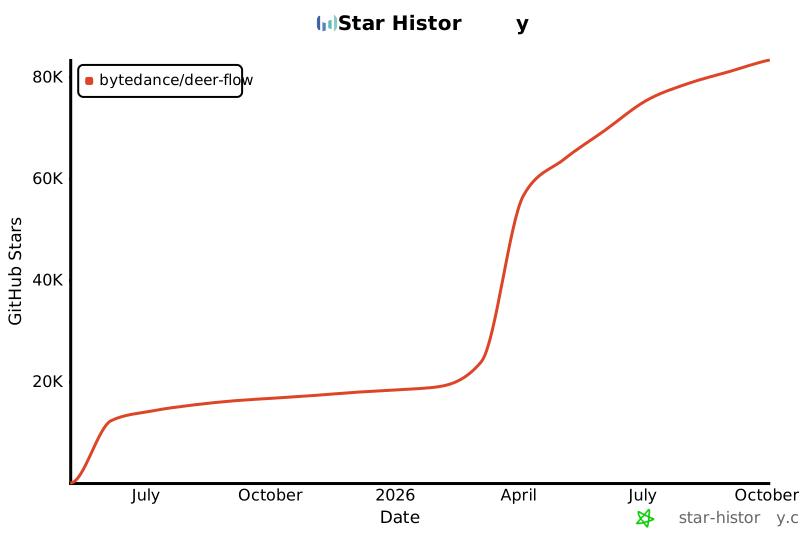](https://star-history.com/#bytedance/deer-flow&Date)
> Le 28 février 2026, DeerFlow a décroché la 🏆 1re place sur GitHub Trending suite au lancement de la version 2. Un immense merci à notre incroyable communauté — c'est grâce à vous ! 💪🔥
DeerFlow (**D**eep **E**xploration and **E**fficient **R**esearch **Flow**) est un **super agent harness** open source qui orchestre des **sub-agents**, de la **mémoire** et des **sandboxes** pour accomplir pratiquement n'importe quelle tâche — le tout propulsé par des **skills extensibles**.
> **DeerFlow 2.0 est une réécriture complète.** Il ne partage aucun code avec la v1. Si vous cherchez le framework Deep Research original, il est maintenu sur la [branche `1.x`](https://github.com/bytedance/deer-flow/tree/main-1.x) — les contributions y sont toujours les bienvenues. Le développement actif a migré vers la 2.0.
- [Développeurs en Chine continentale, cliquez ici](https://www.volcengine.com/activity/codingplan?utm_campaign=deer_flow&utm_content=deer_flow&utm_medium=devrel&utm_source=OWO&utm_term=deer_flow)
## InfoQuest
DeerFlow intègre désormais le toolkit de recherche et de crawling intelligent développé par BytePlus — [InfoQuest (essai gratuit en ligne)](https://docs.byteplus.com/en/docs/InfoQuest/What_is_Info_Quest)
## Installation en une phrase pour un coding agent
Si vous utilisez Claude Code, Codex, Cursor, Windsurf ou un autre coding agent, vous pouvez simplement lui envoyer cette phrase :
```text
Aide-moi à cloner DeerFlow si nécessaire, puis à initialiser son environnement de développement local en suivant https://raw.githubusercontent.com/bytedance/deer-flow/main/Install.md
```
Ce prompt est destiné aux coding agents. Il leur demande de cloner le dépôt si nécessaire, de privilégier Docker quand il est disponible, puis de s'arrêter avec la commande exacte pour lancer DeerFlow et la liste des configurations encore manquantes.
2. **Générer les fichiers de configuration locaux**
Depuis le répertoire racine du projet (`deer-flow/`), exécutez :
```bash
make config
```
Cette commande crée les fichiers de configuration locaux à partir des templates fournis.
3. **Configurer le(s) modèle(s) de votre choix**
Éditez `config.yaml` et définissez au moins un modèle :
```yaml
models:
- name: gpt-4 # Internal identifier
display_name: GPT-4 # Human-readable name
use: langchain_openai:ChatOpenAI # LangChain class path
model: gpt-4 # Model identifier for API
api_key: $OPENAI_API_KEY # API key (recommended: use env var)
max_tokens: 4096 # Maximum tokens per request
temperature: 0.7 # Sampling temperature
- name: openrouter-gemini-2.5-flash
display_name: Gemini 2.5 Flash (OpenRouter)
use: langchain_openai:ChatOpenAI
model: google/gemini-2.5-flash-preview
api_key: $OPENAI_API_KEY # OpenRouter still uses the OpenAI-compatible field name here
base_url: https://openrouter.ai/api/v1
- name: gpt-5-responses
display_name: GPT-5 (Responses API)
use: langchain_openai:ChatOpenAI
model: gpt-5
api_key: $OPENAI_API_KEY
use_responses_api: true
output_version: responses/v1
```
OpenRouter et les passerelles compatibles OpenAI similaires doivent être configurés avec `langchain_openai:ChatOpenAI` et `base_url`. Si vous préférez utiliser un nom de variable d'environnement propre au fournisseur, pointez `api_key` vers cette variable explicitement (par exemple `api_key: $OPENROUTER_API_KEY`).
Pour router les modèles OpenAI via `/v1/responses`, continuez d'utiliser `langchain_openai:ChatOpenAI` et définissez `use_responses_api: true` avec `output_version: responses/v1`.
- L'endpoint Responses de Codex rejette actuellement `max_tokens` et `max_output_tokens`, donc `CodexChatModel` n'expose pas de limite de tokens par requête
- Claude Code accepte `CLAUDE_CODE_OAUTH_TOKEN`, `ANTHROPIC_AUTH_TOKEN`, `CLAUDE_CODE_OAUTH_TOKEN_FILE_DESCRIPTOR`, `CLAUDE_CODE_CREDENTIALS_PATH`, ou en clair `~/.claude/.credentials.json`
- Sur macOS, DeerFlow ne sonde pas le Keychain automatiquement. Exportez l'auth Claude Code explicitement si nécessaire :
**Développement** (hot-reload, montage des sources) :
```bash
make docker-init # Pull sandbox image (only once or when image updates)
make docker-start # Start services (auto-detects sandbox mode from config.yaml)
```
`make docker-start` ne lance `provisioner` que si `config.yaml` utilise le mode provisioner (`sandbox.use: deerflow.community.aio_sandbox:AioSandboxProvider` avec `provisioner_url`).
Les processus backend récupèrent automatiquement les changements dans `config.yaml` au prochain accès à la configuration, donc les mises à jour de métadonnées des modèles ne nécessitent pas de redémarrage manuel en développement.
> [!TIP]
> Sous Linux, si les commandes Docker échouent avec `permission denied while trying to connect to the Docker daemon socket at unix:///var/run/docker.sock`, ajoutez votre utilisateur au groupe `docker` et reconnectez-vous avant de réessayer. Voir [CONTRIBUTING.md](CONTRIBUTING.md#linux-docker-daemon-permission-denied) pour la solution complète.
**Production** (build des images en local, montage de la config et des données) :
```bash
make up # Build images and start all production services
make down # Stop and remove containers
```
> [!NOTE]
> Le serveur d'agents LangGraph fonctionne actuellement via `langgraph dev` (le serveur CLI open source).
Accès : http://localhost:2026
Voir [CONTRIBUTING.md](CONTRIBUTING.md) pour le guide complet de développement avec Docker.
#### Option 2 : Développement local
Si vous préférez lancer les services en local :
Prérequis : complétez d'abord les étapes de « Configuration » ci-dessus (`make config` et clés API des modèles). `make dev` nécessite un fichier de configuration valide (par défaut `config.yaml` à la racine du projet ; modifiable via `DEER_FLOW_CONFIG_PATH`).
1. **Vérifier les prérequis** :
```bash
make check # Verifies Node.js 22+, pnpm, uv, nginx
```
2. **Installer les dépendances** :
```bash
make install # Install backend + frontend dependencies
# Recommended if using Docker/Container-based sandbox
make setup-sandbox
```
4. **Démarrer les services** :
```bash
make dev
```
5. **Accès** : http://localhost:2026
### Avancé
#### Mode Sandbox
DeerFlow supporte plusieurs modes d'exécution sandbox :
- **Exécution locale** (exécute le code sandbox directement sur la machine hôte)
- **Exécution Docker** (exécute le code sandbox dans des conteneurs Docker isolés)
- **Exécution Docker avec Kubernetes** (exécute le code sandbox dans des pods Kubernetes via le service provisioner)
En développement Docker, le démarrage des services suit le mode sandbox défini dans `config.yaml`. En mode Local/Docker, `provisioner` n'est pas démarré.
Voir le [Guide de configuration Sandbox](backend/docs/CONFIGURATION.md#sandbox) pour configurer le mode de votre choix.
#### Serveur MCP
DeerFlow supporte des serveurs MCP et des skills configurables pour étendre ses capacités.
Pour les serveurs MCP HTTP/SSE, les flux de tokens OAuth sont supportés (`client_credentials`, `refresh_token`).
Voir le [Guide MCP Server](backend/docs/MCP_SERVER.md) pour les instructions détaillées.
#### Canaux de messagerie
DeerFlow peut recevoir des tâches depuis des applications de messagerie. Les canaux démarrent automatiquement une fois configurés — aucune IP publique n'est requise.
| Canal | Transport | Difficulté |
|---------|-----------|------------|
| Telegram | Bot API (long-polling) | Facile |
| Slack | Socket Mode | Modérée |
| Feishu / Lark | WebSocket | Modérée |
**Configuration dans `config.yaml` :**
```yaml
channels:
# LangGraph Server URL (default: http://localhost:2024)
langgraph_url: http://localhost:2024
# Gateway API URL (default: http://localhost:8001)
gateway_url: http://localhost:8001
# Optional: global session defaults for all mobile channels
session:
assistant_id: lead_agent
config:
recursion_limit: 100
context:
thinking_enabled: true
is_plan_mode: false
subagent_enabled: false
feishu:
enabled: true
app_id: $FEISHU_APP_ID
app_secret: $FEISHU_APP_SECRET
# domain: https://open.feishu.cn # China (default)
# domain: https://open.larksuite.com # International
1. Ouvrez une conversation avec [@BotFather](https://t.me/BotFather), envoyez `/newbot`, et copiez le token HTTP API.
2. Définissez `TELEGRAM_BOT_TOKEN` dans `.env` et activez le canal dans `config.yaml`.
**Configuration Slack**
1. Créez une Slack App sur [api.slack.com/apps](https://api.slack.com/apps) → Create New App → From scratch.
2. Dans **OAuth & Permissions**, ajoutez les Bot Token Scopes : `app_mentions:read`, `chat:write`, `im:history`, `im:read`, `im:write`, `files:write`.
3. Activez le **Socket Mode** → générez un App-Level Token (`xapp-…`) avec le scope `connections:write`.
4. Dans **Event Subscriptions**, abonnez-vous aux bot events : `app_mention`, `message.im`.
5. Définissez `SLACK_BOT_TOKEN` et `SLACK_APP_TOKEN` dans `.env` et activez le canal dans `config.yaml`.
**Configuration Feishu / Lark**
1. Créez une application sur [Feishu Open Platform](https://open.feishu.cn/) → activez la capacité **Bot**.
2. Ajoutez les permissions : `im:message`, `im:message.p2p_msg:readonly`, `im:resource`.
3. Dans **Events**, abonnez-vous à `im.message.receive_v1` et sélectionnez le mode **Long Connection**.
4. Copiez l'App ID et l'App Secret. Définissez `FEISHU_APP_ID` et `FEISHU_APP_SECRET` dans `.env` et activez le canal dans `config.yaml`.
**Commandes**
Une fois un canal connecté, vous pouvez interagir avec DeerFlow directement depuis le chat :
| Commande | Description |
|---------|-------------|
| `/new` | Démarrer une nouvelle conversation |
| `/status` | Afficher les infos du thread en cours |
| `/models` | Lister les modèles disponibles |
| `/memory` | Consulter la mémoire |
| `/help` | Afficher l'aide |
> Les messages sans préfixe de commande sont traités comme du chat classique — DeerFlow crée un thread et répond de manière conversationnelle.
#### Traçage LangSmith
DeerFlow intègre nativement [LangSmith](https://smith.langchain.com) pour l'observabilité. Une fois activé, tous les appels LLM, les exécutions d'agents et les exécutions d'outils sont tracés et visibles dans le tableau de bord LangSmith.
Ajoutez les lignes suivantes à votre fichier `.env` :
Pour les déploiements Docker, le traçage est désactivé par défaut. Définissez `LANGSMITH_TRACING=true` et `LANGSMITH_API_KEY` dans votre `.env` pour l'activer.
## Du Deep Research au Super Agent Harness
DeerFlow a démarré comme un framework de Deep Research — et la communauté s'en est emparée. Depuis le lancement, les développeurs l'ont poussé bien au-delà de la recherche : construction de pipelines de données, génération de présentations, mise en place de dashboards, automatisation de workflows de contenu. Des usages qu'on n'avait jamais anticipés.
Ça nous a révélé quelque chose d'important : DeerFlow n'était pas qu'un simple outil de recherche. C'était un **harness** — un runtime qui donne aux agents l'infrastructure nécessaire pour vraiment accomplir du travail.
On l'a donc reconstruit de zéro.
DeerFlow 2.0 n'est plus un framework à assembler soi-même. C'est un super agent harness — clé en main et entièrement extensible. Construit sur LangGraph et LangChain, il embarque tout ce dont un agent a besoin out of the box : un système de fichiers, de la mémoire, des skills, une exécution sandboxée, et la capacité de planifier et de lancer des sub-agents pour les tâches complexes et multi-étapes.
Utilisez-le tel quel. Ou démontez-le et faites-en le vôtre.
## Fonctionnalités principales
### Skills et outils
Les skills sont ce qui permet à DeerFlow de faire *pratiquement n'importe quoi*.
Un Agent Skill standard est un module de capacité structuré — un fichier Markdown qui définit un workflow, des bonnes pratiques et des références vers des ressources associées. DeerFlow est livré avec des skills intégrés pour la recherche, la génération de rapports, la création de présentations, les pages web, la génération d'images et de vidéos, et bien plus. Mais la vraie force réside dans l'extensibilité : ajoutez vos propres skills, remplacez ceux fournis, ou combinez-les en workflows composites.
Les skills sont chargés progressivement — uniquement quand la tâche le nécessite, pas tous en même temps. Ça permet de garder la fenêtre de contexte légère et de bien fonctionner même avec des modèles sensibles au nombre de tokens.
Quand vous installez des archives `.skill` via le Gateway, DeerFlow accepte les métadonnées frontmatter optionnelles standard comme `version`, `author` et `compatibility`, plutôt que de rejeter des skills externes par ailleurs valides.
Les outils suivent la même philosophie. DeerFlow est livré avec un ensemble d'outils de base — recherche web, fetch de pages web, opérations sur les fichiers, exécution bash — et supporte les outils custom via des serveurs MCP et des fonctions Python. Remplacez n'importe quoi. Ajoutez n'importe quoi.
Les suggestions de suivi générées par le Gateway normalisent désormais aussi bien la sortie texte brut du modèle que le contenu riche au format bloc/liste avant de parser la réponse en tableau JSON, de sorte que les wrappers de contenu propres à chaque provider ne suppriment plus silencieusement les suggestions.
```
# Paths inside the sandbox container
/mnt/skills/public
├── research/SKILL.md
├── report-generation/SKILL.md
├── slide-creation/SKILL.md
├── web-page/SKILL.md
└── image-generation/SKILL.md
/mnt/skills/custom
└── your-custom-skill/SKILL.md ← yours
```
#### Intégration Claude Code
Le skill `claude-to-deerflow` vous permet d'interagir avec une instance DeerFlow en cours d'exécution directement depuis [Claude Code](https://docs.anthropic.com/en/docs/claude-code). Envoyez des tâches de recherche, vérifiez le statut, gérez les threads — le tout sans quitter le terminal.
Assurez-vous ensuite que DeerFlow tourne (par défaut sur `http://localhost:2026`) et utilisez la commande `/claude-to-deerflow` dans Claude Code.
**Ce que vous pouvez faire** :
- Envoyer des messages à DeerFlow et recevoir des réponses en streaming
- Choisir le mode d'exécution : flash (rapide), standard, pro (planification), ultra (sub-agents)
- Vérifier la santé de DeerFlow, lister les modèles/skills/agents
- Gérer les threads et l'historique des conversations
- Upload des fichiers pour analyse
**Variables d'environnement** (optionnel, pour des endpoints custom) :
```bash
DEERFLOW_URL=http://localhost:2026 # Unified proxy base URL
DEERFLOW_GATEWAY_URL=http://localhost:2026 # Gateway API
DEERFLOW_LANGGRAPH_URL=http://localhost:2026/api/langgraph # LangGraph API
```
Voir [`skills/public/claude-to-deerflow/SKILL.md`](skills/public/claude-to-deerflow/SKILL.md) pour la référence API complète.
### Sub-Agents
Les tâches complexes tiennent rarement en une seule passe. DeerFlow les décompose.
L'agent principal peut lancer des sub-agents à la volée — chacun avec son propre contexte délimité, ses outils et ses conditions d'arrêt. Les sub-agents s'exécutent en parallèle quand c'est possible, remontent des résultats structurés, et l'agent principal synthétise le tout en une sortie cohérente.
C'est comme ça que DeerFlow gère les tâches qui prennent de quelques minutes à plusieurs heures : une tâche de recherche peut se déployer en une dizaine de sub-agents, chacun explorant un angle différent, puis converger vers un seul rapport — ou un site web — ou un jeu de slides avec des visuels générés. Un seul harness, de nombreuses mains.
### Sandbox et système de fichiers
DeerFlow ne se contente pas de *parler* de faire les choses. Il dispose de son propre ordinateur.
Chaque tâche s'exécute dans un conteneur Docker isolé avec un système de fichiers complet — skills, workspace, uploads, outputs. L'agent lit, écrit et édite des fichiers. Il exécute des commandes bash et du code. Il visualise des images. Le tout sandboxé, le tout auditable, zéro contamination entre les sessions.
C'est la différence entre un chatbot avec accès à des outils et un agent doté d'un véritable environnement d'exécution.
```
# Paths inside the sandbox container
/mnt/user-data/
├── uploads/ ← your files
├── workspace/ ← agents' working directory
└── outputs/ ← final deliverables
```
### Context Engineering
**Contexte isolé des Sub-Agents** : chaque sub-agent s'exécute dans son propre contexte isolé. Il ne peut voir ni le contexte de l'agent principal, ni celui des autres sub-agents. L'objectif est de garantir que chaque sub-agent reste concentré sur sa tâche sans être parasité par des informations non pertinentes.
**Résumé** : au sein d'une session, DeerFlow gère le contexte de manière agressive — en résumant les sous-tâches terminées, en déchargeant les résultats intermédiaires vers le système de fichiers, en compressant ce qui n'est plus immédiatement pertinent. Ça lui permet de rester efficace sur des tâches longues et multi-étapes sans faire exploser la fenêtre de contexte.
### Mémoire à long terme
La plupart des agents oublient tout dès qu'une conversation se termine. DeerFlow, lui, se souvient.
D'une session à l'autre, DeerFlow construit une mémoire persistante de votre profil, de vos préférences et de vos connaissances accumulées. Plus vous l'utilisez, mieux il vous connaît — votre style d'écriture, votre stack technique, vos workflows récurrents. La mémoire est stockée localement et reste sous votre contrôle.
Les mises à jour de la mémoire ignorent désormais les entrées de faits en double au moment de l'application, de sorte que les préférences et le contexte répétés ne s'accumulent plus indéfiniment entre les sessions.
## Modèles recommandés
DeerFlow est agnostique en termes de modèle — il fonctionne avec n'importe quel LLM implémentant l'API compatible OpenAI. Cela dit, il offre de meilleures performances avec des modèles qui supportent :
- **De longues fenêtres de contexte** (100k+ tokens) pour la recherche approfondie et les tâches multi-étapes
- **Des capacités de raisonnement** pour la planification adaptative et la décomposition de tâches complexes
- **Des entrées multimodales** pour la compréhension d'images et de vidéos
- **Un usage fiable des outils (tool use)** pour des appels de fonctions et des sorties structurées fiables
## Client Python intégré
DeerFlow peut être utilisé comme bibliothèque Python intégrée sans lancer l'ensemble des services HTTP. Le `DeerFlowClient` fournit un accès direct in-process à toutes les capacités d'agent et de Gateway, en retournant les mêmes schémas de réponse que l'API HTTP Gateway. Le HTTP Gateway expose également `DELETE /api/threads/{thread_id}` pour supprimer les données de thread locales gérées par DeerFlow après la suppression du thread LangGraph :
```python
from deerflow.client import DeerFlowClient
client = DeerFlowClient()
# Chat
response = client.chat("Analyze this paper for me", thread_id="my-thread")
Toutes les méthodes retournant des dicts sont validées en CI contre les modèles de réponse Pydantic du Gateway (`TestGatewayConformance`), garantissant que le client intégré reste synchronisé avec les schémas de l'API HTTP. Voir `backend/packages/harness/deerflow/client.py` pour la documentation API complète.
## Documentation
- [Guide de contribution](CONTRIBUTING.md) - Mise en place de l'environnement de développement et workflow
- [Guide de configuration](backend/docs/CONFIGURATION.md) - Instructions d'installation et de configuration
- [Vue d'ensemble de l'architecture](backend/CLAUDE.md) - Détails de l'architecture technique
- [Architecture backend](backend/README.md) - Architecture backend et référence API
## ⚠️ Avertissement de sécurité
### Un déploiement inapproprié peut introduire des risques de sécurité
DeerFlow dispose de capacités clés à hauts privilèges, notamment **l'exécution de commandes système, les opérations sur les ressources et l'invocation de logique métier**. Il est conçu par défaut pour être **déployé dans un environnement local de confiance (accessible uniquement via l'interface de loopback 127.0.0.1)**. Si vous déployez l'agent dans des environnements non fiables — tels que des réseaux LAN, des serveurs cloud publics ou d'autres environnements accessibles depuis plusieurs terminaux — sans mesures de sécurité strictes, cela peut introduire des risques, notamment :
- **Invocation non autorisée** : les fonctionnalités de l'agent pourraient être découvertes par des tiers non autorisés ou des scanners malveillants, déclenchant des requêtes non autorisées en masse qui exécutent des opérations à haut risque (commandes système, lecture/écriture de fichiers), pouvant causer de graves conséquences.
- **Risques juridiques et de conformité** : si l'agent est utilisé illégalement pour mener des cyberattaques, du vol de données ou d'autres activités illicites, cela peut entraîner des responsabilités juridiques et des risques de conformité.
### Recommandations de sécurité
**Note : nous recommandons fortement de déployer DeerFlow dans un environnement réseau local de confiance.** Si vous avez besoin d'un déploiement multi-appareils ou multi-réseaux, vous devez mettre en place des mesures de sécurité strictes, par exemple :
- **Liste blanche d'IP** : utilisez `iptables`, ou déployez des pare-feux matériels / commutateurs avec ACL, pour **configurer des règles de liste blanche d'IP** et refuser l'accès à toutes les autres adresses IP.
- **Passerelle d'authentification** : configurez un proxy inverse (ex. nginx) et **activez une authentification forte en amont**, bloquant tout accès non authentifié.
- **Isolation réseau** : si possible, placez l'agent et les appareils de confiance dans le **même VLAN dédié**, isolé des autres équipements réseau.
- **Restez informé** : continuez à suivre les mises à jour de sécurité du projet DeerFlow.
## Contribuer
Les contributions sont les bienvenues ! Consultez [CONTRIBUTING.md](CONTRIBUTING.md) pour la mise en place de l'environnement de développement, le workflow et les conventions.
La couverture de tests de régression inclut la détection du mode sandbox Docker et les tests de gestion du kubeconfig-path du provisioner dans `backend/tests/`.
## Licence
Ce projet est open source et disponible sous la [Licence MIT](./LICENSE).
## Remerciements
DeerFlow est construit sur le travail remarquable de la communauté open source. Nous sommes profondément reconnaissants envers tous les projets et contributeurs dont les efforts ont rendu DeerFlow possible. Nous nous tenons véritablement sur les épaules de géants.
Nous tenons à exprimer notre sincère gratitude aux projets suivants pour leurs contributions inestimables :
- **[LangChain](https://github.com/langchain-ai/langchain)** : leur excellent framework propulse nos interactions LLM et nos chaînes, permettant une intégration et des fonctionnalités fluides.
- **[LangGraph](https://github.com/langchain-ai/langgraph)** : leur approche innovante de l'orchestration multi-agents a été déterminante pour les workflows sophistiqués de DeerFlow.
Ces projets illustrent le pouvoir transformateur de la collaboration open source, et nous sommes fiers de bâtir sur leurs fondations.
### Contributeurs principaux
Un grand merci aux auteurs principaux de `DeerFlow`, dont la vision, la passion et le dévouement ont donné vie à ce projet :
> 28 февраля 2026 года DeerFlow занял 🏆 #1 в GitHub Trending после релиза версии 2. Спасибо огромное нашему сообществу — всё благодаря вам! 💪🔥
DeerFlow (**D**eep **E**xploration and **E**fficient **R**esearch **Flow**) — open-source **Super Agent Harness**, который управляет **Sub-Agents**, **Memory** и **Sandbox** для решения почти любой задачи. Всё на основе расширяемых **Skills**.
> **DeerFlow 2.0 — проект переписан с нуля.** Общего кода с v1 нет. Если нужен оригинальный Deep Research фреймворк — он живёт в ветке [`1.x`](https://github.com/bytedance/deer-flow/tree/main-1.x), туда тоже принимают контрибьюты. Активная разработка идёт в 2.0.
- [Для разработчиков из материкового Китая](https://www.volcengine.com/activity/codingplan?utm_campaign=deer_flow&utm_content=deer_flow&utm_medium=devrel&utm_source=OWO&utm_term=deer_flow)
## InfoQuest
DeerFlow интегрирован с инструментарием для умного поиска и краулинга от BytePlus — [InfoQuest (есть бесплатный онлайн-доступ)](https://docs.byteplus.com/en/docs/InfoQuest/What_is_Info_Quest)
Если вы используете Claude Code, Codex, Cursor, Windsurf или другой coding agent, просто отправьте ему эту фразу:
```text
Если DeerFlow еще не клонирован, сначала клонируй его, а затем подготовь локальное окружение разработки по инструкции https://raw.githubusercontent.com/bytedance/deer-flow/main/Install.md
```
Этот prompt предназначен для coding agent. Он просит агента при необходимости сначала клонировать репозиторий, предпочесть Docker, если он доступен, и в конце вернуть точную команду запуска и список недостающих настроек.
make docker-init # Загрузить образ Sandbox (один раз или при обновлении)
make docker-start # Запустить сервисы
```
**Продакшен** (собирает образы локально):
```bash
make up # Собрать образы и запустить все сервисы
make down # Остановить и удалить контейнеры
```
> [!TIP]
> На Linux при ошибке `permission denied` для Docker daemon добавьте пользователя в группу `docker` и перелогиньтесь. Подробнее в [CONTRIBUTING.md](CONTRIBUTING.md#linux-docker-daemon-permission-denied).
Адрес: http://localhost:2026
#### Вариант 2: Локальная разработка
1. **Проверить зависимости**:
```bash
make check # Проверяет Node.js 22+, pnpm, uv, nginx
```
2. **Установить зависимости**:
```bash
make install
```
3. **(Опционально) Загрузить образ Sandbox заранее**:
```bash
make setup-sandbox
```
4. **Запустить сервисы**:
```bash
make dev
```
5. **Адрес**: http://localhost:2026
### Дополнительно
#### Режим Sandbox
DeerFlow поддерживает несколько режимов выполнения:
- **Локальное выполнение** — код запускается прямо на хосте
- **Docker** — код выполняется в изолированных Docker-контейнерах
- **Docker + Kubernetes** — выполнение в Kubernetes-подах через provisioner
Подробнее в [руководстве по конфигурации Sandbox](backend/docs/CONFIGURATION.md#sandbox).
#### MCP-сервер
DeerFlow поддерживает настраиваемые MCP-серверы для расширения возможностей. Для HTTP/SSE MCP-серверов поддерживаются OAuth-токены (`client_credentials`, `refresh_token`). Подробнее в [руководстве по MCP-серверу](backend/docs/MCP_SERVER.md).
#### Мессенджеры
DeerFlow принимает задачи прямо из мессенджеров. Каналы запускаются автоматически при настройке, публичный IP не нужен.
| Канал | Транспорт | Сложность |
|-------|-----------|-----------|
| Telegram | Bot API (long-polling) | Просто |
| Slack | Socket Mode | Средне |
| Feishu / Lark | WebSocket | Средне |
**Конфигурация в `config.yaml`:**
```yaml
channels:
feishu:
enabled: true
app_id: $FEISHU_APP_ID
app_secret: $FEISHU_APP_SECRET
# domain: https://open.feishu.cn # China (default)
# domain: https://open.larksuite.com # International
slack:
enabled: true
bot_token: $SLACK_BOT_TOKEN
app_token: $SLACK_APP_TOKEN
allowed_users: []
telegram:
enabled: true
bot_token: $TELEGRAM_BOT_TOKEN
allowed_users: []
```
**Настройка Telegram**
1. Напишите [@BotFather](https://t.me/BotFather), отправьте `/newbot` и скопируйте HTTP API-токен.
2. Укажите `TELEGRAM_BOT_TOKEN` в `.env` и включите канал в `config.yaml`.
**Доступные команды**
| Команда | Описание |
|---------|----------|
| `/new` | Начать новый диалог |
| `/status` | Показать информацию о текущем треде |
| `/models` | Список доступных моделей |
| `/memory` | Просмотреть память |
| `/help` | Показать справку |
> Сообщения без команды воспринимаются как обычный чат — DeerFlow создаёт тред и отвечает.
#### Трассировка LangSmith
DeerFlow имеет встроенную интеграцию с [LangSmith](https://smith.langchain.com) для наблюдаемости. При включении все вызовы LLM, запуски агентов и выполнения инструментов отслеживаются и отображаются в дашборде LangSmith.
Добавьте в файл `.env` в корне проекта:
```bash
LANGSMITH_TRACING=true
LANGSMITH_API_KEY=lsv2_pt_xxxxxxxxxxxxxxxx
LANGSMITH_PROJECT=deer-flow
```
`LANGSMITH_ENDPOINT` по умолчанию `https://api.smith.langchain.com` и может быть переопределён при необходимости. Устаревшие переменные `LANGCHAIN_*` (`LANGCHAIN_TRACING_V2`, `LANGCHAIN_API_KEY` и т.д.) также поддерживаются для обратной совместимости; `LANGSMITH_*` имеет приоритет, когда заданы обе.
В Docker-развёртываниях трассировка отключена по умолчанию. Установите `LANGSMITH_TRACING=true` и `LANGSMITH_API_KEY` в `.env` для включения.
## От Deep Research к Super Agent Harness
DeerFlow начинался как фреймворк для Deep Research, и сообщество вышло далеко за эти рамки. После запуска разработчики строили пайплайны, генерировали презентации, поднимали дашборды, автоматизировали контент. То, чего мы не ожидали.
Стало понятно: DeerFlow не просто research-инструмент. Это **harness**: runtime, который даёт агентам необходимую инфраструктуру.
Поэтому мы переписали всё с нуля.
DeerFlow 2.0 — это Super Agent Harness «из коробки». Batteries included, полностью расширяемый. Построен на LangGraph и LangChain. По умолчанию есть всё, что нужно агенту: файловая система, memory, skills, sandbox-выполнение и возможность планировать и запускать sub-agents для сложных многошаговых задач.
Используйте как есть. Или разберите и переделайте под себя.
## Core Features
### Skills & Tools
Skills — это то, что позволяет DeerFlow делать почти что угодно.
Agent Skill — это структурированный модуль: Markdown-файл с описанием воркфлоу, лучших практик и ссылок на ресурсы. DeerFlow поставляется со встроенными skills для ресёрча, генерации отчётов, слайдов, веб-страниц, изображений и видео. Но главное — расширяемость: добавляйте свои skills, заменяйте встроенные или собирайте из них составные воркфлоу.
Skills загружаются по мере необходимости, только когда задача их требует. Это держит контекстное окно чистым.
```
# Пути внутри контейнера sandbox
/mnt/skills/public
├── research/SKILL.md
├── report-generation/SKILL.md
├── slide-creation/SKILL.md
├── web-page/SKILL.md
└── image-generation/SKILL.md
/mnt/skills/custom
└── your-custom-skill/SKILL.md ← ваш skill
```
#### Интеграция с Claude Code
Skill `claude-to-deerflow` позволяет работать с DeerFlow прямо из [Claude Code](https://docs.anthropic.com/en/docs/claude-code). Отправляйте задачи, проверяйте статус, управляйте тредами, не выходя из терминала.
- Проверять статус DeerFlow, просматривать модели, скиллы, агентов
- Управлять тредами и историей диалога
- Загружать файлы для анализа
Полный справочник API в [`skills/public/claude-to-deerflow/SKILL.md`](skills/public/claude-to-deerflow/SKILL.md).
### Sub-Agents
Сложные задачи редко решаются за один проход. DeerFlow их декомпозирует.
Lead agent запускает sub-agents на лету, каждый со своим изолированным контекстом, инструментами и условиями завершения. Sub-agents работают параллельно, возвращают структурированные результаты, а lead agent собирает всё в единый итог.
Вот как DeerFlow справляется с задачами на минуты и часы: research-задача разветвляется в дюжину sub-agents, каждый копает свой угол, потом всё сходится в один отчёт, или сайт, или слайддек со сгенерированными визуалами. Один harness, много рук.
### Sandbox & файловая система
DeerFlow не просто *говорит* о том, что умеет что-то делать. У него есть собственный компьютер.
Каждая задача выполняется внутри изолированного Docker-контейнера с полной файловой системой: skills, workspace, uploads, outputs. Агент читает, пишет и редактирует файлы. Выполняет bash-команды и пишет код. Смотрит на изображения. Всё изолировано, всё прозрачно, никакого пересечения между сессиями.
Это разница между чатботом с доступом к инструментам и агентом с реальной средой выполнения.
```
# Пути внутри контейнера sandbox
/mnt/user-data/
├── uploads/ ← ваши файлы
├── workspace/ ← рабочая директория агентов
└── outputs/ ← результаты
```
### Context Engineering
**Изолированный контекст**: каждый sub-agent работает в своём контексте и не видит контекст главного агента или других sub-agents. Агент фокусируется на своей задаче.
**Управление контекстом**: внутри сессии DeerFlow агрессивно сжимает контекст и суммирует завершённые подзадачи, выгружает промежуточные результаты в файловую систему, сжимает то, что уже не актуально. На длинных многошаговых задачах контекстное окно не переполняется.
### Long-Term Memory
Большинство агентов забывают всё, когда диалог заканчивается. DeerFlow помнит.
DeerFlow сохраняет ваш профиль, предпочтения и накопленные знания между сессиями. Чем больше используете, тем лучше он вас знает: стиль, технологический стек, повторяющиеся воркфлоу. Всё хранится локально и остаётся под вашим контролем.
## Рекомендуемые модели
DeerFlow работает с любым LLM через OpenAI-совместимый API. Лучше всего — с моделями, которые поддерживают:
- **Большое контекстное окно** (100k+ токенов) — для deep research и многошаговых задач
- **Reasoning capabilities** — для адаптивного планирования и сложной декомпозиции
- **Multimodal inputs** — для работы с изображениями и видео
- **Strong tool-use** — для надёжного вызова функций и структурированных ответов
## Встроенный Python-клиент
DeerFlow можно использовать как Python-библиотеку прямо в коде — без запуска HTTP-сервисов. `DeerFlowClient` даёт доступ ко всем возможностям агента и Gateway, возвращает те же схемы ответов, что и HTTP Gateway API:
```python
from deerflow.client import DeerFlowClient
client = DeerFlowClient()
# Chat
response = client.chat("Analyze this paper for me", thread_id="my-thread")
- [Архитектура бэкенда](backend/README.md) — бэкенд и справочник API
## ⚠️ Безопасность
### Неправильное развёртывание может привести к угрозам безопасности
DeerFlow обладает ключевыми высокопривилегированными возможностями, включая **выполнение системных команд, операции с ресурсами и вызов бизнес-логики**. По умолчанию он рассчитан на **развёртывание в локальной доверенной среде (доступ только через loopback-адрес 127.0.0.1)**. Если вы разворачиваете агент в недоверенных средах — локальных сетях, публичных облачных серверах или других окружениях, доступных с нескольких устройств — без строгих мер безопасности, это может привести к следующим угрозам:
- **Несанкционированные вызовы**: функциональность агента может быть обнаружена неавторизованными третьими лицами или вредоносными сканерами, что приведёт к массовым несанкционированным запросам с выполнением высокорисковых операций (системные команды, чтение/запись файлов) и серьёзным последствиям для безопасности.
- **Юридические и compliance-риски**: если агент будет незаконно использован для кибератак, кражи данных или других противоправных действий, это может повлечь юридическую ответственность и compliance-риски.
### Рекомендации по безопасности
**Примечание: настоятельно рекомендуем развёртывать DeerFlow только в локальной доверенной сети.** Если вам необходимо развёртывание через несколько устройств или сетей, обязательно реализуйте строгие меры безопасности, например:
- **Белый список IP-адресов**: используйте `iptables` или аппаратные межсетевые экраны / коммутаторы с ACL, чтобы **настроить правила белого списка IP** и заблокировать доступ со всех остальных адресов.
- **Шлюз аутентификации**: настройте обратный прокси (nginx и др.) и **включите строгую предварительную аутентификацию**, запрещающую любой доступ без авторизации.
- **Сетевая изоляция**: по возможности разместите агент и доверенные устройства в **одном выделенном VLAN**, изолированном от остальной сети.
- **Следите за обновлениями**: регулярно отслеживайте обновления безопасности проекта DeerFlow.
## Участие в разработке
Приветствуем контрибьюторов! Настройка среды разработки, воркфлоу и гайдлайны — в [CONTRIBUTING.md](CONTRIBUTING.md).
## Лицензия
Проект распространяется под [лицензией MIT](./LICENSE).
## Благодарности
DeerFlow стоит на плечах open-source сообщества. Спасибо всем проектам и разработчикам, чья работа сделала его возможным.
Отдельная благодарность:
- **[LangChain](https://github.com/langchain-ai/langchain)** — фреймворк для взаимодействия с LLM и построения цепочек.
- **[LangGraph](https://github.com/langchain-ai/langgraph)** — многоагентная оркестрация, на которой держатся сложные воркфлоу DeerFlow.
This file provides guidance to Claude Code (claude.ai/code) when working with code in this repository.
## Project Overview
DeerFlow is a LangGraph-based AI super agent system with a full-stack architecture. The backend provides a "super agent" with sandbox execution, persistent memory, subagent delegation, and extensible tool integration - all operating in per-thread isolated environments.
**Architecture**:
- **LangGraph Server** (port 2024): Agent runtime and workflow execution
- **Gateway API** (port 8001): REST API for models, MCP, skills, memory, artifacts, uploads, and local thread cleanup
- **Frontend** (port 3000): Next.js web interface
- **Nginx** (port 2026): Unified reverse proxy entry point
- **Provisioner** (port 8002, optional in Docker dev): Started only when sandbox is configured for provisioner/Kubernetes mode
**Runtime Modes**:
- **Standard mode** (`make dev`): LangGraph Server handles agent execution as a separate process. 4 processes total.
- **Gateway mode** (`make dev-pro`, experimental): Agent runtime embedded in Gateway via `RunManager` + `run_agent()` + `StreamBridge` (`packages/harness/deerflow/runtime/`). Service manages its own concurrency via async tasks. 3 processes total, no LangGraph Server.
-`tests/test_harness_boundary.py` — ensures `packages/harness/deerflow/` never imports from `app.*`
CI runs these regression tests for every pull request via [.github/workflows/backend-unit-tests.yml](../.github/workflows/backend-unit-tests.yml).
## Architecture
### Harness / App Split
The backend is split into two layers with a strict dependency direction:
- **Harness** (`packages/harness/deerflow/`): Publishable agent framework package (`deerflow-harness`). Import prefix: `deerflow.*`. Contains agent orchestration, tools, sandbox, models, MCP, skills, config — everything needed to build and run agents.
- **App** (`app/`): Unpublished application code. Import prefix: `app.*`. Contains the FastAPI Gateway API and IM channel integrations (Feishu, Slack, Telegram).
**Dependency rule**: App imports deerflow, but deerflow never imports app. This boundary is enforced by `tests/test_harness_boundary.py` which runs in CI.
Middlewares execute in strict order in `packages/harness/deerflow/agents/lead_agent/agent.py`:
1.**ThreadDataMiddleware** - Creates per-thread directories (`backend/.deer-flow/threads/{thread_id}/user-data/{workspace,uploads,outputs}`); Web UI thread deletion now follows LangGraph thread removal with Gateway cleanup of the local `.deer-flow/threads/{thread_id}` directory
2.**UploadsMiddleware** - Tracks and injects newly uploaded files into conversation
3.**SandboxMiddleware** - Acquires sandbox, stores `sandbox_id` in state
4.**DanglingToolCallMiddleware** - Injects placeholder ToolMessages for AIMessage tool_calls that lack responses (e.g., due to user interruption)
5.**GuardrailMiddleware** - Pre-tool-call authorization via pluggable `GuardrailProvider` protocol (optional, if `guardrails.enabled` in config). Evaluates each tool call and returns error ToolMessage on deny. Three provider options: built-in `AllowlistProvider` (zero deps), OAP policy providers (e.g. `aport-agent-guardrails`), or custom providers. See [docs/GUARDRAILS.md](docs/GUARDRAILS.md) for setup, usage, and how to implement a provider.
6.**SummarizationMiddleware** - Context reduction when approaching token limits (optional, if enabled)
7.**TodoListMiddleware** - Task tracking with `write_todos` tool (optional, if plan_mode)
8.**TitleMiddleware** - Auto-generates thread title after first complete exchange and normalizes structured message content before prompting the title model
9.**MemoryMiddleware** - Queues conversations for async memory update (filters to user + final AI responses)
10.**ViewImageMiddleware** - Injects base64 image data before LLM call (conditional on vision support)
11.**SubagentLimitMiddleware** - Truncates excess `task` tool calls from model response to enforce `MAX_CONCURRENT_SUBAGENTS` limit (optional, if subagent_enabled)
12.**ClarificationMiddleware** - Intercepts `ask_clarification` tool calls, interrupts via `Command(goto=END)` (must be last)
### Configuration System
**Main Configuration** (`config.yaml`):
Setup: Copy `config.example.yaml` to `config.yaml` in the **project root** directory.
**Config Versioning**: `config.example.yaml` has a `config_version` field. On startup, `AppConfig.from_file()` compares user version vs example version and emits a warning if outdated. Missing `config_version` = version 0. Run `make config-upgrade` to auto-merge missing fields. When changing the config schema, bump `config_version` in `config.example.yaml`.
**Config Lifecycle**: All config models are `frozen=True` (immutable after construction). `AppConfig.from_file()` is a pure function — no side effects on sub-module globals. `get_app_config()` is backed by a single `ContextVar`, set once via `init_app_config()` at process startup. To update config at runtime (e.g., Gateway API updates MCP/Skills), construct a new `AppConfig.from_file()` and call `init_app_config()` again. No mtime detection, no auto-reload.
**DeerFlowContext**: Per-invocation typed context for the agent execution path, injected via LangGraph `Runtime[DeerFlowContext]`. Holds `app_config: AppConfig`, `thread_id: str`, `agent_name: str | None`. Gateway runtime and `DeerFlowClient` construct full `DeerFlowContext` at invoke time; LangGraph Server path uses a fallback via `resolve_context()`. Middleware and tools access context through `resolve_context(runtime)` which returns a typed `DeerFlowContext` regardless of entry point. Mutable runtime state (`sandbox_id`) flows through `ThreadState.sandbox`, not context.
Configuration priority:
1. Explicit `config_path` argument
2.`DEER_FLOW_CONFIG_PATH` environment variable
3.`config.yaml` in current directory (backend/)
4.`config.yaml` in parent directory (project root - **recommended location**)
Config values starting with `$` are resolved as environment variables (e.g., `$OPENAI_API_KEY`).
`ModelConfig` also declares `use_responses_api` and `output_version` so OpenAI `/v1/responses` can be enabled explicitly while still using `langchain_openai:ChatOpenAI`.
| **Threads** (`/api/threads/{id}`) | `DELETE /` - remove DeerFlow-managed local thread data after LangGraph thread deletion; unexpected failures are logged server-side and return a generic 500 detail |
| **Artifacts** (`/api/threads/{id}/artifacts`) | `GET /{path}` - serve artifacts; active content types (`text/html`, `application/xhtml+xml`, `image/svg+xml`) are always forced as download attachments to reduce XSS risk; `?download=true` still forces download for other file types |
| **Suggestions** (`/api/threads/{id}/suggestions`) | `POST /` - generate follow-up questions; rich list/block model content is normalized before JSON parsing |
Proxied through nginx: `/api/langgraph/*` → LangGraph, all other `/api/*` → Gateway.
### Sandbox System (`packages/harness/deerflow/sandbox/`)
**Interface**: Abstract `Sandbox` with `execute_command`, `read_file`, `write_file`, `list_dir`
**Provider Pattern**: `SandboxProvider` with `acquire`, `get`, `release` lifecycle
**Implementations**:
-`LocalSandboxProvider` - Singleton local filesystem execution with path mappings
**Sandbox Tools** (in `packages/harness/deerflow/sandbox/tools.py`):
-`bash` - Execute commands with path translation and error handling
-`ls` - Directory listing (tree format, max 2 levels)
-`read_file` - Read file contents with optional line range
-`write_file` - Write/append to files, creates directories
-`str_replace` - Substring replacement (single or all occurrences); same-path serialization is scoped to `(sandbox.id, path)` so isolated sandboxes do not contend on identical virtual paths inside one process
### Subagent System (`packages/harness/deerflow/subagents/`)
-`tavily/` - Web search (5 results default) and web fetch (4KB limit)
-`jina_ai/` - Web fetch via Jina reader API with readability extraction
-`firecrawl/` - Web scraping via Firecrawl API
**ACP agent tools**:
-`invoke_acp_agent` - Invokes external ACP-compatible agents from `config.yaml`
- ACP launchers must be real ACP adapters. The standard `codex` CLI is not ACP-compatible by itself; configure a wrapper such as `npx -y @zed-industries/codex-acp` or an installed `codex-acp` binary
- Missing ACP executables now return an actionable error message instead of a raw `[Errno 2]`
- Each ACP agent uses a per-thread workspace at `{base_dir}/threads/{thread_id}/acp-workspace/`. The workspace is accessible to the lead agent via the virtual path `/mnt/acp-workspace/` (read-only). In docker sandbox mode, the directory is volume-mounted into the container at `/mnt/acp-workspace` (read-only); in local sandbox mode, path translation is handled by `tools.py`
-`image_search/` - Image search via DuckDuckGo
### MCP System (`packages/harness/deerflow/mcp/`)
- Uses `langchain-mcp-adapters``MultiServerMCPClient` for multi-server management
- **Lazy initialization**: Tools loaded on first use via `get_cached_mcp_tools()`
- **Cache invalidation**: Detects config file changes via mtime comparison
- **Loading**: `load_skills()` recursively scans `skills/{public,custom}` for `SKILL.md`, parses metadata, and reads enabled state from extensions_config.json
- **Injection**: Enabled skills listed in agent system prompt with container paths
- **Installation**: `POST /api/skills/install` extracts .skill ZIP archive to custom/ directory
### Model Factory (`packages/harness/deerflow/models/factory.py`)
-`create_chat_model(name, thinking_enabled)` instantiates LLM from config via reflection
- Supports `thinking_enabled` flag with per-model `when_thinking_enabled` overrides
- Supports vLLM-style thinking toggles via `when_thinking_enabled.extra_body.chat_template_kwargs.enable_thinking` for Qwen reasoning models, while normalizing legacy `thinking` configs for backward compatibility
- Supports `supports_vision` flag for image understanding models
- Config values starting with `$` resolved as environment variables
- Missing provider modules surface actionable install hints from reflection resolvers (for example `uv add langchain-google-genai`)
-`VllmChatModel` subclasses `langchain_openai:ChatOpenAI` for vLLM 0.19.0 OpenAI-compatible endpoints
- Preserves vLLM's non-standard assistant `reasoning` field on full responses, streaming deltas, and follow-up tool-call turns
- Designed for configs that enable thinking through `extra_body.chat_template_kwargs.enable_thinking` on vLLM 0.19.0 Qwen reasoning models, while accepting the older `thinking` alias
### IM Channels System (`app/channels/`)
Bridges external messaging platforms (Feishu, Slack, Telegram) to the DeerFlow agent via the LangGraph Server.
**Architecture**: Channels communicate with the LangGraph Server through `langgraph-sdk` HTTP client (same as the frontend), ensuring threads are created and managed server-side.
-`store.py` - JSON-file persistence mapping `channel_name:chat_id[:topic_id]` → `thread_id` (keys are `channel:chat` for root conversations and `channel:chat:topic` for threaded conversations)
-`manager.py` - Core dispatcher: creates threads via `client.threads.create()`, routes commands, keeps Slack/Telegram on `client.runs.wait()`, and uses `client.runs.stream(["messages-tuple", "values"])` for Feishu incremental outbound updates
-`base.py` - Abstract `Channel` base class (start/stop/send lifecycle)
-`service.py` - Manages lifecycle of all configured channels from `config.yaml`
-`slack.py` / `feishu.py` / `telegram.py` - Platform-specific implementations (`feishu.py` tracks the running card `message_id` in memory and patches the same card in place)
6. Feishu channel sends one running reply card up front, then patches the same card for each outbound update (card JSON sets `config.update_multi=true` for Feishu's patch API requirement)
7. For commands (`/new`, `/status`, `/models`, `/memory`, `/help`): handle locally or query Gateway API
8. Outbound → channel callbacks → platform reply
**Configuration** (`config.yaml` -> `channels`):
-`langgraph_url` - LangGraph Server URL (default: `http://localhost:2024`)
-`gateway_url` - Gateway API URL for auxiliary commands (default: `http://localhost:8001`)
- In Docker Compose, IM channels run inside the `gateway` container, so `localhost` points back to that container. Use `http://langgraph:2024` / `http://gateway:8001`, or set `DEER_FLOW_CHANNELS_LANGGRAPH_URL` / `DEER_FLOW_CHANNELS_GATEWAY_URL`.
-`max_injection_tokens` - Token limit for prompt injection (2000)
### Reflection System (`packages/harness/deerflow/reflection/`)
-`resolve_variable(path)` - Import module and return variable (e.g., `module.path:variable_name`)
-`resolve_class(path, base_class)` - Import and validate class against base class
### Config Schema
**`config.yaml`** key sections:
-`models[]` - LLM configs with `use` class path, `supports_thinking`, `supports_vision`, provider-specific fields
- vLLM reasoning models should use `deerflow.models.vllm_provider:VllmChatModel`; for Qwen-style parsers prefer `when_thinking_enabled.extra_body.chat_template_kwargs.enable_thinking`, and DeerFlow will also normalize the older `thinking` alias
-`tools[]` - Tool configs with `use` variable path and `group`
-`tool_groups[]` - Logical groupings for tools
-`sandbox.use` - Sandbox provider class path
-`skills.path` / `skills.container_path` - Host and container paths to skills directory
`DeerFlowClient` provides direct in-process access to all DeerFlow capabilities without HTTP services. All return types align with the Gateway API response schemas, so consumer code works identically in HTTP and embedded modes.
**Architecture**: Imports the same `deerflow` modules that LangGraph Server and Gateway API use. Shares the same config files and data directories. No FastAPI dependency.
-`chat(message, thread_id)` — synchronous, accumulates streaming deltas per message-id and returns the final AI text
-`stream(message, thread_id)` — subscribes to LangGraph `stream_mode=["values", "messages", "custom"]` and yields `StreamEvent`:
-`"values"` — full state snapshot (title, messages, artifacts); AI text already delivered via `messages` mode is **not** re-synthesized here to avoid duplicate deliveries
-`"messages-tuple"` — per-chunk update: for AI text this is a **delta** (concat per `id` to rebuild the full message); tool calls and tool results are emitted once each
-`"custom"` — forwarded from `StreamWriter`
-`"end"` — stream finished (carries cumulative `usage` counted once per message id)
- Agent created lazily via `create_agent()` + `_build_middlewares()`, same as `make_lead_agent`
- Supports `checkpointer` parameter for state persistence across turns
-`reset_agent()` forces agent recreation (e.g. after memory or skill changes)
- See [docs/STREAMING.md](docs/STREAMING.md) for the full design: why Gateway and DeerFlowClient are parallel paths, LangGraph's `stream_mode` semantics, the per-id dedup invariants, and regression testing strategy
**Key difference from Gateway**: Upload accepts local `Path` objects instead of HTTP `UploadFile`, rejects directory paths before copying, and reuses a single worker when document conversion must run inside an active event loop. Artifact returns `(bytes, mime_type)` instead of HTTP Response. The new Gateway-only thread cleanup route deletes `.deer-flow/threads/{thread_id}` after LangGraph thread deletion; there is no matching `DeerFlowClient` method yet. `update_mcp_config()` and `update_skill()` automatically invalidate the cached agent.
**Tests**: `tests/test_client.py` (77 unit tests including `TestGatewayConformance`), `tests/test_client_live.py` (live integration tests, requires config.yaml)
**Gateway Conformance Tests** (`TestGatewayConformance`): Validate that every dict-returning client method conforms to the corresponding Gateway Pydantic response model. Each test parses the client output through the Gateway model — if Gateway adds a required field that the client doesn't provide, Pydantic raises `ValidationError` and CI catches the drift. Covers: `ModelsListResponse`, `ModelResponse`, `SkillsListResponse`, `SkillResponse`, `SkillInstallResponse`, `McpConfigResponse`, `UploadResponse`, `MemoryConfigResponse`, `MemoryStatusResponse`.
## Development Workflow
### Test-Driven Development (TDD) — MANDATORY
**Every new feature or bug fix MUST be accompanied by unit tests. No exceptions.**
- Write tests in `backend/tests/` following the existing naming convention `test_<feature>.py`
- Run the full suite before and after your change: `make test`
- Tests must pass before a feature is considered complete
- For lightweight config/utility modules, prefer pure unit tests with no external dependencies
- If a module causes circular import issues in tests, add a `sys.modules` mock in `tests/conftest.py` (see existing example for `deerflow.subagents.executor`)
```bash
# Run all tests
make test
# Run a specific test file
PYTHONPATH=. uv run pytest tests/test_<feature>.py -v
```
### Running the Full Application
From the **project root** directory:
```bash
make dev
```
This starts all services and makes the application available at `http://localhost:2026`.
DeerFlow is a LangGraph-based AI super agent with sandbox execution, persistent memory, and extensible tool integration. The backend enables AI agents to execute code, browse the web, manage files, delegate tasks to subagents, and retain context across conversations - all in isolated, per-thread environments.
---
## Architecture
```
┌──────────────────────────────────────┐
│ Nginx (Port 2026) │
│ Unified reverse proxy │
└───────┬──────────────────┬───────────┘
│ │
/api/langgraph/* │ │ /api/* (other)
▼ ▼
┌────────────────────┐ ┌────────────────────────┐
│ LangGraph Server │ │ Gateway API (8001) │
│ (Port 2024) │ │ FastAPI REST │
│ │ │ │
│ ┌────────────────┐ │ │ Models, MCP, Skills, │
│ │ Lead Agent │ │ │ Memory, Uploads, │
│ │ ┌──────────┐ │ │ │ Artifacts │
│ │ │Middleware│ │ │ └────────────────────────┘
│ │ │ Chain │ │ │
│ │ └──────────┘ │ │
│ │ ┌──────────┐ │ │
│ │ │ Tools │ │ │
│ │ └──────────┘ │ │
│ │ ┌──────────┐ │ │
│ │ │Subagents │ │ │
│ │ └──────────┘ │ │
│ └────────────────┘ │
└────────────────────┘
```
**Request Routing** (via Nginx):
-`/api/langgraph/*` → LangGraph Server - agent interactions, threads, streaming
- **Skills loading**: Recursively discovers nested `SKILL.md` files under `skills/{public,custom}` and preserves nested container paths
- **File-write safety**: `str_replace` serializes read-modify-write per `(sandbox.id, path)` so isolated sandboxes keep concurrency even when virtual paths match
- **Tools**: `bash`, `ls`, `read_file`, `write_file`, `str_replace` (`bash` is disabled by default when using `LocalSandboxProvider`; use `AioSandboxProvider` for isolated shell access)
### Subagent System
Async task delegation with concurrent execution:
- **Built-in agents**: `general-purpose` (full toolset) and `bash` (command specialist, exposed only when shell access is available)
- **Concurrency**: Max 3 subagents per turn, 15-minute timeout
- **Execution**: Background thread pools with status tracking and SSE events
- **Flow**: Agent calls `task()` tool → executor runs subagent in background → polls for completion → returns result
### Memory System
LLM-powered persistent context retention across conversations:
- **Automatic extraction**: Analyzes conversations for user context, facts, and preferences
- **Structured storage**: User context (work, personal, top-of-mind), history, and confidence-scored facts
| `GET /api/threads/{id}/uploads/list` | List uploaded files |
| `DELETE /api/threads/{id}` | Delete DeerFlow-managed local thread data after LangGraph thread deletion; unexpected failures are logged server-side and return a generic 500 detail |
The IM bridge supports Feishu, Slack, and Telegram. Slack and Telegram still use the final `runs.wait()` response path, while Feishu now streams through `runs.stream(["messages-tuple", "values"])` and updates a single in-thread card in place.
For Feishu card updates, DeerFlow stores the running card's `message_id` per inbound message and patches that same card until the run finishes, preserving the existing `OK` / `DONE` reaction flow.
- Model API keys: `OPENAI_API_KEY`, `ANTHROPIC_API_KEY`, `DEEPSEEK_API_KEY`, etc.
- Tool API keys: `TAVILY_API_KEY`, `GITHUB_TOKEN`, etc.
### LangSmith Tracing
DeerFlow has built-in [LangSmith](https://smith.langchain.com) integration for observability. When enabled, all LLM calls, agent runs, tool executions, and middleware processing are traced and visible in the LangSmith dashboard.
**Setup:**
1. Sign up at [smith.langchain.com](https://smith.langchain.com) and create a project.
2. Add the following to your `.env` file in the project root:
**Legacy variables:** The `LANGCHAIN_TRACING_V2`, `LANGCHAIN_API_KEY`, `LANGCHAIN_PROJECT`, and `LANGCHAIN_ENDPOINT` variables are also supported for backward compatibility. `LANGSMITH_*` variables take precedence when both are set.
### Langfuse Tracing
DeerFlow also supports [Langfuse](https://langfuse.com) observability for LangChain-compatible runs.
Add the following to your `.env` file:
```bash
LANGFUSE_TRACING=true
LANGFUSE_PUBLIC_KEY=pk-lf-xxxxxxxxxxxxxxxx
LANGFUSE_SECRET_KEY=sk-lf-xxxxxxxxxxxxxxxx
LANGFUSE_BASE_URL=https://cloud.langfuse.com
```
If you are using a self-hosted Langfuse deployment, set `LANGFUSE_BASE_URL` to your Langfuse host.
### Dual Provider Behavior
If both LangSmith and Langfuse are enabled, DeerFlow initializes and attaches both callbacks so the same run data is reported to both systems.
If a provider is explicitly enabled but required credentials are missing, or the provider callback cannot be initialized, DeerFlow raises an error when tracing is initialized during model creation instead of silently disabling tracing.
**Docker:** In `docker-compose.yaml`, tracing is disabled by default (`LANGSMITH_TRACING=false`). Set `LANGSMITH_TRACING=true` and/or `LANGFUSE_TRACING=true` in your `.env`, together with the required credentials, to enable tracing in containerized deployments.
---
## Development
### Commands
```bash
make install # Install dependencies
make dev # Run LangGraph server (port 2024)
make gateway # Run Gateway API (port 8001)
make lint # Run linter (ruff)
make format # Format code (ruff)
```
### Code Style
- **Linter/Formatter**: `ruff`
- **Line length**: 240 characters
- **Python**: 3.12+ with type hints
- **Quotes**: Double quotes
- **Indentation**: 4 spaces
### Testing
```bash
uv run pytest
```
---
## Technology Stack
- **LangGraph** (1.0.6+) - Agent framework and multi-agent orchestration
- **LangChain** (1.2.3+) - LLM abstractions and tool system
- **FastAPI** (0.115.0+) - Gateway REST API
- **langchain-mcp-adapters** - Model Context Protocol support
logger.warning("[Feishu] running card creation returned no message_id for source=%s, subsequent updates will fall back to new replies",source_message_id)
returnrunning_card_id
def_ensure_running_card_started(self,source_message_id:str,text:str="Working on it...")->asyncio.Task|None:
"""Start running-card creation once per source message."""
raiseInvalidChannelSessionConfigError(f"Invalid channel session assistant_id {raw_value!r}. Use 'lead_agent' or a custom agent name containing only letters, digits, and hyphens.")
returnnormalized
def_extract_response_text(result:dict|list)->str:
"""Extract the last AI message text from a LangGraph runs.wait result.
``runs.wait`` returns the final state dict which contains a ``messages``
list. Each message is a dict with at least ``type`` and ``content``.
raiseRuntimeError("Installed wecom-aibot-python-sdk does not expose the WebSocket media upload API expected by DeerFlow. Use wecom-aibot-python-sdk==0.1.6 or update the adapter.")
description="Retrieve an artifact file generated by the AI agent. Text and binary files can be viewed inline, while active web content is always downloaded.",
# LangGraph >= 0.6.0 introduced ``context`` as the preferred way to
# pass thread-level data and rejects requests that include both
# ``configurable`` and ``context``. If the caller already sends
# ``context``, honour it and skip our own ``configurable`` dict.
if"context"inrequest_config:
if"configurable"inrequest_config:
logger.warning(
"build_run_config: client sent both 'context' and 'configurable'; preferring 'context' (LangGraph >= 0.6.0). thread_id=%s, caller_configurable keys=%s",
If you skip pre-pulling, the image will be automatically pulled on first agent execution, which may take several minutes depending on your network speed.
## Cleanup Scripts
The project includes a unified cleanup script that handles both runtimes:
**Script:** `scripts/cleanup-containers.sh`
**Usage:**
```bash
# Clean up all DeerFlow sandbox containers
./scripts/cleanup-containers.sh deer-flow-sandbox
# Custom prefix
./scripts/cleanup-containers.sh my-prefix
```
**Makefile Integration:**
All cleanup commands in `Makefile` automatically handle both runtimes:
```bash
make stop # Stops all services and cleans up containers
make clean # Full cleanup including logs
```
## Testing
Test the container runtime detection:
```bash
cd backend
python test_container_runtime.py
```
This will:
1. Detect the available runtime
2. Optionally start a test container
3. Verify connectivity
4. Clean up
## Troubleshooting
### Apple Container not detected on macOS
1. Check if installed:
```bash
which container
container --version
```
2. Check if service is running:
```bash
container system start
```
3. Check logs for detection:
```bash
# Look for detection message in application logs
grep "container runtime" logs/*.log
```
### Containers not cleaning up
1. Manually check running containers:
```bash
# Apple Container
container list
# Docker
docker ps
```
2. Run cleanup script manually:
```bash
./scripts/cleanup-containers.sh deer-flow-sandbox
```
### Performance issues
- Apple Container should be faster on Apple Silicon
- If experiencing issues, you can force Docker by temporarily renaming the `container` command:
```bash
# Temporary workaround - not recommended for permanent use
The web conversation delete flow is now split across both backend surfaces: LangGraph handles `DELETE /api/langgraph/threads/{thread_id}` for thread state, then the Gateway `threads.py` router removes DeerFlow-managed filesystem data via `Paths.delete_thread_dir()`.
This guide explains how to configure DeerFlow for your environment.
## Config Versioning
`config.example.yaml` contains a `config_version` field that tracks schema changes. When the example version is higher than your local `config.yaml`, the application emits a startup warning:
```
WARNING - Your config.yaml (version 0) is outdated — the latest version is 1.
Run `make config-upgrade` to merge new fields into your config.
```
- **Missing `config_version`** in your config is treated as version 0.
- Run `make config-upgrade` to auto-merge missing fields (your existing values are preserved, a `.bak` backup is created).
- When changing the config schema, bump `config_version` in `config.example.yaml`.
## Configuration Sections
### Models
Configure the LLM models available to the agent:
```yaml
models:
- name: gpt-4 # Internal identifier
display_name: GPT-4 # Human-readable name
use: langchain_openai:ChatOpenAI # LangChain class path
model: gpt-4 # Model identifier for API
api_key: $OPENAI_API_KEY # API key (use env var)
max_tokens: 4096 # Max tokens per request
temperature: 0.7 # Sampling temperature
```
**Supported Providers**:
- OpenAI (`langchain_openai:ChatOpenAI`)
- Anthropic (`langchain_anthropic:ChatAnthropic`)
- DeepSeek (`langchain_deepseek:ChatDeepSeek`)
- Claude Code OAuth (`deerflow.models.claude_provider:ClaudeChatModel`)
- `CodexChatModel` loads Codex CLI auth from `~/.codex/auth.json`
- The Codex Responses endpoint currently rejects `max_tokens` and `max_output_tokens`, so `CodexChatModel` does not expose a request-level token cap
- `ClaudeChatModel` accepts `CLAUDE_CODE_OAUTH_TOKEN`, `ANTHROPIC_AUTH_TOKEN`, `CLAUDE_CODE_OAUTH_TOKEN_FILE_DESCRIPTOR`, `CLAUDE_CODE_CREDENTIALS_PATH`, or plaintext `~/.claude/.credentials.json`
- On macOS, DeerFlow does not probe Keychain automatically. Use `scripts/export_claude_code_oauth.py` to export Claude Code auth explicitly when needed
To use OpenAI's `/v1/responses` endpoint with LangChain, keep using `langchain_openai:ChatOpenAI` and set:
```yaml
models:
- name: gpt-5-responses
display_name: GPT-5 (Responses API)
use: langchain_openai:ChatOpenAI
model: gpt-5
api_key: $OPENAI_API_KEY
use_responses_api: true
output_version: responses/v1
```
For OpenAI-compatible gateways (for example Novita or OpenRouter), keep using `langchain_openai:ChatOpenAI` and set `base_url`:
```yaml
models:
- name: novita-deepseek-v3.2
display_name: Novita DeepSeek V3.2
use: langchain_openai:ChatOpenAI
model: deepseek/deepseek-v3.2
api_key: $NOVITA_API_KEY
base_url: https://api.novita.ai/openai
supports_thinking: true
when_thinking_enabled:
extra_body:
thinking:
type: enabled
- name: minimax-m2.5
display_name: MiniMax M2.5
use: langchain_openai:ChatOpenAI
model: MiniMax-M2.5
api_key: $MINIMAX_API_KEY
base_url: https://api.minimax.io/v1
max_tokens: 4096
temperature: 1.0 # MiniMax requires temperature in (0.0, 1.0]
supports_vision: true
- name: minimax-m2.5-highspeed
display_name: MiniMax M2.5 Highspeed
use: langchain_openai:ChatOpenAI
model: MiniMax-M2.5-highspeed
api_key: $MINIMAX_API_KEY
base_url: https://api.minimax.io/v1
max_tokens: 4096
temperature: 1.0 # MiniMax requires temperature in (0.0, 1.0]
supports_vision: true
- name: openrouter-gemini-2.5-flash
display_name: Gemini 2.5 Flash (OpenRouter)
use: langchain_openai:ChatOpenAI
model: google/gemini-2.5-flash-preview
api_key: $OPENAI_API_KEY
base_url: https://openrouter.ai/api/v1
```
If your OpenRouter key lives in a different environment variable name, point `api_key` at that variable explicitly (for example `api_key: $OPENROUTER_API_KEY`).
**Thinking Models**:
Some models support "thinking" mode for complex reasoning:
```yaml
models:
- name: deepseek-v3
supports_thinking: true
when_thinking_enabled:
extra_body:
thinking:
type: enabled
```
**Gemini with thinking via OpenAI-compatible gateway**:
When routing Gemini through an OpenAI-compatible proxy (Vertex AI OpenAI compat endpoint, AI Studio, or third-party gateways) with thinking enabled, the API attaches a `thought_signature` to each tool-call object returned in the response. Every subsequent request that replays those assistant messages **must** echo those signatures back on the tool-call entries or the API returns:
```
HTTP 400 INVALID_ARGUMENT: function call `<tool>` in the N. content block is
missing a `thought_signature`.
```
Standard `langchain_openai:ChatOpenAI` silently drops `thought_signature` when serialising messages. Use `deerflow.models.patched_openai:PatchedChatOpenAI` instead — it re-injects the tool-call signatures (sourced from `AIMessage.additional_kwargs["tool_calls"]`) into every outgoing payload:
model: google/gemini-2.5-pro-preview # model name as expected by your gateway
api_key: $GEMINI_API_KEY
base_url: https://<your-openai-compat-gateway>/v1
max_tokens: 16384
supports_thinking: true
supports_vision: true
when_thinking_enabled:
extra_body:
thinking:
type: enabled
```
For Gemini accessed **without** thinking (e.g. via OpenRouter where thinking is not activated), the plain `langchain_openai:ChatOpenAI` with `supports_thinking: false` is sufficient and no patch is needed.
**Docker Execution with Kubernetes** (runs sandbox code in Kubernetes pods via provisioner service):
This mode runs each sandbox in an isolated Kubernetes Pod on your **host machine's cluster**. Requires Docker Desktop K8s, OrbStack, or similar local K8s setup.
When using Docker development (`make docker-start`), DeerFlow starts the `provisioner` service only if this provisioner mode is configured. In local or plain Docker sandbox modes, `provisioner` is skipped.
See [Provisioner Setup Guide](../../docker/provisioner/README.md) for detailed configuration, prerequisites, and troubleshooting.
Choose between local execution or Docker-based isolation:
**Option 1: Local Sandbox** (default, simpler setup):
```yaml
sandbox:
use: deerflow.sandbox.local:LocalSandboxProvider
allow_host_bash: false
```
`allow_host_bash` is intentionally `false` by default. DeerFlow's local sandbox is a host-side convenience mode, not a secure shell isolation boundary. If you need `bash`, prefer `AioSandboxProvider`. Only set `allow_host_bash: true` for fully trusted single-user local workflows.
**Option 2: Docker Sandbox** (isolated, more secure):
When you configure `sandbox.mounts`, DeerFlow exposes those `container_path` values in the agent prompt so the agent can discover and operate on mounted directories directly instead of assuming everything must live under `/mnt/user-data`.
### Skills
Configure the skills directory for specialized workflows:
```yaml
skills:
# Host path (optional, default: ../skills)
path: /custom/path/to/skills
# Container mount path (default: /mnt/skills)
container_path: /mnt/skills
```
**How Skills Work**:
- Skills are stored in `deer-flow/skills/{public,custom}/`
- Each skill has a `SKILL.md` file with metadata
- Skills are automatically discovered and loaded
- Available in both local and Docker sandbox via path mapping
**Per-Agent Skill Filtering**:
Custom agents can restrict which skills they load by defining a `skills` field in their `config.yaml` (located at `workspace/agents/<agent_name>/config.yaml`):
- **Omitted or `null`**: Loads all globally enabled skills (default fallback).
- **`[]` (empty list)**: Disables all skills for this specific agent.
- **`["skill-name"]`**: Loads only the explicitly specified skills.
### Title Generation
Automatic conversation title generation:
```yaml
title:
enabled: true
max_words: 6
max_chars: 60
model_name: null # Use first model in list
```
### GitHub API Token (Optional for GitHub Deep Research Skill)
The default GitHub API rate limits are quite restrictive. For frequent project research, we recommend configuring a personal access token (PAT) with read-only permissions.
**Configuration Steps**:
1. Uncomment the `GITHUB_TOKEN` line in the `.env` file and add your personal access token
2. Restart the DeerFlow service to apply changes
## Environment Variables
DeerFlow supports environment variable substitution using the `$` prefix:
```yaml
models:
- api_key: $OPENAI_API_KEY # Reads from environment
```
**Common Environment Variables**:
- `OPENAI_API_KEY` - OpenAI API key
- `ANTHROPIC_API_KEY` - Anthropic API key
- `DEEPSEEK_API_KEY` - DeepSeek API key
- `NOVITA_API_KEY` - Novita API key (OpenAI-compatible endpoint)
> **Context:** [Issue #1213](https://github.com/bytedance/deer-flow/issues/1213) — DeerFlow has Docker sandboxing and human approval via `ask_clarification`, but no deterministic, policy-driven authorization layer for tool calls. An agent running autonomous multi-step tasks can execute any loaded tool with any arguments. Guardrails add a middleware that evaluates every tool call against a policy **before** execution.
The `GuardrailMiddleware` implements `wrap_tool_call` / `awrap_tool_call` (the same `AgentMiddleware` pattern used by `ToolErrorHandlingMiddleware`). It:
1. Builds a `GuardrailRequest` with tool name, arguments, and passport reference
2. Calls `provider.evaluate(request)` on whatever provider is configured
3. If **deny**: returns `ToolMessage(status="error")` with the reason -- agent sees the denial and adapts
4. If **allow**: passes through to the actual tool handler
5. If **provider error** and `fail_closed=true` (default): blocks the call
6. `GraphBubbleUp` exceptions (LangGraph control signals) are always propagated, never caught
For policy enforcement based on the [Open Agent Passport (OAP)](https://github.com/aporthq/aport-spec) open standard. An OAP passport is a JSON document that declares an agent's identity, capabilities, and operational limits. Any provider that reads an OAP passport and returns OAP-compliant decisions works with DeerFlow.
An OAP passport is just a JSON file. You can create one by hand following the [OAP specification](https://github.com/aporthq/aport-spec/blob/main/oap/oap-spec.md) and validate it against the [JSON schema](https://github.com/aporthq/aport-spec/blob/main/oap/passport-schema.json). See the [examples](https://github.com/aporthq/aport-spec/tree/main/oap/examples) directory for templates.
**Using APort as a reference implementation:**
[APort Agent Guardrails](https://github.com/aporthq/aport-agent-guardrails) is one open-source (Apache 2.0) implementation of an OAP provider. It handles passport creation, local evaluation, and optional hosted API evaluation.
```bash
pip install aport-agent-guardrails
aport setup --framework deerflow
```
This creates:
- `~/.aport/deerflow/config.yaml` -- evaluator config (local or API mode)
- `~/.aport/deerflow/aport/passport.json` -- OAP passport with capabilities and limits
Any provider that accepts `framework` as a kwarg and implements `evaluate`/`aevaluate` works. The OAP standard defines the passport format and decision codes; DeerFlow doesn't care which provider reads them.
**What the passport controls:**
| Passport field | What it does | Example |
|---|---|---|
| `capabilities[].id` | Which tool categories the agent can use | `system.command.execute`, `data.file.write` |
| `limits.*.allowed_commands` | Which commands are allowed | `["git", "npm", "node"]` or `["*"]` for all |
DeerFlow loads providers via `resolve_variable()` -- the same mechanism used for models, tools, and sandbox providers. The `use:` field is a Python class path: `package.module:ClassName`.
The provider is instantiated with `**config` kwargs if `config:` is set, plus `framework="deerflow"` is always injected. Accept `**kwargs` to stay forward-compatible:
DeerFlow supports configurable MCP servers and skills to extend its capabilities, which are loaded from a dedicated `extensions_config.json` file in the project root directory.
## Setup
1. Copy `extensions_config.example.json` to `extensions_config.json` in the project root directory.
MCP servers expose tools that are automatically discovered and integrated into DeerFlow’s agent system at runtime. Once enabled, these tools become available to agents without additional code changes.
## Example Capabilities
MCP servers can provide access to:
- **File systems**
- **Databases** (e.g., PostgreSQL)
- **External APIs** (e.g., GitHub, Brave Search)
- **Browser automation** (e.g., Puppeteer)
- **Custom MCP server implementations**
## Learn More
For detailed documentation about the Model Context Protocol, visit:
**Recommended**: Place `config.yaml` in project root (`deer-flow/config.yaml`).
## Sandbox Setup (Optional but Recommended)
If you plan to use Docker/Container-based sandbox (configured in `config.yaml` under `sandbox.use: deerflow.community.aio_sandbox:AioSandboxProvider`), it's highly recommended to pre-pull the container image:
```bash
# From project root
make setup-sandbox
```
**Why pre-pull?**
- The sandbox image (~500MB+) is pulled on first use, causing a long wait
- Pre-pulling provides clear progress indication
- Avoids confusion when first using the agent
If you skip this step, the image will be automatically pulled on first agent execution, which may take several minutes depending on your network speed.
Some files were not shown because too many files have changed in this diff
Show More
Reference in New Issue
Block a user
Blocking a user prevents them from interacting with repositories, such as opening or commenting on pull requests or issues. Learn more about blocking a user.
 greatmengqi
